What This Document Is
This document is a detailed exploration of core microeconomic principles, specifically focusing on the concept of profit and its relationship to resource allocation. Part of a comprehensive Introduction to Microeconomics course at Washington University in St. Louis, it delves into the theoretical underpinnings of how market forces operate, building upon foundational economic ideas. It examines different types of profit calculations and their significance in decision-making.
Why This Document Matters
This material is essential for students seeking a robust understanding of how markets function and how individual self-interest can contribute to broader societal outcomes. It’s particularly valuable for those grappling with the complexities of economic modeling and analysis, and for anyone preparing to analyze real-world economic scenarios. Students will find this helpful when studying market structures, firm behavior, and the efficiency of competitive markets. It’s best used as a core study resource alongside lectures and problem sets.
Common Limitations or Challenges
This resource focuses on theoretical frameworks and conceptual understanding. It does not offer step-by-step solutions to specific economic problems, nor does it provide current event analysis or policy recommendations. It assumes a basic understanding of economic terminology and principles introduced in earlier course materials. It also doesn’t cover advanced econometric techniques or mathematical proofs related to these concepts.
What This Document Provides
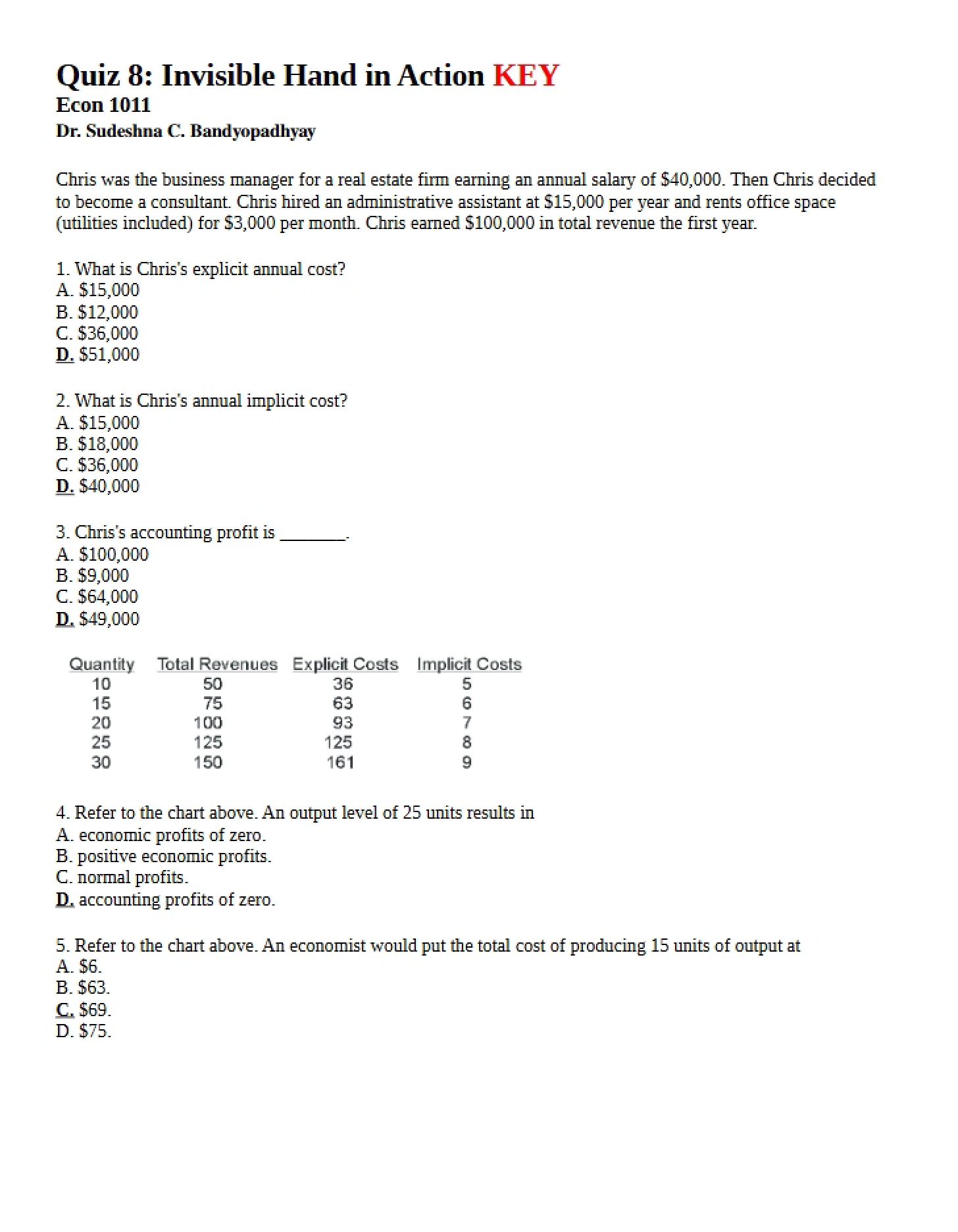
* A clear distinction between accounting profit, economic profit, and normal profit.
* An examination of how economic profit influences resource allocation within perfectly competitive markets.
* An exploration of the concept of opportunity cost and its role in economic profit calculations.
* Discussion of the “invisible hand” principle and its implications for market efficiency.
* Illustrative examples designed to demonstrate the practical application of profit concepts.
* A framework for evaluating business decisions based on economic profitability.