What This Document Is
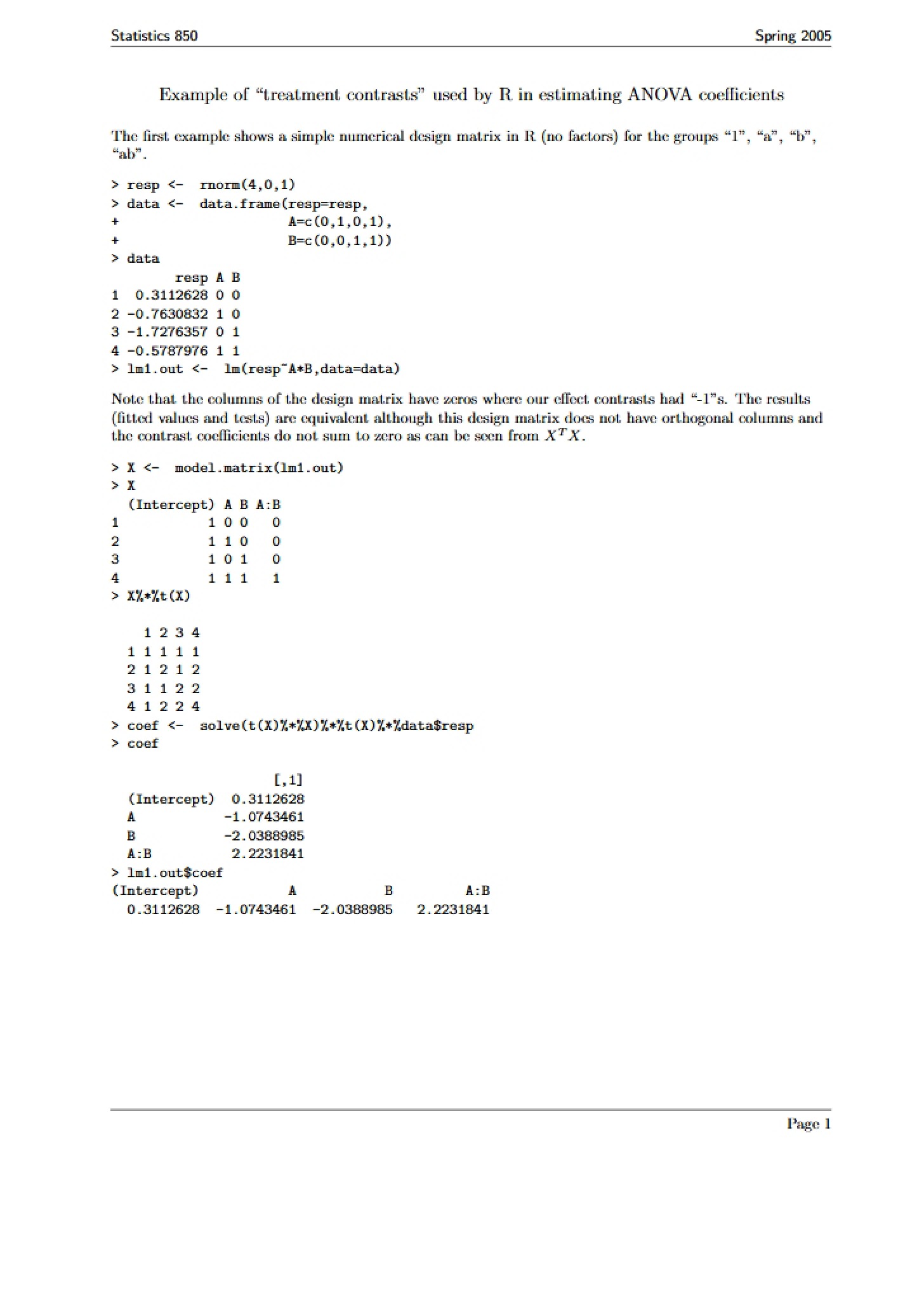
This resource delves into the practical application of Analysis of Variance (ANOVA) and regression techniques, specifically focusing on a two-by-two factorial design. It’s a focused exploration of how to determine coefficient estimates and fitted values within this statistical framework. The material builds upon foundational ANOVA and regression concepts, moving into a more detailed examination of model building and interpretation. It utilizes a specific example to illustrate key principles.
Why This Document Matters
Students enrolled in advanced statistics courses – particularly those covering regression and ANOVA – will find this exceptionally valuable. It’s ideal for those seeking a deeper understanding of how statistical models translate into concrete calculations and estimations. Researchers and analysts needing to implement and interpret 2x2 ANOVA models in their work will also benefit. This is particularly useful when you need to understand the underlying mechanics of coefficient estimation and how fitted values are derived, rather than simply relying on statistical software output. It’s best used *after* grasping the core concepts of ANOVA and regression.
Common Limitations or Challenges
This resource concentrates specifically on a 2x2 ANOVA scenario with a limited dataset for illustrative purposes. It does not cover more complex ANOVA designs (e.g., unbalanced designs, designs with more than two factors) or alternative methods for coefficient estimation. It also assumes a foundational understanding of linear algebra and statistical modeling terminology. It doesn’t provide a comprehensive overview of ANOVA assumptions or diagnostic checks.
What This Document Provides
* An examination of model matrix construction for a 2x2 ANOVA.
* Illustrative calculations related to the inverse of the model matrix.
* A comparison of coefficient estimates derived using different parameterizations of the model.
* A demonstration of how fitted values are calculated based on model estimates.
* A practical example using statistical software output to demonstrate the concepts.