What This Document Is
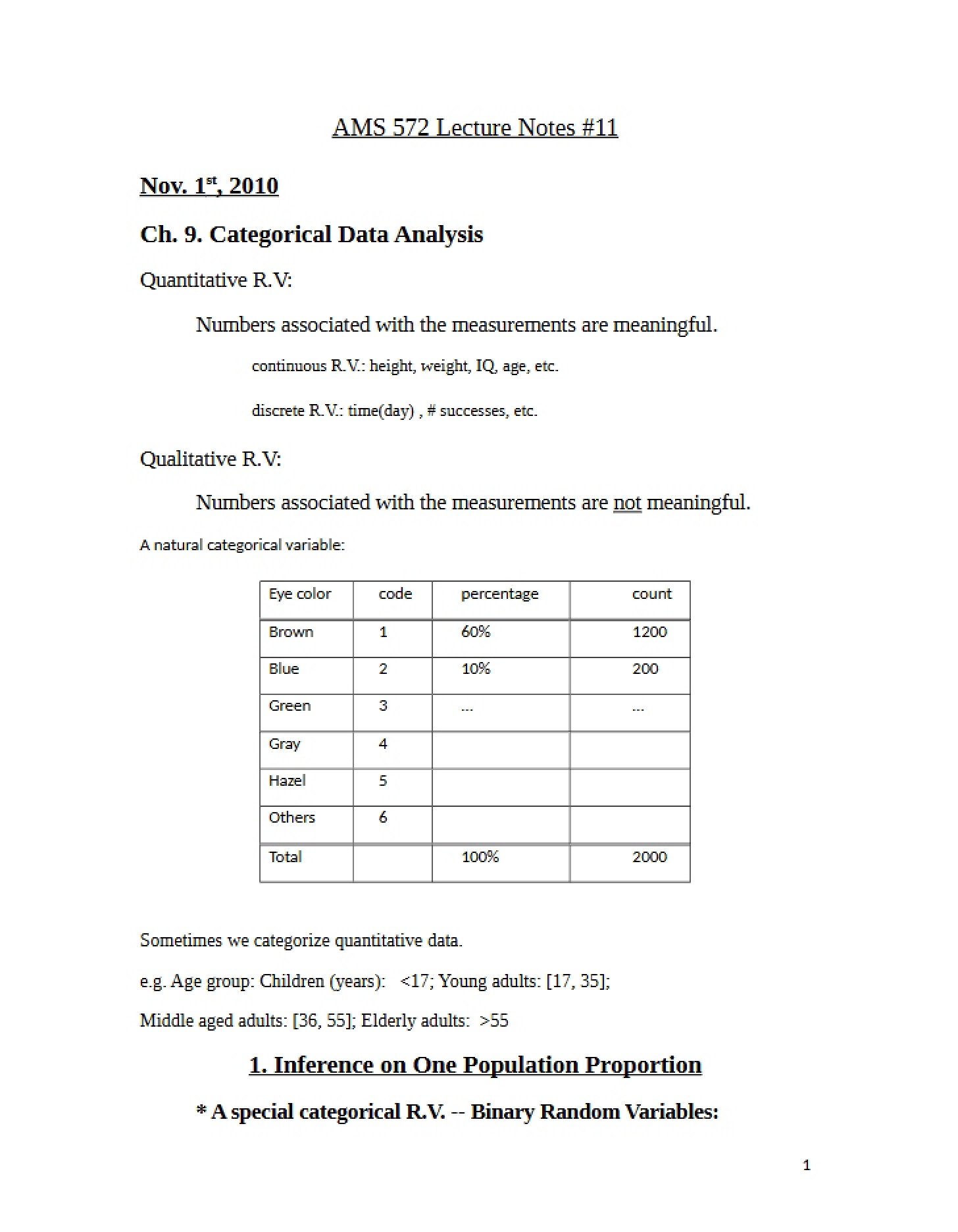
This document contains lecture notes focused on the analysis of categorical data, a core component of introductory statistics and data analysis. Specifically, it delves into methods for understanding and drawing inferences from variables that represent qualities or characteristics rather than numerical measurements. It’s part of the AMS 572 course materials from Stony Brook University, designed for students building a foundation in statistical analysis.
Why This Document Matters
This resource is invaluable for students enrolled in a Data Analysis I course, or anyone seeking to understand the principles behind analyzing non-numerical data. It’s particularly helpful when you need a structured overview of how to approach problems involving qualitative variables – like gender, color, or preference – and how to estimate population characteristics based on sample data. It’s best used as a companion to lectures and textbook readings, offering a focused and detailed exploration of these concepts.
Topics Covered
* Distinction between quantitative and qualitative variables, including continuous and discrete types.
* Methods for making inferences about population proportions based on sample data.
* The principles of the binomial experiment and its application to categorical data analysis.
* Construction of confidence intervals for population proportions.
* Hypothesis testing related to population proportions.
* Understanding p-values and significance levels in the context of categorical data.
What This Document Provides
* A clear framework for understanding the fundamental concepts of categorical data analysis.
* A detailed exploration of the statistical tools used to analyze single categorical variables.
* An introduction to the mathematical foundations underlying these statistical methods.
* A foundation for more advanced statistical modeling techniques involving categorical data.
* A structured presentation of key definitions and terminology related to the field.