What This Document Is
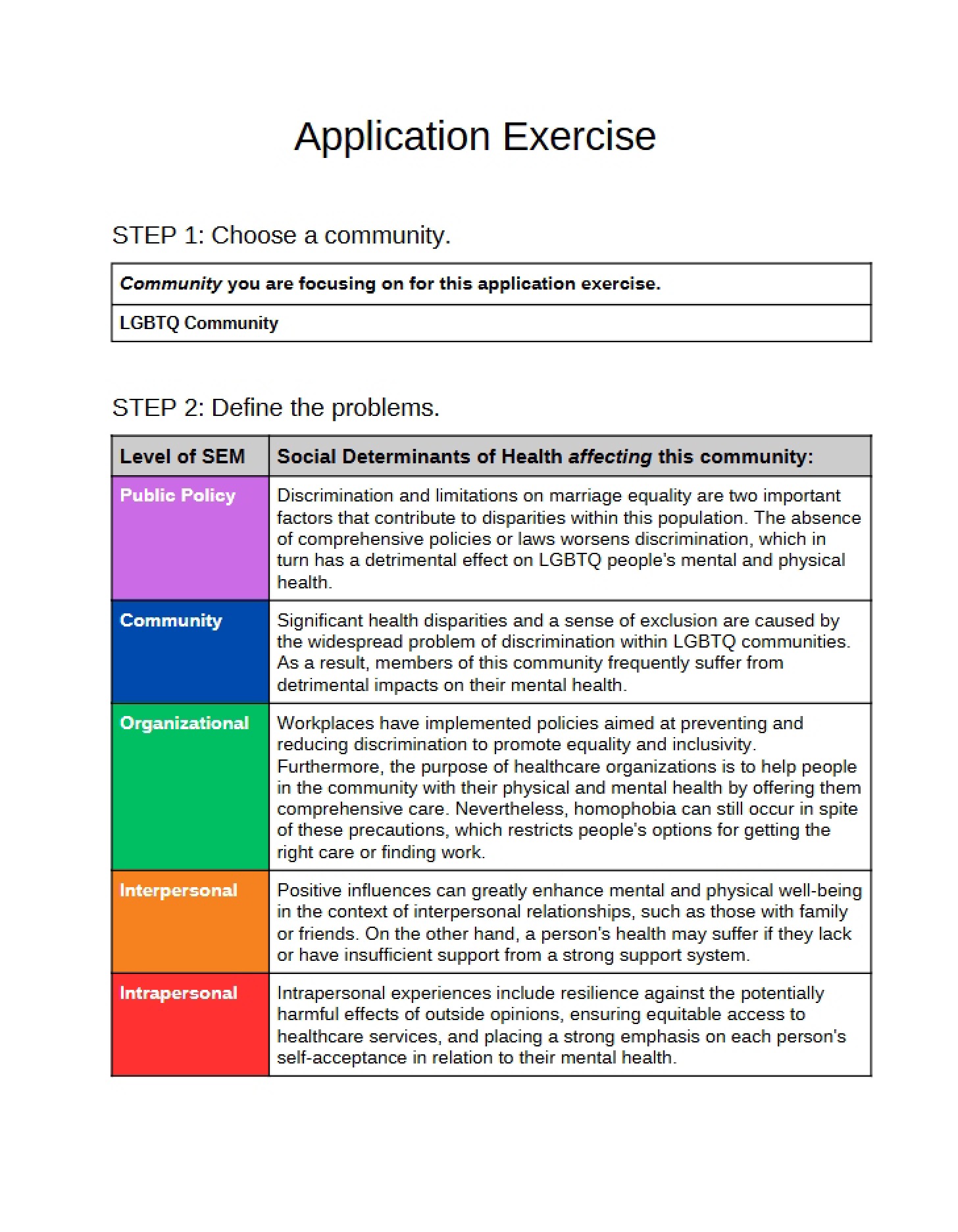
This is an application exercise designed for students in a Health Equity course, specifically focusing on the health challenges faced by a particular population within the United States. It’s a practical assignment intended to bridge theoretical knowledge of social determinants of health with a real-world community. The exercise centers around a detailed exploration of factors impacting health equity, requiring students to analyze these factors at multiple systemic levels.
Why This Document Matters
This exercise is valuable for students preparing for careers in public health, healthcare administration, social work, or any field concerned with addressing health disparities. It’s particularly useful when applying concepts learned in coursework to a specific population, and developing skills in problem identification and potential intervention strategies. Students grappling with understanding the complexities of health equity and the interplay of various social determinants will find this a helpful tool for solidifying their understanding. It’s best utilized *after* foundational coursework on social determinants of health has been completed.
Common Limitations or Challenges
This exercise focuses on a single community and requires focused analysis. It does not provide a comprehensive overview of *all* health equity issues in the U.S., nor does it offer definitive solutions. The assignment is designed to stimulate critical thinking and brainstorming, and does not present pre-determined answers or a step-by-step guide to resolving complex health inequities. It also doesn’t include statistical data or extensive research findings – those are expected to be incorporated by the student.
What This Document Provides
* A framework for analyzing health equity issues through the lens of the Social Ecological Model (SEM).
* A specific population group to focus analysis on.
* Categorization of social determinants of health into distinct levels (Public Policy, Community, Organizational, Interpersonal, Intrapersonal).
* Guidance on identifying potential areas for intervention to promote health equity.
* A structured approach to applying theoretical concepts to a practical scenario.