What This Document Is
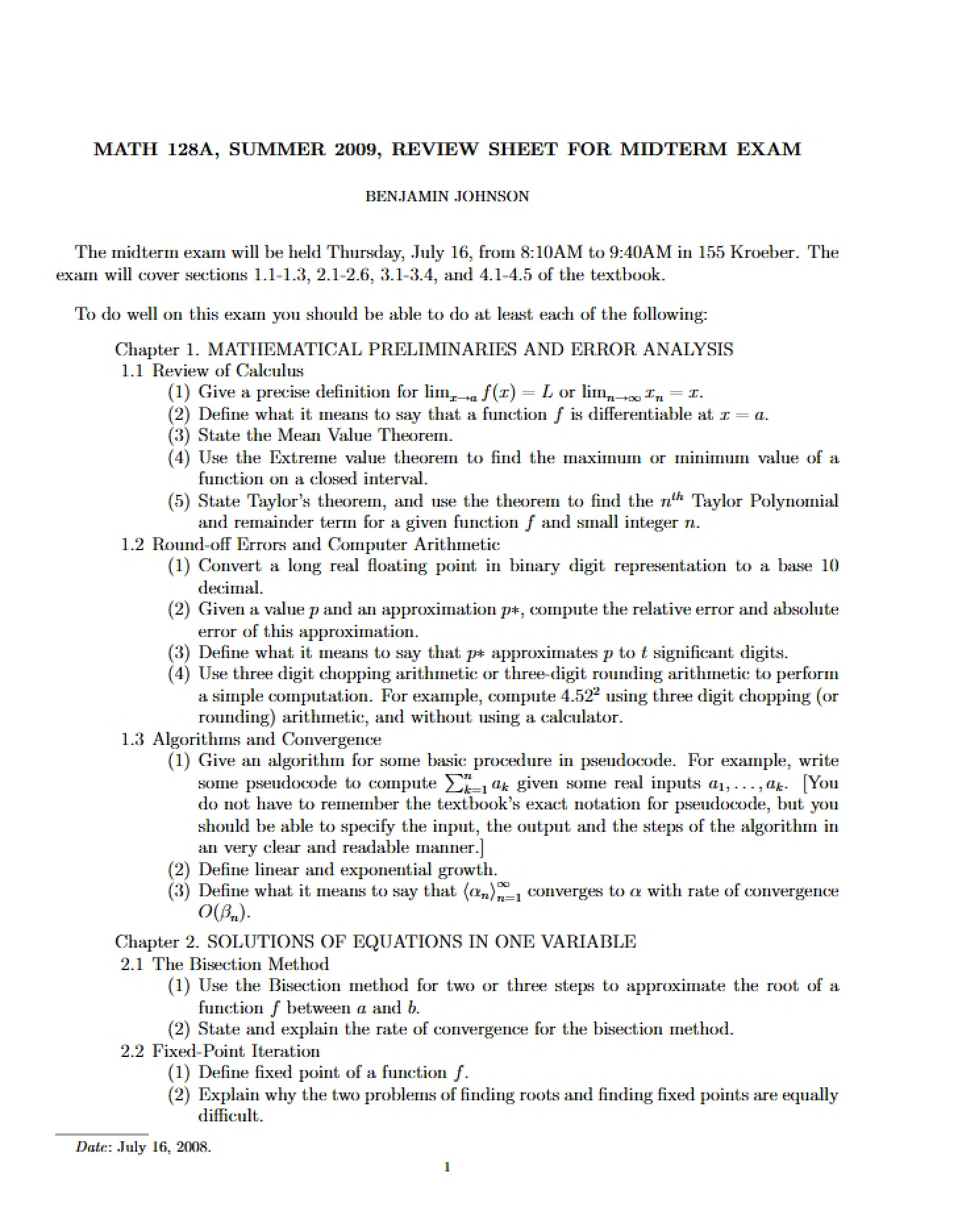
This is a programming assignment for Numerical Analysis (MATH 128A) at the University of California, Berkeley. It challenges students to apply theoretical knowledge to practical problem-solving using computational methods. The assignment centers around finding the roots of polynomial equations, specifically cubic equations, and comparing different numerical techniques for achieving this. It requires the creation of several custom functions within the MATLAB environment.
Why This Document Matters
This assignment is crucial for students enrolled in a Numerical Analysis course who aim to solidify their understanding of root-finding algorithms. It’s particularly beneficial for those preparing for more advanced coursework or careers in fields like engineering, physics, or applied mathematics where numerical computation is essential. Working through this assignment will build practical skills in algorithm implementation, error analysis, and code verification – skills highly valued in quantitative disciplines. It’s best utilized when actively studying root-finding methods and needing to translate theory into working code.
Topics Covered
* Cubic Equation Root Finding
* Bisection Method
* Newton’s Method
* Muller’s Method
* Polynomial Deflation
* Quadratic Equation Root Finding
* Error Analysis & Tolerance
* Algorithm Implementation in MATLAB
* Comparison of Numerical Methods with Exact Solutions
What This Document Provides
* A detailed problem statement outlining the objectives of the assignment.
* Specific function signatures (names, inputs, and outputs) that *must* be adhered to for grading purposes.
* Requirements for implementing root-finding algorithms in MATLAB.
* Instructions for comparing the accuracy of different methods against exact solutions and MATLAB’s built-in root-finding command.
* Guidance on generating test cases using random coefficients.
* A clear expectation for reporting and presenting the results of the comparison.
* A framework for evaluating the performance of numerical methods.