What This Document Is
This document provides a foundational overview of signal processing principles, specifically tailored for students in a medical imaging course. It delves into the mathematical underpinnings that are crucial for understanding how medical images are acquired, manipulated, and interpreted. The material establishes core concepts necessary for more advanced topics within the field.
Why This Document Matters
This resource is invaluable for students beginning their study of medical imaging, particularly those needing a refresher on essential mathematical concepts. It’s also beneficial for anyone seeking to understand the theoretical basis behind image formation and processing techniques. Reviewing this material will strengthen your understanding as you progress through more complex imaging modalities and analysis methods. It serves as a strong base for interpreting the results and limitations of various imaging technologies.
Topics Covered
* Periodic Signals and Functions
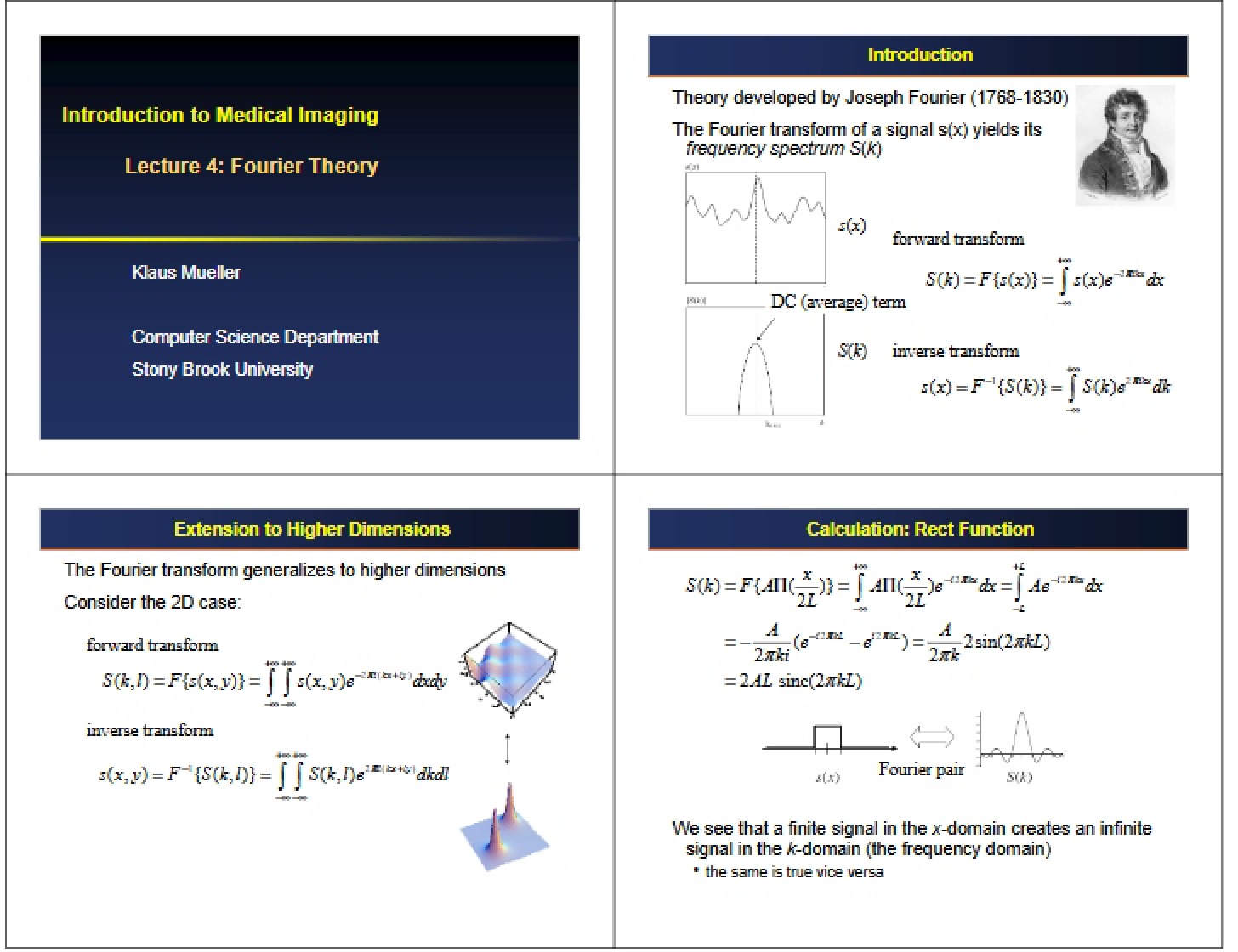
* Fourier Theory and its Historical Context
* Frequency Domain Representation of Signals
* The Fourier Series and its Components
* Discrete Fourier Transform (DFT) Fundamentals
* Relationship between Signal Characteristics and Frequency Spectrum
* Complex Numbers and their Application to Signal Processing
* Two-Dimensional Fourier Spectrum Concepts
* Implications of Signal Processing for Image Representation
What This Document Provides
* An introduction to the core principles of signal processing.
* A historical perspective on the development of Fourier analysis.
* A conceptual framework for understanding frequency spectra.
* An exploration of how signals can be decomposed into their constituent frequencies.
* A foundation for understanding the limitations and artifacts that can arise in image processing.
* A bridge between mathematical theory and practical applications in medical imaging.
* An overview of how these concepts apply to discrete signals, such as digital images.