What This Document Is
This document comprises lecture notes from an advanced digital integrated circuits course (ELENG 241B) at the University of California, Berkeley, specifically focusing on the topic of adiabatic circuits and advanced arithmetic circuits. It appears to be a detailed exploration of low-power design techniques and high-performance arithmetic building blocks, intended for upper-level electrical engineering students. The material delves into theoretical concepts and potential circuit implementations.
Why This Document Matters
This resource is invaluable for students seeking a deeper understanding of energy-efficient circuit design and advanced computational hardware. It’s particularly relevant for those specializing in VLSI design, low-power systems, or high-performance computing. Engineers working on power-constrained applications, such as mobile devices or embedded systems, will also find the concepts presented here highly applicable. Access to the full content will provide a strong foundation for tackling complex design challenges and optimizing circuit performance.
Topics Covered
* Adiabatic Charging Principles and Techniques
* Reversible Computing Concepts
* Adiabatic Circuit Architectures (Pipelines, Latches)
* Advanced Arithmetic Circuit Design
* Binary Adder Implementations (Ripple-Carry, Mirror Structures)
* Carry-Skip Adder Techniques and Optimizations
* Resources for Further Study in Computer Arithmetic
What This Document Provides
* A comprehensive overview of adiabatic computing principles, exploring methods to reduce power dissipation in digital circuits.
* Detailed discussion of various latch designs and their energy efficiency trade-offs.
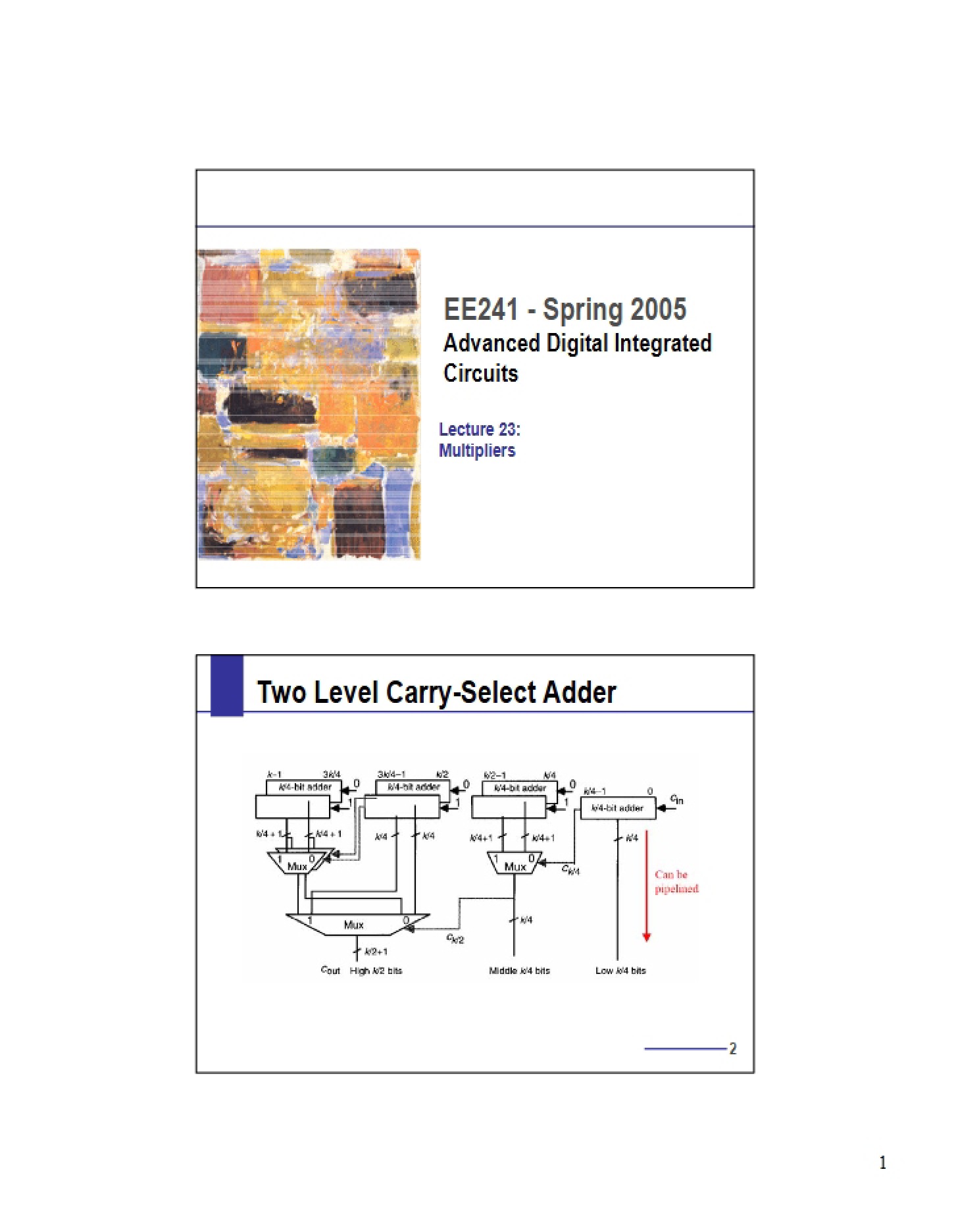
* Exploration of different adder architectures, including their performance characteristics and design considerations.
* References to key research publications and textbooks in the field of computer arithmetic and digital circuit design.
* Visual aids and diagrams illustrating circuit structures and concepts.