What This Document Is
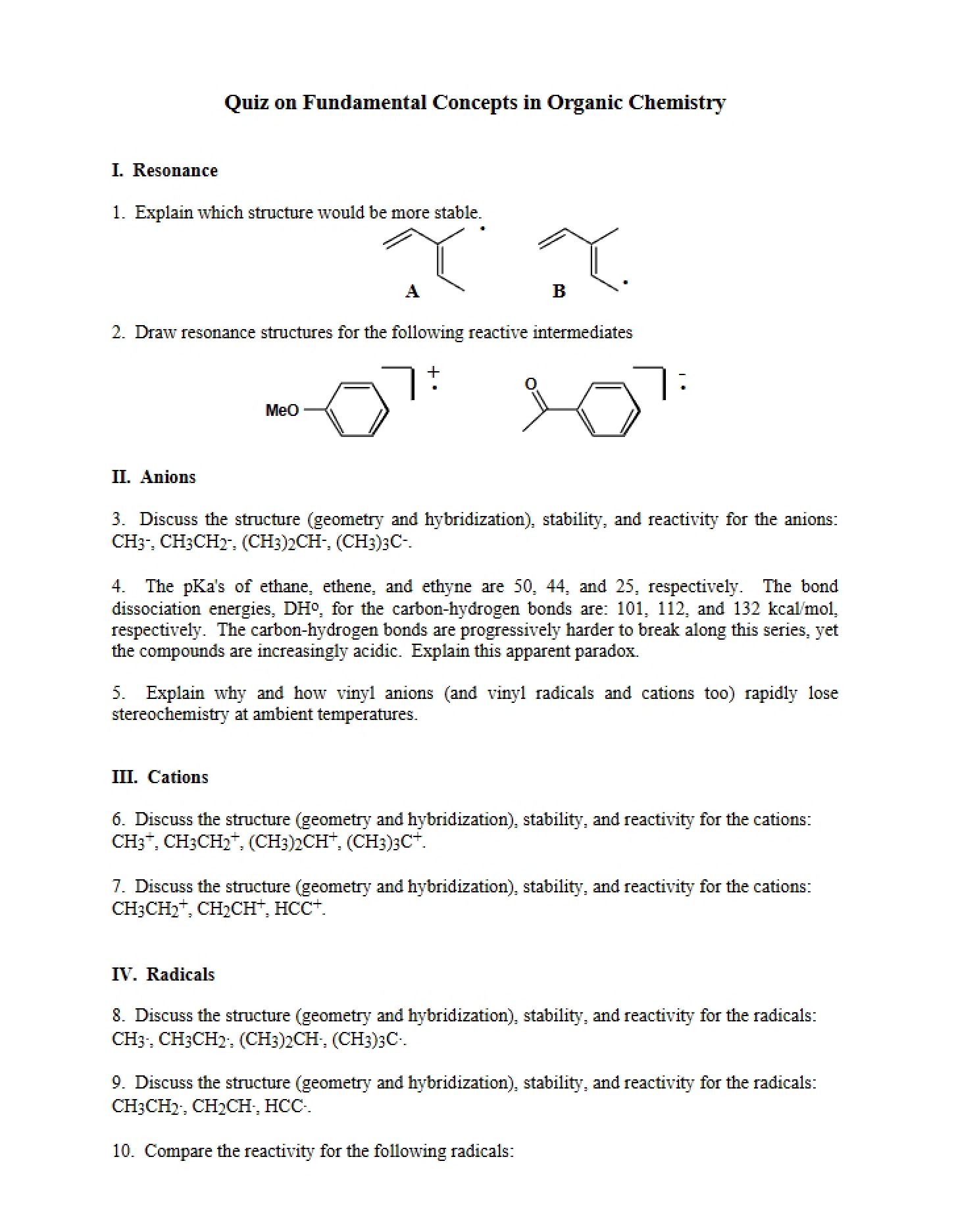
This handout from UCLA’s CHEM 144 course, Practical and Theoretical Introductory Organic Synthesis, provides a detailed exploration of fundamental concepts in organic chemistry. It focuses on the behavior and characteristics of key reactive intermediates – resonance structures, anions, cations, and radicals – and how these relate to chemical stability and reactivity. This resource is designed to reinforce core principles taught in lectures and provide a deeper understanding of foundational organic chemistry topics.
Why This Document Matters
This study guide is invaluable for students enrolled in organic chemistry courses, particularly those seeking to solidify their grasp of essential concepts. It’s especially helpful when tackling problem sets, preparing for quizzes, or reviewing material before exams. Understanding the nuances of these fundamental building blocks is crucial for success in more advanced organic chemistry topics and related fields like biochemistry and pharmaceuticals. Access to the full content will allow you to confidently approach complex reaction mechanisms and predict chemical behavior.
Topics Covered
* Resonance and Stability of Intermediates
* Structure and Reactivity of Carbanions
* Acidity and Bond Dissociation Energies
* Isomerization of Reactive Intermediates
* Structure and Reactivity of Carbocations
* Hyperconjugation and Cation Stability
* Structure and Reactivity of Carbon Radicals
* Orbital Hybridization and its Impact on Stability
What This Document Provides
* Detailed discussions of the geometric and electronic structures of various reactive species.
* Explanations of how alkyl group effects influence the stability and reactivity of anions, cations, and radicals.
* Insights into the relationship between orbital hybridization and the energetic favorability of different chemical forms.
* A framework for understanding how seemingly contradictory trends (like acidity vs. bond strength) can be explained through fundamental chemical principles.
* A resource to help you build a strong foundation in organic chemistry concepts.