What This Document Is
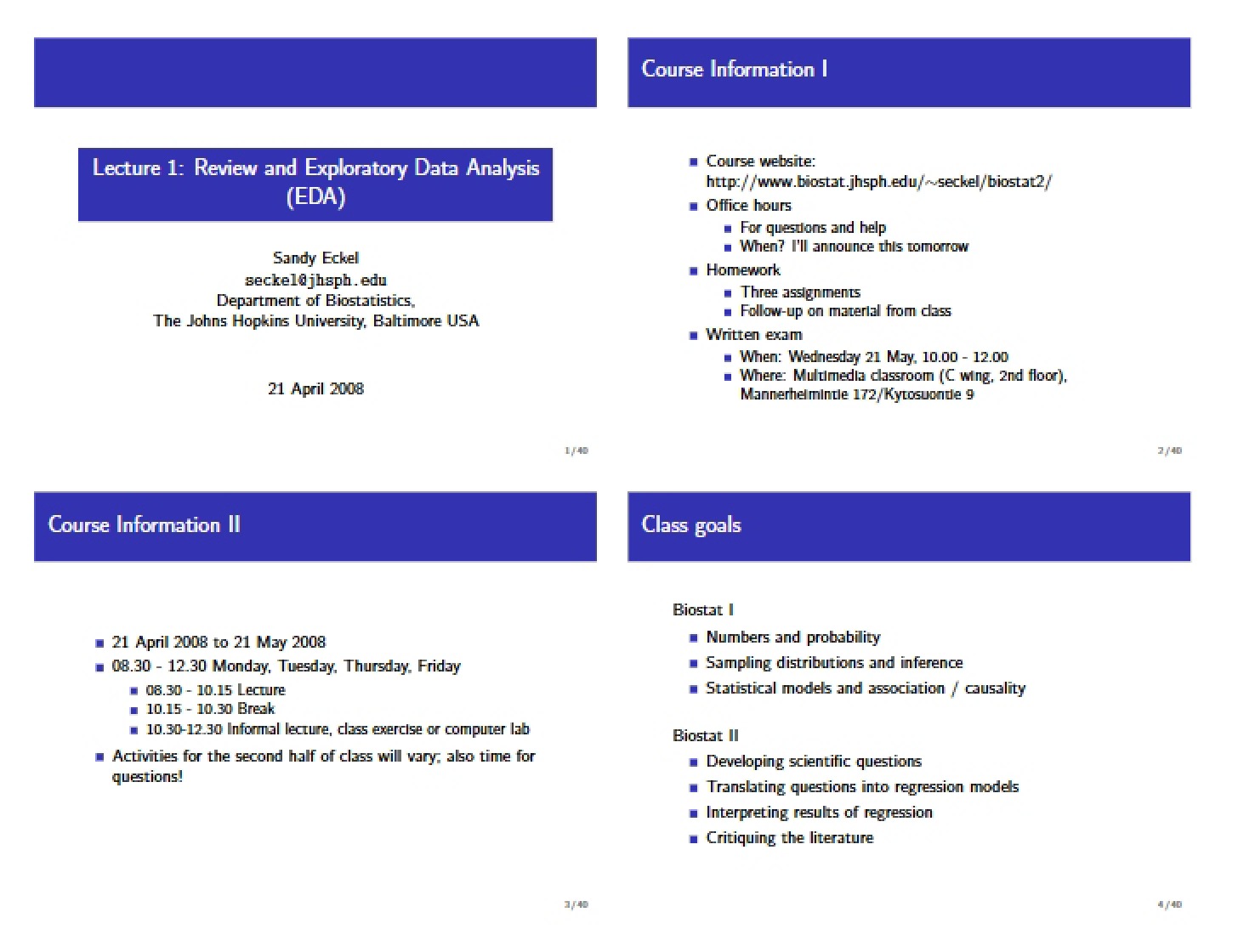
This document comprises a set of class notes from a Biostatistical Modelling course (BIOSTATISTICS II) at the University of Southern California. It appears to be lecture notes covering foundational concepts and practical applications within the field of biostatistics, specifically building upon prior knowledge. The notes detail the course structure, expectations, and a deep dive into exploratory data analysis techniques. It’s formatted as a lecture transcript, likely accompanied by visual aids presented during the course.
Why This Document Matters
These notes are invaluable for students currently enrolled in a similar biostatistics course, or those seeking a refresher on core principles. They would be particularly helpful for individuals needing a structured overview of how to approach data analysis in a biological or health-related context. Students preparing for assignments, exams, or aiming to solidify their understanding of statistical modelling will find this resource beneficial. It’s best utilized *during* or *immediately after* a related lecture to reinforce learning.
Common Limitations or Challenges
These notes are designed to *supplement* – not replace – active participation in the course and independent study. They do not offer complete, self-contained explanations of every statistical concept. The notes assume a base level of statistical understanding from prerequisite coursework. Furthermore, the notes represent one instructor’s approach and may not align perfectly with all biostatistics curricula. Access to the full document is required to fully grasp the detailed explanations and examples presented.
What This Document Provides
* An overview of the course structure, including lecture schedules and assessment components.
* Discussion of the core principles and recurring themes within biostatistics.
* Introduction to the importance of exploratory data analysis (EDA) in the research process.
* Examination of various EDA methods for visualizing and summarizing data.
* Explanation of descriptive statistics, including measures of central tendency and dispersion.
* Discussion of frequency distributions and cumulative frequency tables.
* Overview of percentile calculations and their application in data analysis.