What This Document Is
This document presents a focused exploration of Classical Thermodynamics, a core component of the Introduction to Statistical and Thermal Physics course (PHYSICS 112) at the University of California, Berkeley. It delves into the fundamental principles governing energy, entropy, and the behavior of systems undergoing thermodynamic processes. This material builds upon foundational physics concepts and prepares students for more advanced studies in statistical mechanics and related fields.
Why This Document Matters
This resource is invaluable for students enrolled in a rigorous thermal physics course. It’s particularly helpful when seeking a deeper understanding of thermodynamic concepts beyond lectures and textbooks. Students preparing for exams, working on problem sets, or needing a concise yet comprehensive reference on classical thermodynamics will find this document beneficial. It’s designed to solidify understanding of key principles and their applications.
Topics Covered
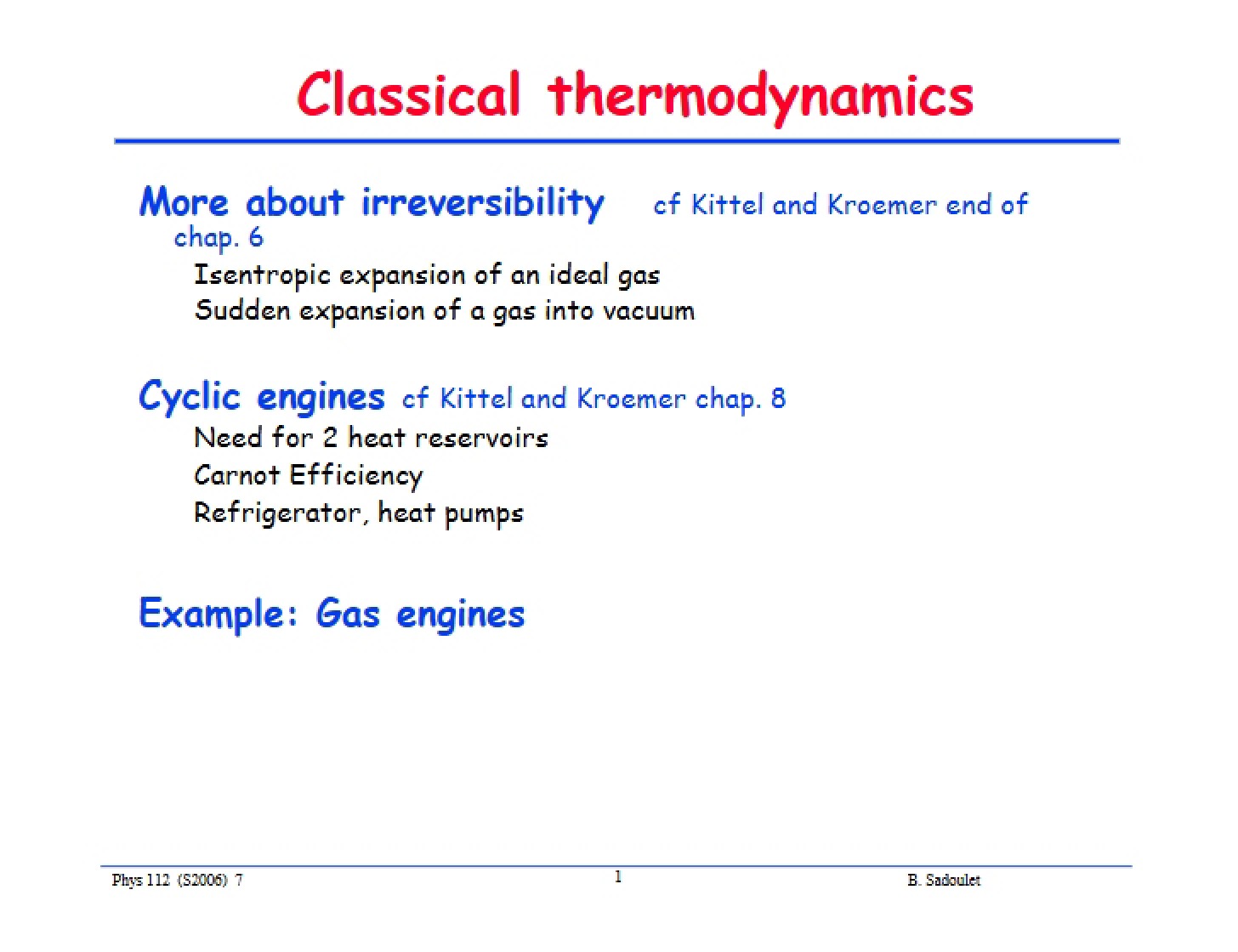
* Isentropic and adiabatic processes in ideal gases
* Cyclic engines and their efficiency, including the Carnot cycle
* Heat capacities and their relationship to internal energy and enthalpy
* The concept of irreversibility and its implications for thermodynamic systems
* Entropy changes in various processes, including expansion into a vacuum
* Thermodynamic identities and their limitations
* Heat transport between systems at different temperatures
* The role of reservoirs in reversible and irreversible processes
What This Document Provides
* A detailed examination of the theoretical underpinnings of classical thermodynamics.
* Discussion of the conditions required for reversible processes.
* Exploration of how thermodynamic principles apply to real-world scenarios.
* A framework for analyzing the efficiency of thermodynamic engines.
* Connections to related concepts in quantum mechanics, such as the adiabatic approximation.
* A resource referencing key concepts from Kittel and Kroemer’s textbook for further study.