What This Document Is
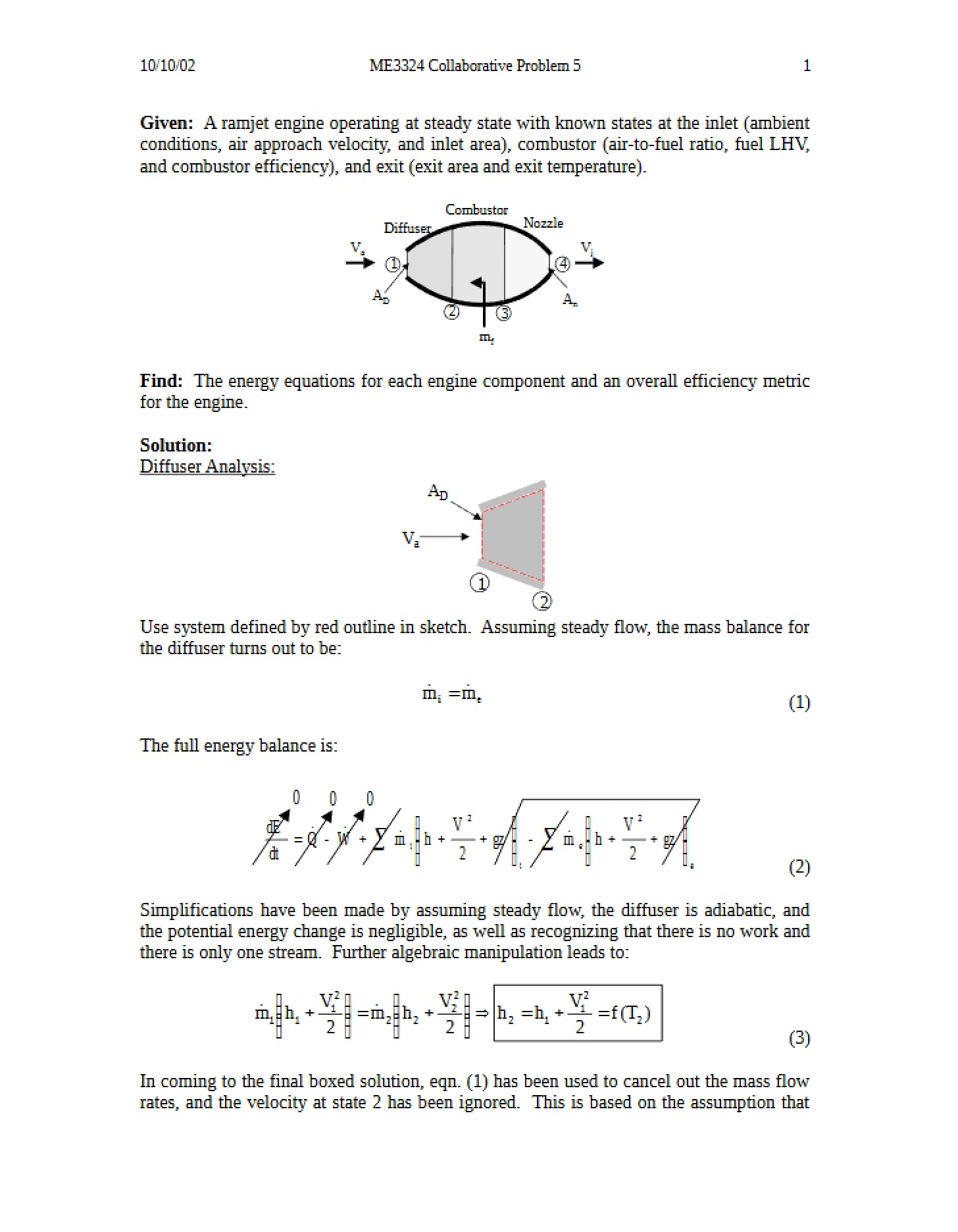
This is a worked example focusing on the application of thermal science principles to a ramjet engine. It’s presented as a collaborative problem solution, likely stemming from a university-level mechanical engineering course (specifically, Introduction to Thermal Science – ME 3324 at the University of Minnesota Twin Cities). The material centers around calculating engine performance, specifically overall efficiency, given a set of operating conditions and component characteristics. It builds upon previously established equations and concepts covered in the course.
Why This Document Matters
This resource is invaluable for students learning about gas turbine engines and the thermodynamics of jet propulsion. It’s particularly helpful for those who benefit from seeing a complete problem-solving process, from initial conditions to final results. Students preparing for exams, working on assignments, or needing to solidify their understanding of energy balances, efficiency calculations, and ideal gas relationships will find this example beneficial. It’s best used *after* familiarizing yourself with the foundational concepts of thermal science and ramjet engine operation.
Common Limitations or Challenges
This example focuses on a specific ramjet configuration and set of assumptions. It does not provide a comprehensive overview of all ramjet engine types or operating scenarios. The solution relies on previously derived equations, so it won’t be useful without understanding the preceding course material. It also doesn’t delve into the complexities of real-world ramjet design, such as compressibility effects or detailed combustion modeling. The analysis presented is a simplified model intended for educational purposes.
What This Document Provides
* A detailed analysis of ramjet engine efficiency.
* Application of thermodynamic principles to a practical engineering problem.
* A step-by-step approach to solving a complex thermal science problem.
* Consideration of key engine parameters like inlet conditions, air-fuel ratio, and exit temperature.
* Discussion of the relationship between combustor efficiency and overall engine performance.
* Graphical representation of results and interpretation of key trends.