What This Document Is
This is a detailed exploration of advanced techniques in logic synthesis, specifically focusing on achieving timing closure in integrated circuit design. It delves into the challenges of accurately predicting and managing signal delays within complex digital circuits, and presents a methodology centered around a “constant delay paradigm.” The material originates from an upper-level undergraduate course at the University of California, Berkeley, and is geared towards students with a solid foundation in digital logic design.
Why This Document Matters
This resource is invaluable for electrical engineering students specializing in VLSI design, computer architecture, or related fields. It’s particularly helpful when tackling projects involving high-speed digital systems where meeting strict timing constraints is critical. Professionals seeking to refine their understanding of timing analysis and optimization techniques will also find this material beneficial. It’s best utilized during coursework on logic synthesis, digital circuit design, or as a reference when facing real-world timing closure issues.
Topics Covered
* The challenges of timing closure due to inaccuracies in delay modeling.
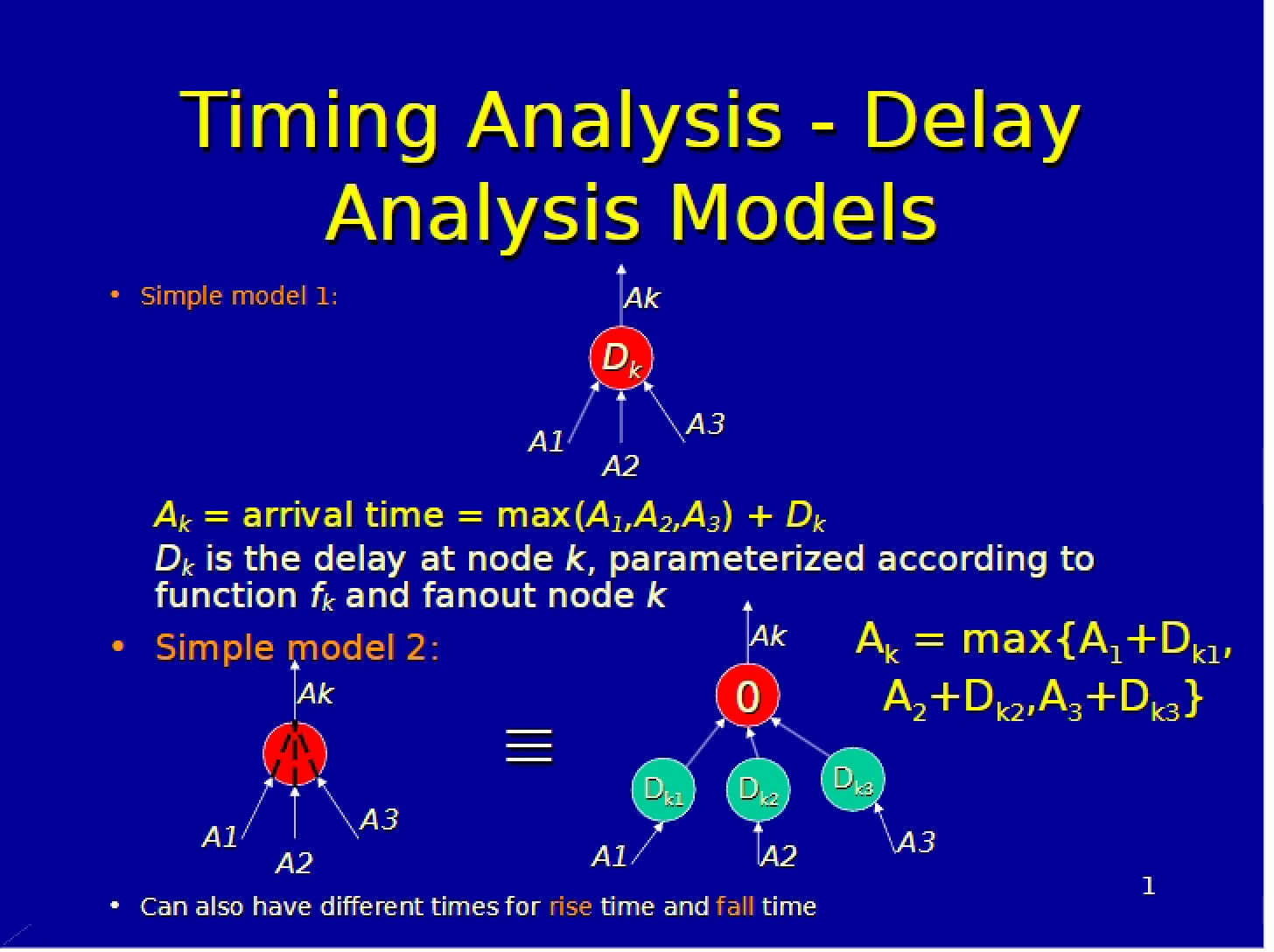
* Relationships between gate delay, resistance, capacitance, and transistor sizing.
* Sutherland’s delay equation and its components (computing effort, inherent delay, restoring effort).
* The impact of capacitance and area scaling on circuit performance.
* Heuristic methods for distributing restoring efforts to minimize area while meeting delay requirements.
* Constant delay synthesis as an alternative to traditional iterative logic synthesis and layout approaches.
* Area-delay tradeoffs and the potential for optimization.
What This Document Provides
* A detailed examination of the constant delay paradigm and its underlying principles.
* A framework for understanding the interplay between logic synthesis, layout, and timing analysis.
* Key equations and relationships governing gate delays and circuit performance.
* Insights into heuristic approaches for gate sizing and timing optimization.
* A discussion of the benefits of constant delay synthesis, including potential improvements in area, power consumption, and timing closure.
* Considerations for technology-independent and dependent logic synthesis techniques.