What This Document Is
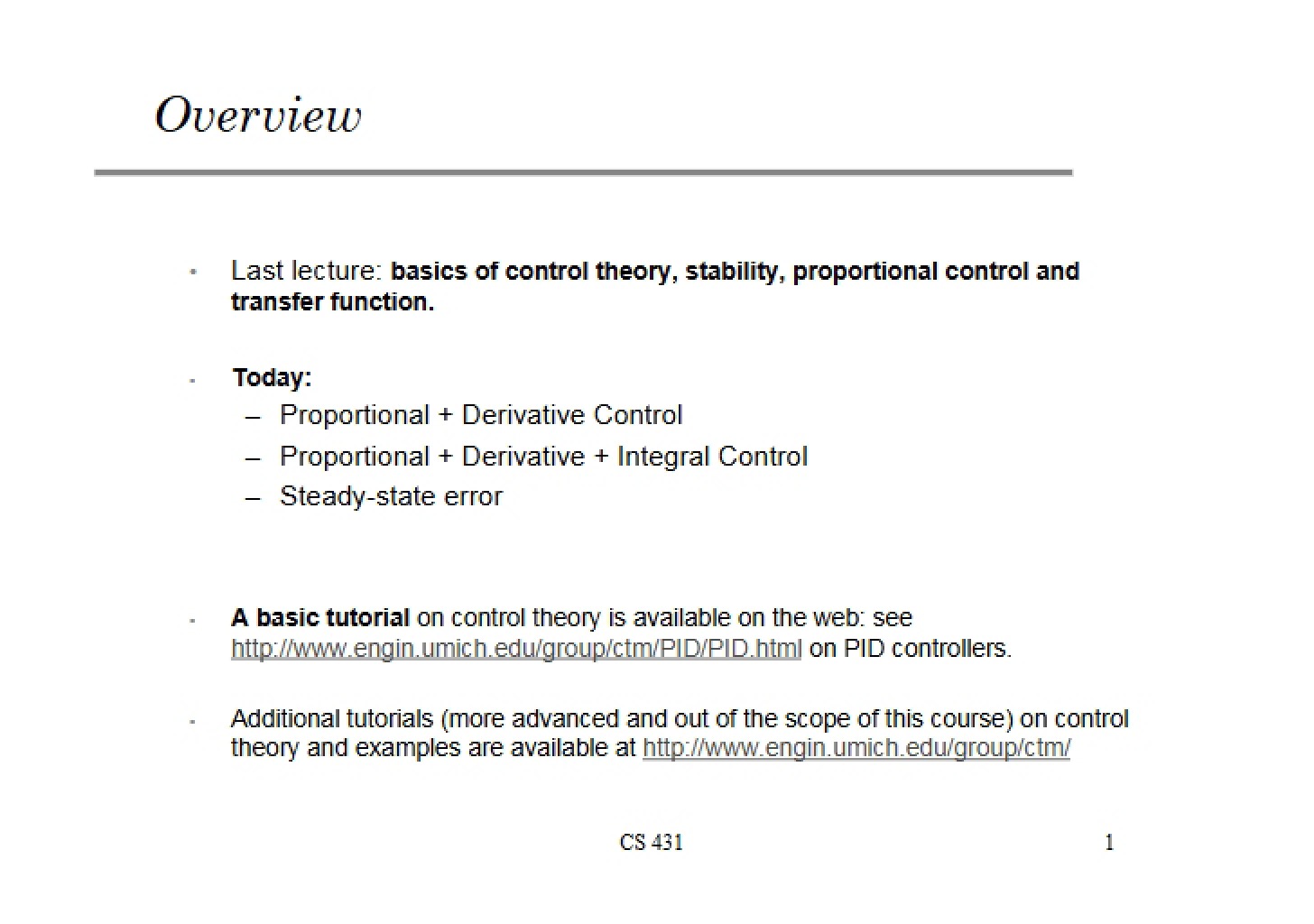
This document presents a focused exploration of fundamental control theory concepts, specifically as applied within the context of an embedded systems course. It delves into the principles governing system stability and introduces proportional control as a core technique for managing system behavior. This material represents a solution set related to Lecture 11 of CS 431 at the University of Illinois at Urbana-Champaign.
Why This Document Matters
This resource is invaluable for students enrolled in embedded systems or control systems courses seeking a deeper understanding of how to analyze and influence the dynamics of physical systems. It’s particularly helpful when tackling assignments or preparing for assessments that require applying control theory to practical scenarios, such as those encountered in a laboratory setting. Understanding these concepts is crucial for anyone designing or working with systems that require precise and reliable operation.
Topics Covered
* Foundational principles of system stability (asymptotic, marginal, and instability)
* The concept of error in control systems and its relationship to set points
* Proportional control and its impact on system response
* Mathematical tools for analyzing stability, including the role of eigenvalues
* Modeling systems using linear differential equations
* Application of control theory to a simple physical system (marble on a table)
What This Document Provides
* A conceptual framework for understanding control system behavior.
* Illustrative examples to aid in grasping abstract concepts.
* Opportunities for self-assessment through integrated quizzes designed to reinforce learning.
* A connection between theoretical principles and practical applications, preparing students for hands-on laboratory work.
* A foundation for more advanced study in control systems and related fields.