What This Document Is
This document represents a lecture from the Structure and Interpretation of Systems and Signals (ELENG 20) course at the University of California, Berkeley, specifically focusing on the principles of Control Systems. It delves into the theoretical foundations and practical considerations involved in designing systems to achieve desired behaviors. This lecture builds upon prior concepts related to signal processing and system analysis, offering a deeper exploration of how to influence and regulate dynamic systems.
Why This Document Matters
This material is essential for students studying electrical engineering, control systems, robotics, and related fields. It’s particularly valuable when you’re tackling problems involving system stability, performance optimization, and the mitigation of unwanted disturbances. Understanding these concepts is crucial for designing reliable and effective systems in a wide range of applications, from aerospace engineering to automated manufacturing. This lecture will provide a foundational understanding for more advanced topics in control theory.
Topics Covered
* Corrections and refinements to Continuous-Time Fourier Transform (CTFT) theory.
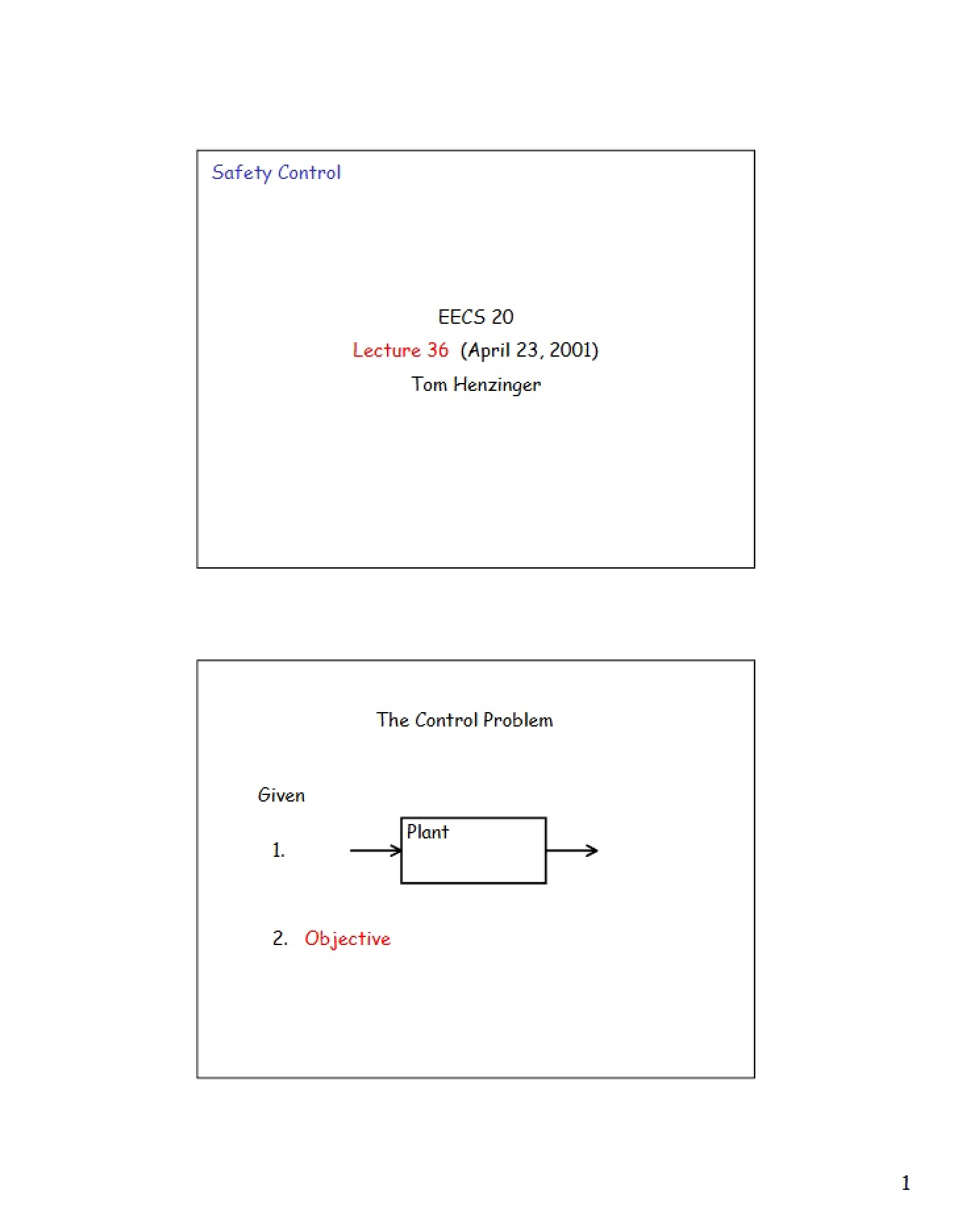
* The fundamental problem of control systems design.
* Concepts of stability and its importance in system behavior.
* Time-domain and frequency-domain performance specifications.
* The relationship between control systems and finite-state machines.
* Feedback control mechanisms and their advantages.
* Analysis of first-order models as a starting point for control design.
* The role of feedback in system stabilization.
What This Document Provides
* A theoretical framework for understanding control system design principles.
* An exploration of the benefits of closed-loop control architectures.
* Discussion of key design objectives, including stability, response time, and disturbance rejection.
* An introduction to proportional state feedback as a control strategy.
* Analysis of frequency response and impulse response characteristics.
* Insights into the trade-offs between different control parameters and system performance.
* Graphical representations to aid in understanding system behavior.