What This Document Is
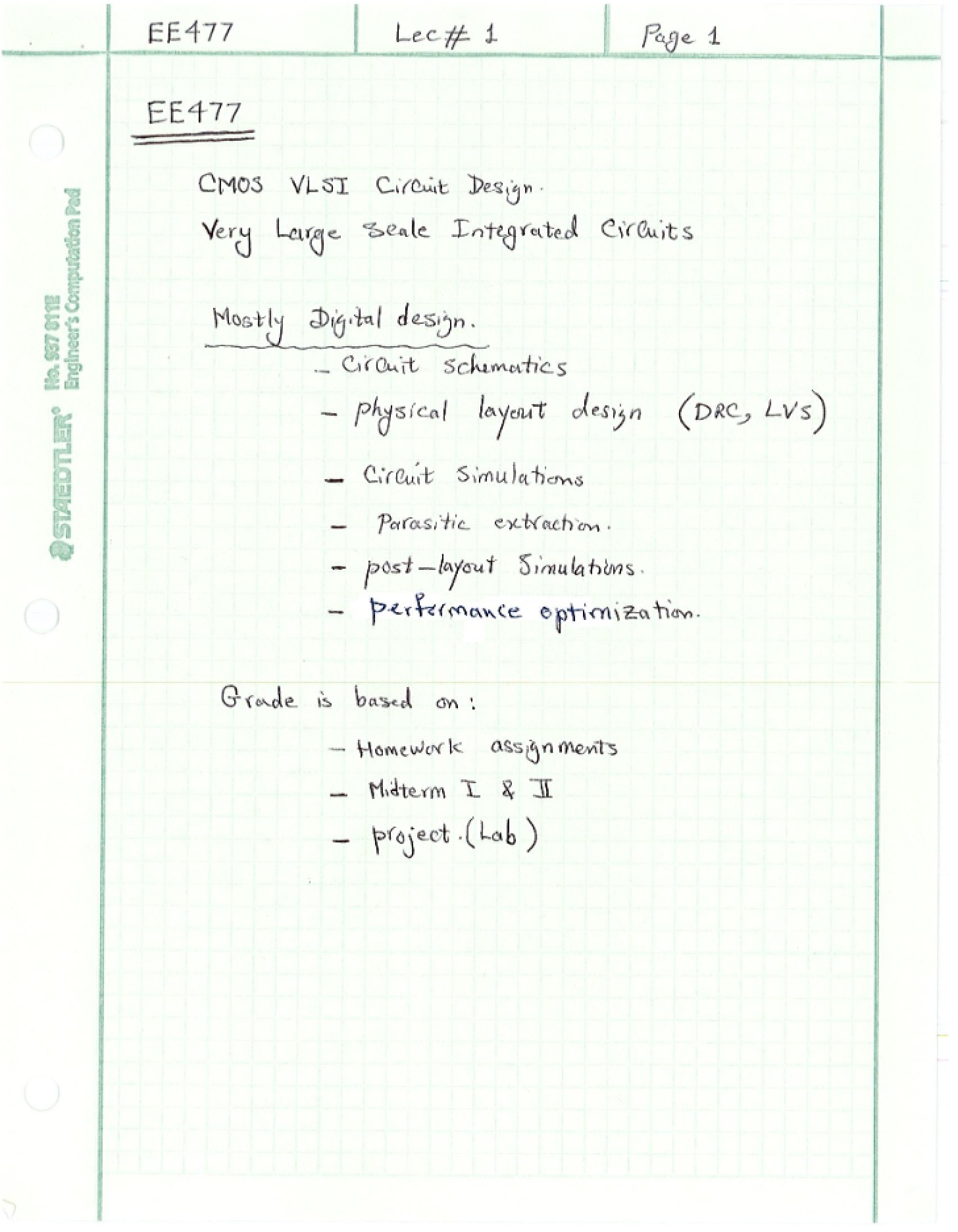
This document represents the foundational lecture material – Lecture 01 – for MOS VLSI Circuit Design (EE 477L) at the University of Southern California. It serves as an introductory overview to the complexities of Very Large Scale Integrated (VLSI) circuit design, specifically focusing on Complementary Metal-Oxide-Semiconductor (CMOS) technology. The lecture establishes core concepts and provides a high-level roadmap for the course, touching upon the design flow from schematic capture to physical layout and simulation. It’s a starting point for understanding the principles behind modern digital circuit creation.
Why This Document Matters
This material is crucial for students enrolled in advanced digital logic design courses, particularly those specializing in VLSI. It’s beneficial for anyone seeking a strong foundation in the design and analysis of integrated circuits. This lecture is most valuable at the *beginning* of a VLSI course, providing essential context before diving into specific circuit implementations and tools. Understanding the concepts presented here will significantly improve comprehension of subsequent lectures and lab assignments. It’s also helpful for students preparing for projects involving complex digital systems.
Common Limitations or Challenges
This lecture provides a broad overview and does *not* delve into detailed circuit analysis or specific design techniques. It doesn’t offer step-by-step instructions for using CAD tools, nor does it present complete circuit solutions. The material focuses on establishing the ‘big picture’ and foundational knowledge, and assumes some prior understanding of basic circuit theory. It also doesn’t cover advanced topics like advanced process technologies or specialized circuit architectures.
What This Document Provides
* An introduction to the VLSI design flow, from initial concept to final implementation.
* An overview of the course structure, grading criteria, and lab components.
* A discussion of Moore’s Law and its impact on integrated circuit development.
* A review of fundamental circuit elements like resistors and capacitors.
* An introduction to basic electronic components and their characteristics.
* A preliminary look at key circuit building blocks, including logic gates and flip-flops.
* An initial exploration of MOS transistor characteristics (NMOS and PMOS).
* A foundational understanding of inverter circuits at both the logic and circuit levels.
* Discussion of design considerations for standard logic cells.