What This Document Is
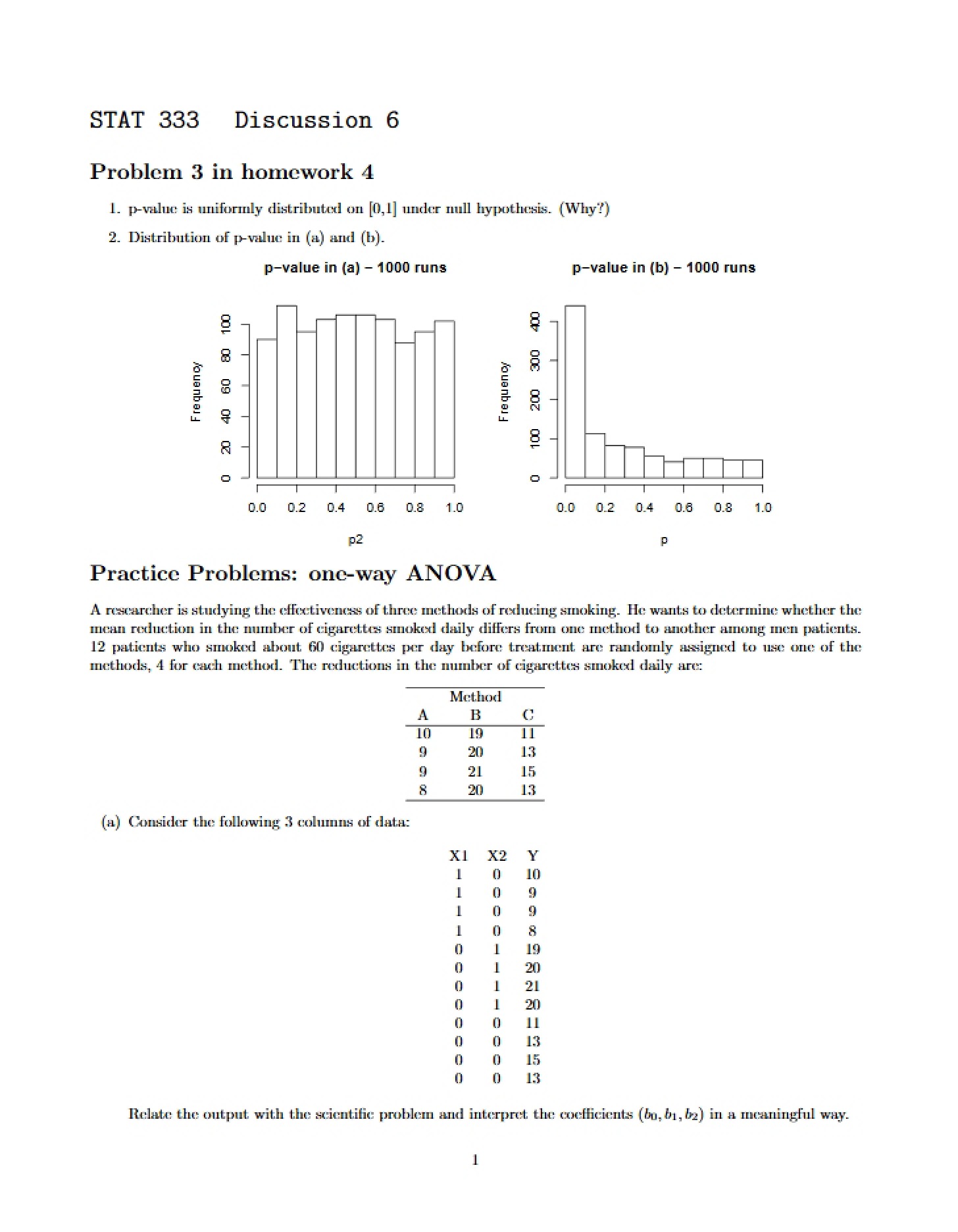
This material supports the Applied Regression Analysis course (STAT 333) at the University of Wisconsin-Madison, specifically focusing on Discussion 06. It’s designed as a supplemental resource to accompany homework assignments and in-class learning. The core subject matter revolves around applying regression techniques to analyze data, with a particular emphasis on understanding the interpretation of model outputs and comparing different modeling approaches. It delves into statistical concepts related to hypothesis testing and the nuances of p-values.
Why This Document Matters
Students enrolled in STAT 333 will find this resource particularly helpful when working through problem sets and preparing for more complex analyses. It’s ideal for those seeking a deeper understanding of how to translate statistical results into practical, real-world interpretations. Individuals who are grappling with the application of ANOVA and regression models, or who need to solidify their understanding of how to assess model fit, will benefit from exploring the concepts presented. This is best used *in conjunction* with lecture notes and assigned readings.
Common Limitations or Challenges
This material does not provide a comprehensive introduction to regression analysis; it assumes a foundational understanding of the core principles. It doesn’t offer step-by-step solutions to homework problems, nor does it replace the need for active participation in discussion sections or independent problem-solving. The resource focuses on specific examples and doesn’t cover the entirety of regression methodologies. It also doesn’t provide new lecture content.
What This Document Provides
* Exploration of the theoretical underpinnings of p-values and their distribution.
* Illustrative examples involving the analysis of experimental data.
* Discussion of how to relate statistical output to the original research question.
* Comparative analysis of regression models built using different variable coding schemes.
* Guidance on interpreting coefficients within a regression framework.
* Examples of calculating and interpreting confidence intervals for model predictions.
* Comparison of ANOVA tables generated from different modeling approaches.