What This Document Is
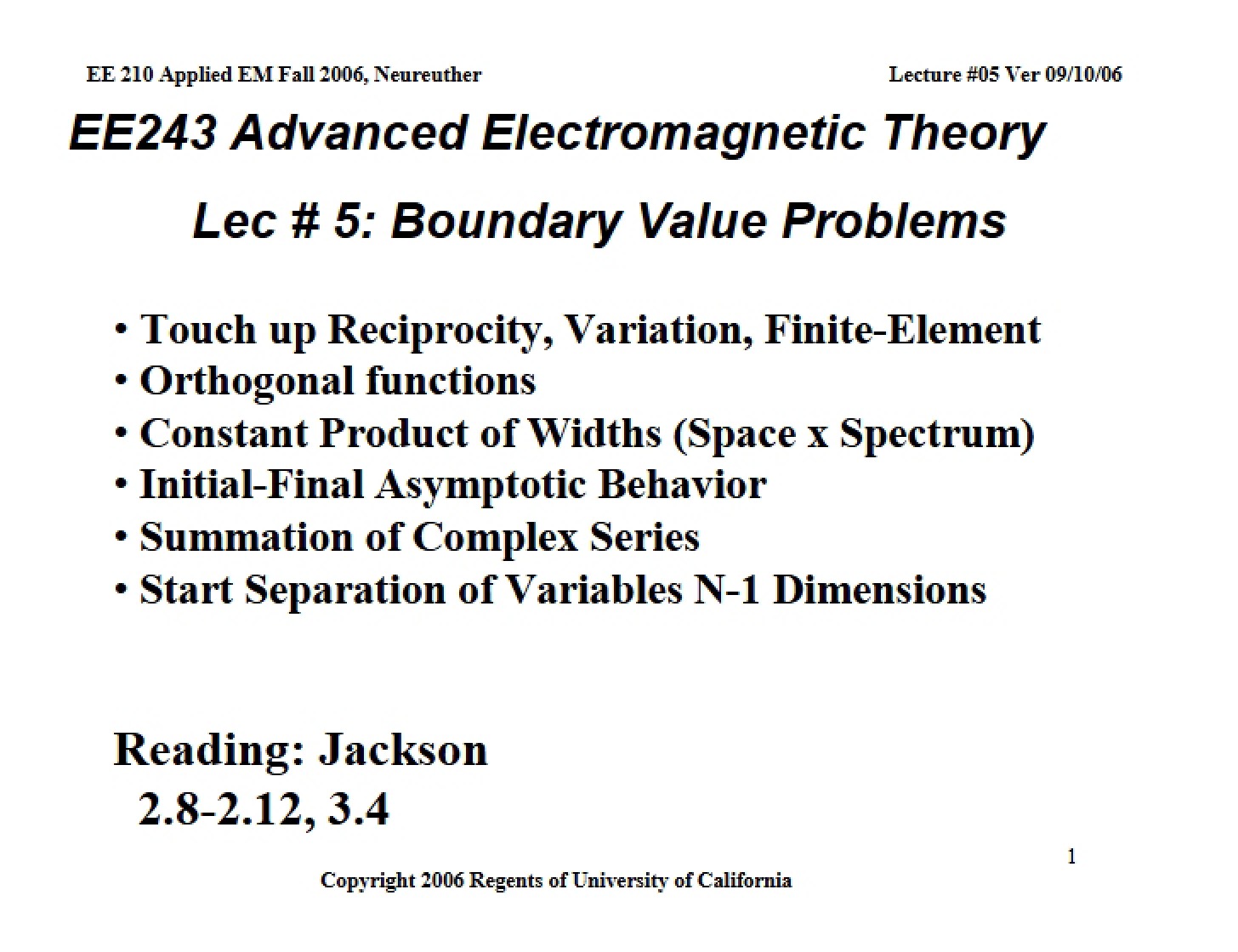
This document comprises lecture notes from EE 210, Applied Electromagnetic Theory, at the University of California, Berkeley. Specifically, it focuses on the behavior of electromagnetic waves as they propagate through materials exhibiting dispersion – meaning materials where the speed of light varies with frequency. It delves into the theoretical underpinnings of how different media interact with electromagnetic radiation, moving beyond simple, idealized scenarios. This lecture, identified as #12 from Fall 2006, provides a detailed exploration of the concepts surrounding dispersive media.
Why This Document Matters
This material is essential for students studying advanced electromagnetics, optics, and related fields like photonics and telecommunications. It’s particularly valuable when you need a deeper understanding of how real-world materials affect signal propagation. If you’re grappling with concepts like pulse broadening, anomalous dispersion, or the relationship between permittivity and refractive index, this resource can provide a solid foundation. It’s ideal for reinforcing classroom learning and preparing for more complex analyses.
Topics Covered
* Modeling material properties using harmonic oscillators.
* The frequency dependence of permittivity and its impact on wave behavior.
* The concept of group velocity and its relationship to energy transport.
* The phenomenon of pulse broadening during wave propagation.
* The fundamental principles of causality and their connection to material response.
* Kramers-Kronig relations and their application to dispersive materials.
* Graphical representation of dispersion using ω-β diagrams.
What This Document Provides
* A detailed examination of the harmonic oscillator model for understanding material response to electromagnetic fields.
* An exploration of how permittivity changes with frequency, including resonant peaks and anomalous dispersion.
* A derivation and explanation of group velocity, crucial for understanding signal propagation.
* A framework for analyzing the effects of dispersion on pulse shape and duration.
* Connections between theoretical concepts and practical observations, such as refractive index variations in water.
* References to relevant chapters in Jackson’s *Classical Electrodynamics* for further study.