What This Document Is
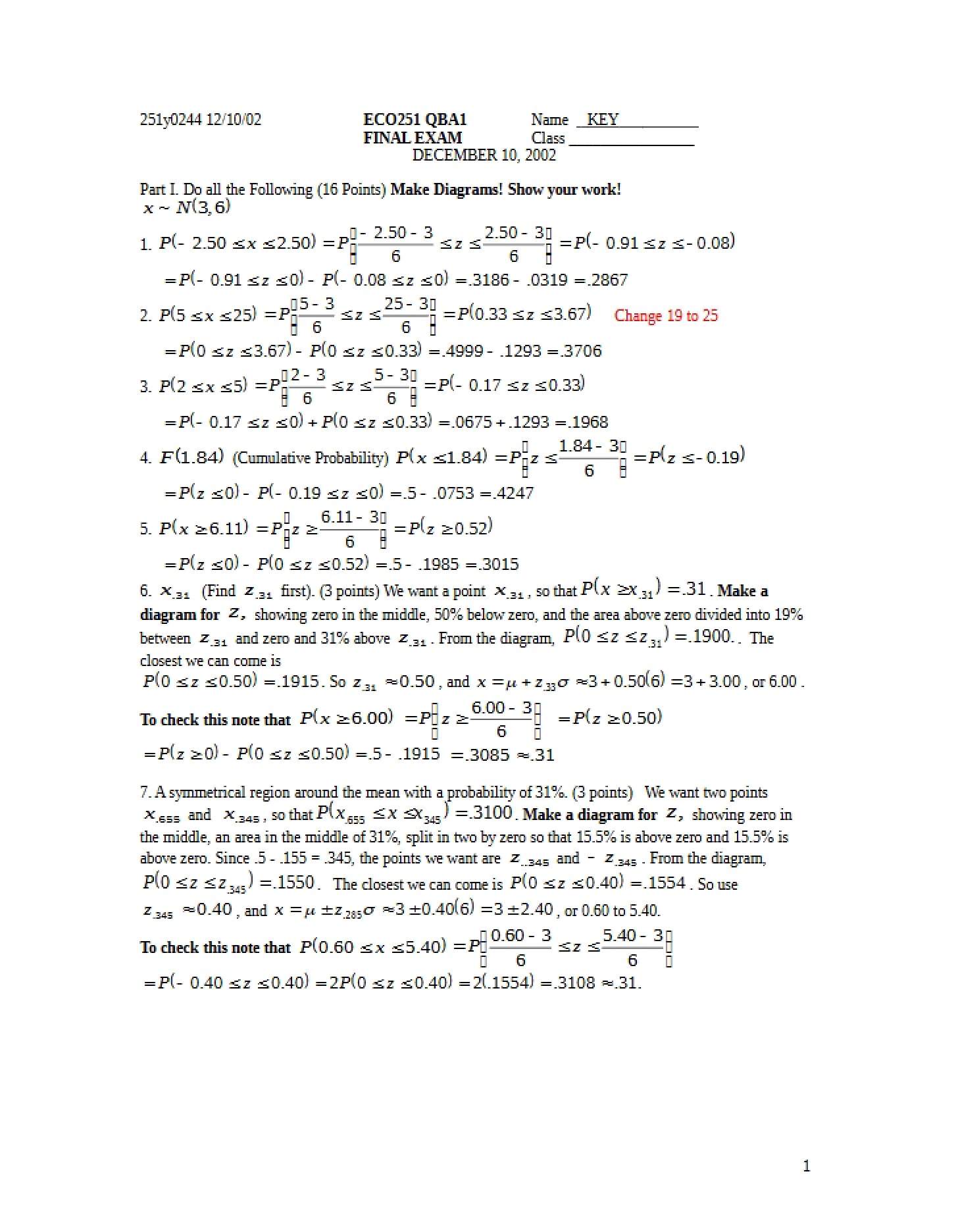
This document is a first-hour exam for ECO 251: Quantitative Business Analysis I, administered at West Chester University of Pennsylvania. It’s designed to assess foundational understanding of key concepts covered early in the course. The exam format is closed-book, focusing on definitions, explanations, and formula application – a style that may differ from later, open-book assessments. It tests core principles related to data analysis and statistical foundations relevant to business decision-making.
Why This Document Matters
This exam is an invaluable resource for students currently enrolled in ECO 251, or those preparing to take the course. It provides a realistic preview of the types of questions and the level of detail expected by the instructor. Reviewing this exam’s structure and scope can help you identify areas where your understanding needs strengthening *before* facing a graded assessment. It’s particularly useful for self-testing and gauging preparedness for similar closed-book evaluations. Students who proactively review past exams often perform better on subsequent assessments.
Common Limitations or Challenges
Please note that this is a past exam and while representative, the specific questions and numerical values will likely differ in future administrations. The course content may also be updated, so this exam shouldn’t be considered a comprehensive substitute for current coursework and study materials. This resource focuses on assessing conceptual understanding and basic calculations; it does not include detailed worked solutions or explanations of the answers.
What This Document Provides
* A range of question types, including definitions, explanations, and formula-based problems.
* Coverage of fundamental concepts such as fields, cells, and stubheads in data organization.
* Assessment of understanding regarding mutually exclusive and collectively exhaustive classes.
* Questions relating to measures of central tendency (mean, median, mode).
* Evaluation of knowledge concerning different types of data (interval, ordinal, ratio).
* Problems involving descriptive statistics like quintiles and kurtosis.
* Practice with interpreting and constructing basic data visualizations (box plots, frequency polygons).
* Formula application related to population variance, harmonic mean, and root-mean-square.
* Questions testing understanding of statistical concepts like parameters versus statistics.