What This Document Is
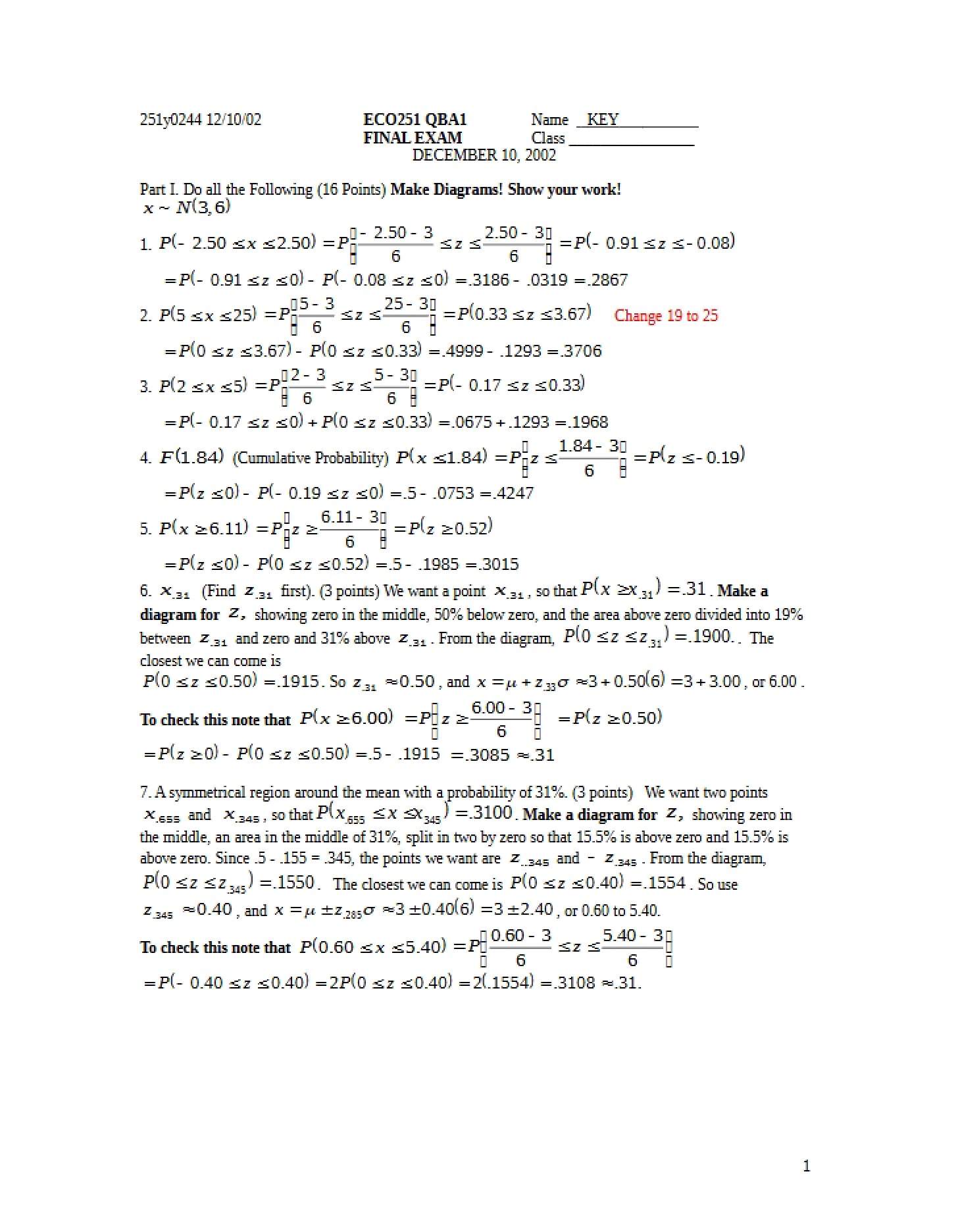
This document is a first-hour examination for ECO 251: Quantitative Business Analysis I, administered at West Chester University of Pennsylvania. It’s designed to assess a student’s understanding of foundational concepts covered in the early stages of the course. The exam focuses on applying statistical methods to analyze data and interpret results, a core skill in quantitative business analysis. It tests both computational abilities and conceptual understanding of statistical principles.
Why This Document Matters
This resource is invaluable for students currently enrolled in ECO 251 or a similar introductory quantitative business analysis course. It’s particularly helpful for students preparing for their first major assessment. Reviewing the *structure* and *types of questions* included can significantly reduce test anxiety and improve performance. Understanding the breadth of topics covered will help focus study efforts. It’s best utilized as part of a comprehensive study plan, alongside lecture notes, textbook readings, and practice problems.
Common Limitations or Challenges
Please note that this document represents a *past* exam. While indicative of the course’s assessment style, the specific questions and data sets will likely differ in future administrations. This resource does *not* provide solutions, detailed explanations, or step-by-step instructions for solving the problems. It is intended as a preview of the exam format and content areas, not a substitute for understanding the underlying course material. Access to the full document is required to view the complete questions and practice applying the concepts.
What This Document Provides
* A range of question types, including calculation-based problems and conceptual multiple-choice questions.
* Focus on core statistical concepts such as measures of central tendency, dispersion, and skewness.
* Application of these concepts to real-world scenarios, including analysis of braking distance data.
* Identification of variable types (qualitative vs. quantitative) and data measurement scales.
* Examination of statistical formulas and their interpretations.
* Problems requiring the use of data previously encountered in course assignments.