What This Document Is
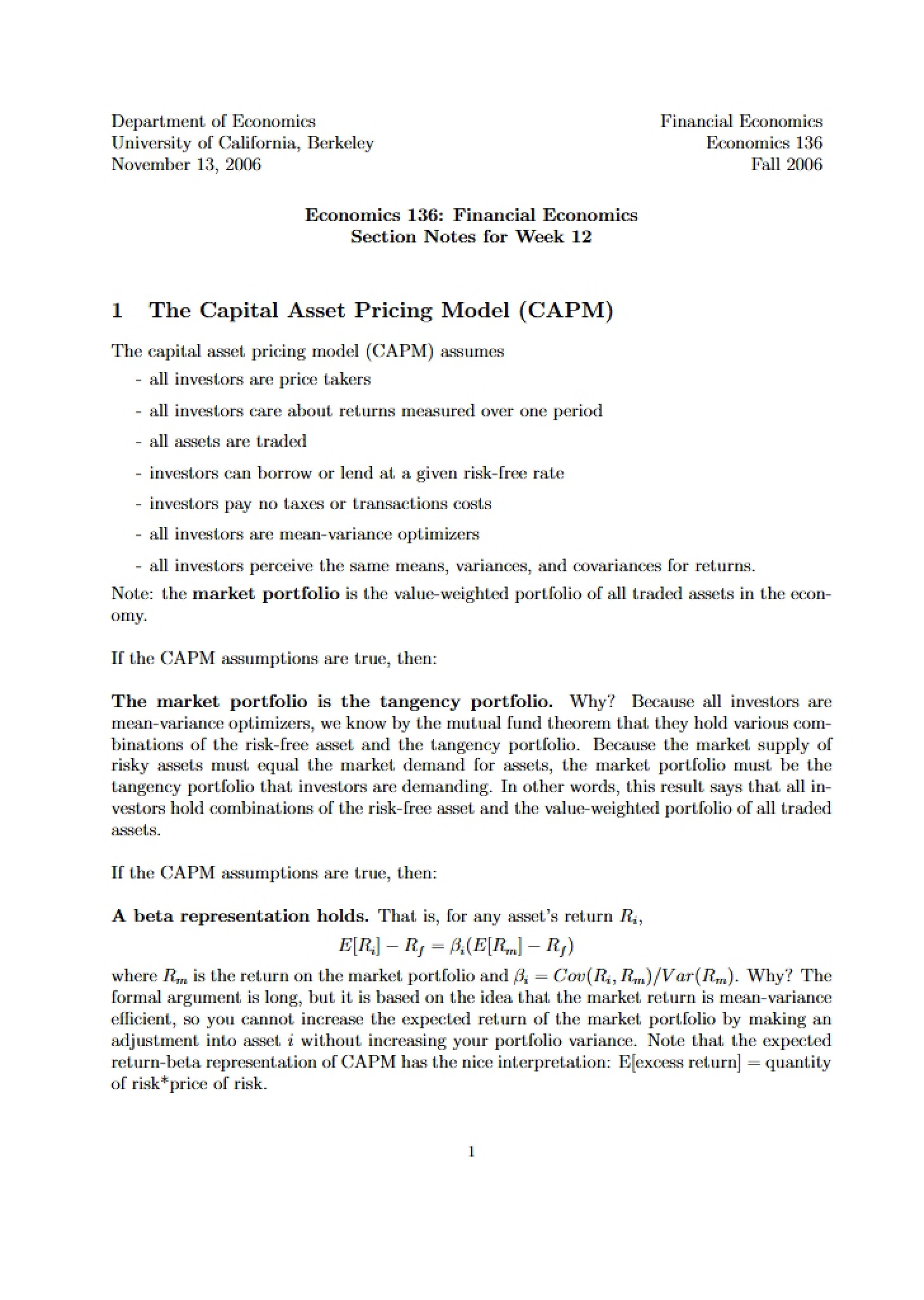
This document contains detailed course notes for Financial Economics (ECON 136) at the University of California, Berkeley. Specifically, these notes cover foundational concepts within the field of finance, designed to supplement lectures and provide a deeper understanding of core principles. It appears to be a set of notes prepared for Week 2 of the course, building upon introductory material. The notes delve into the theoretical underpinnings of asset valuation and portfolio construction.
Why This Document Matters
These notes are invaluable for students enrolled in a rigorous financial economics course. They are particularly helpful for those seeking to solidify their grasp of fundamental concepts, prepare for class discussions, or review material before assessments. Individuals interested in understanding the building blocks of modern financial theory – even outside of a formal course setting – may also find these notes beneficial as a concentrated resource. Access to the full document will provide a comprehensive exploration of these key ideas.
Topics Covered
* Core definitions of prices, payoffs, and various types of financial returns.
* The impact of inflation on financial asset returns and the use of price indexes.
* Portfolio construction and the calculation of portfolio returns.
* The Law of One Price and its implications for asset valuation.
* The concept of arbitrage and strategies for identifying potential opportunities.
* Redundant assets and replicating portfolios.
What This Document Provides
* Precise definitions of key terminology used in financial economics.
* A structured framework for understanding the relationship between asset prices and returns.
* A foundation for analyzing investment opportunities and managing risk.
* A detailed exploration of the theoretical basis for efficient markets.
* A starting point for more advanced study in areas such as asset pricing and corporate finance.