What This Document Is
This document provides a focused exploration of advanced concepts within database systems, specifically building upon foundational knowledge of entity relationships. It delves into the nuances of entity structures, moving beyond basic definitions to examine more complex scenarios and their implications for database design. The material is geared towards students in an introductory database course and forms part of a larger curriculum covering relational algebra and SQL.
Why This Document Matters
This resource is invaluable for students seeking a deeper understanding of how to model real-world data effectively. It’s particularly helpful when you’re grappling with scenarios where simple entity relationships aren’t sufficient and require more sophisticated approaches. It’s best utilized while actively working on database design projects or preparing to write SQL queries that involve complex data dependencies. Understanding these concepts is crucial for building robust and efficient database systems.
Topics Covered
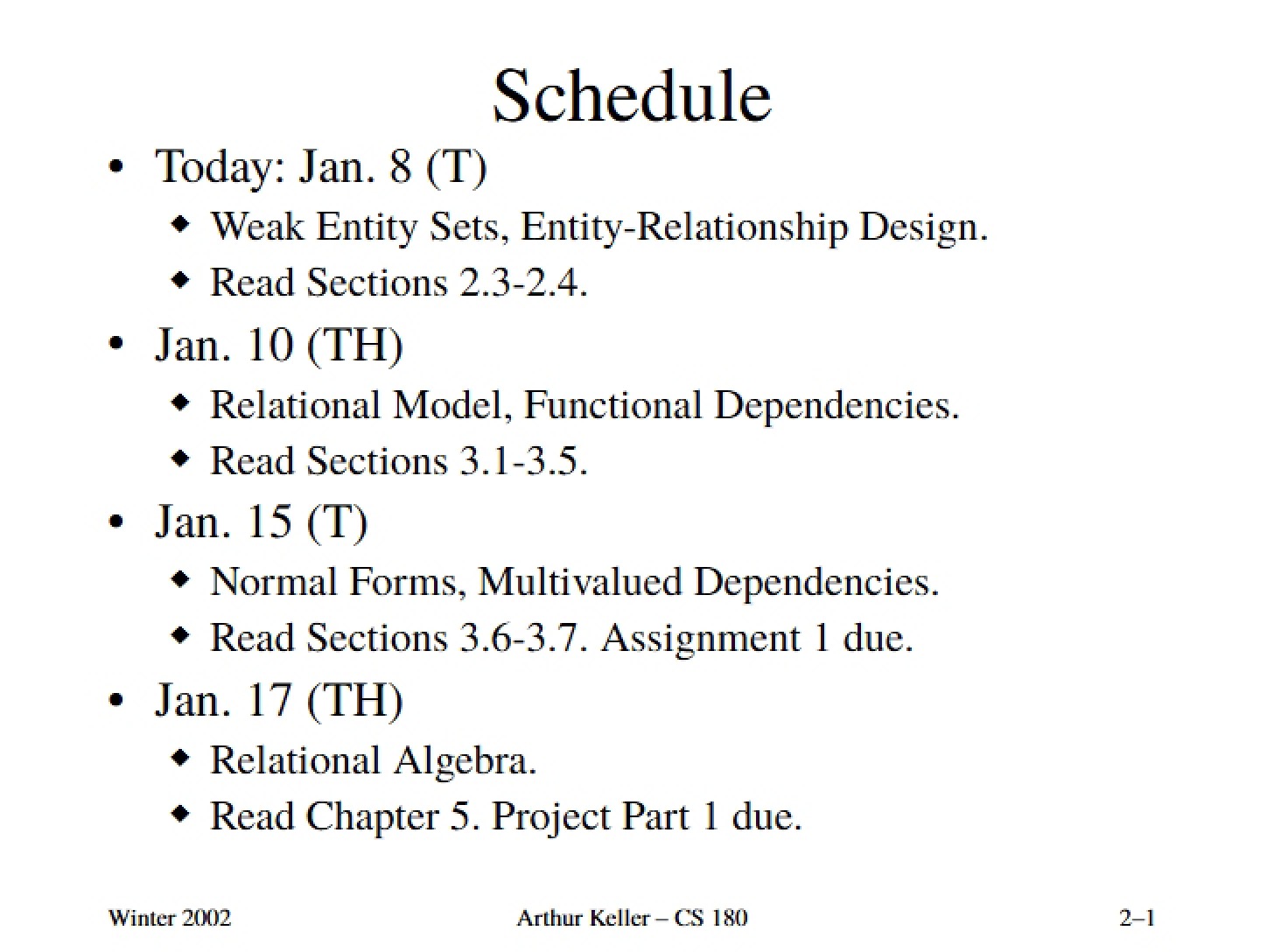
* Weak Entity Sets and their characteristics
* The concept of “bag semantics” in relation to database operations
* Differences between set-based and bag-based operations (union, intersection, difference)
* Extended relational algebra operators for enhanced functionality
* Duplicate elimination techniques
* Sorting and its implications within relational algebra
* Aggregation and grouping operators for data summarization
What This Document Provides
* A review of fundamental entity relationship concepts as a foundation for more advanced topics.
* An examination of how to extend relational algebra to accommodate features commonly found in SQL.
* Detailed explanations of operators designed to handle duplicate data and perform complex data manipulations.
* A framework for understanding how to apply grouping and aggregation to extract meaningful insights from databases.
* Conceptual explorations of how these advanced techniques contribute to effective database design and query optimization.