What This Document Is
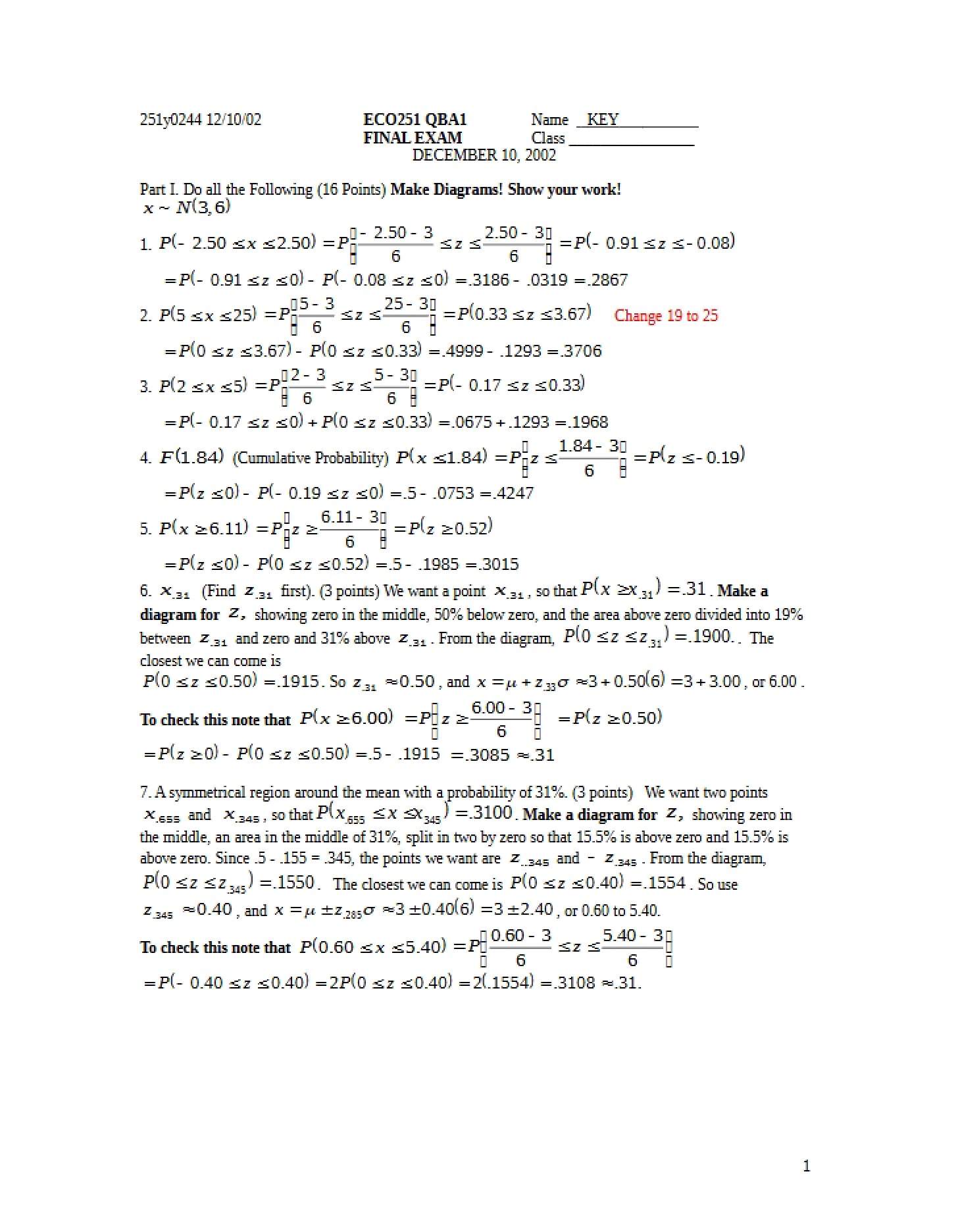
This document is a past exam paper for ECO 251: Quantitative Business Analysis I, administered at West Chester University of Pennsylvania. It’s designed to assess a student’s understanding of foundational statistical concepts as they apply to business decision-making. The exam covers a range of topics typically found in an introductory quantitative methods course, focusing on descriptive statistics and data analysis techniques.
Why This Document Matters
This exam paper is an invaluable resource for students currently enrolled in ECO 251, or those preparing to take a similar course. It provides a realistic preview of the types of questions, the level of difficulty, and the overall format of assessments used in this course. Studying past exams is a proven method for identifying knowledge gaps, practicing problem-solving skills, and reducing test anxiety. It’s particularly useful for self-assessment and targeted review before quizzes or the final exam. Students who utilize this resource can gain confidence and improve their performance.
Common Limitations or Challenges
Please note that while this is a previous exam, it should not be considered a guarantee of future exam content. The instructor may modify questions, topics covered, or the weighting of different sections. This document does *not* include answer keys or detailed solutions; it is intended for practice and self-evaluation only. It also assumes a foundational understanding of the core concepts taught in the course.
What This Document Provides
* A variety of question types, including calculation-based problems, multiple-choice questions, and data interpretation exercises.
* Problems relating to measures of central tendency and dispersion (e.g., median, standard deviation, coefficient of variation).
* Exercises involving frequency distributions and cumulative frequency calculations.
* Questions assessing understanding of data types (nominal, ordinal, interval, ratio).
* Practice with data representation techniques, such as frequency polygons.
* Problems utilizing stem-and-leaf displays and the application of statistical rules like Chebyshev’s inequality.
* A clear indication of the point value assigned to each section and question.