What This Document Is
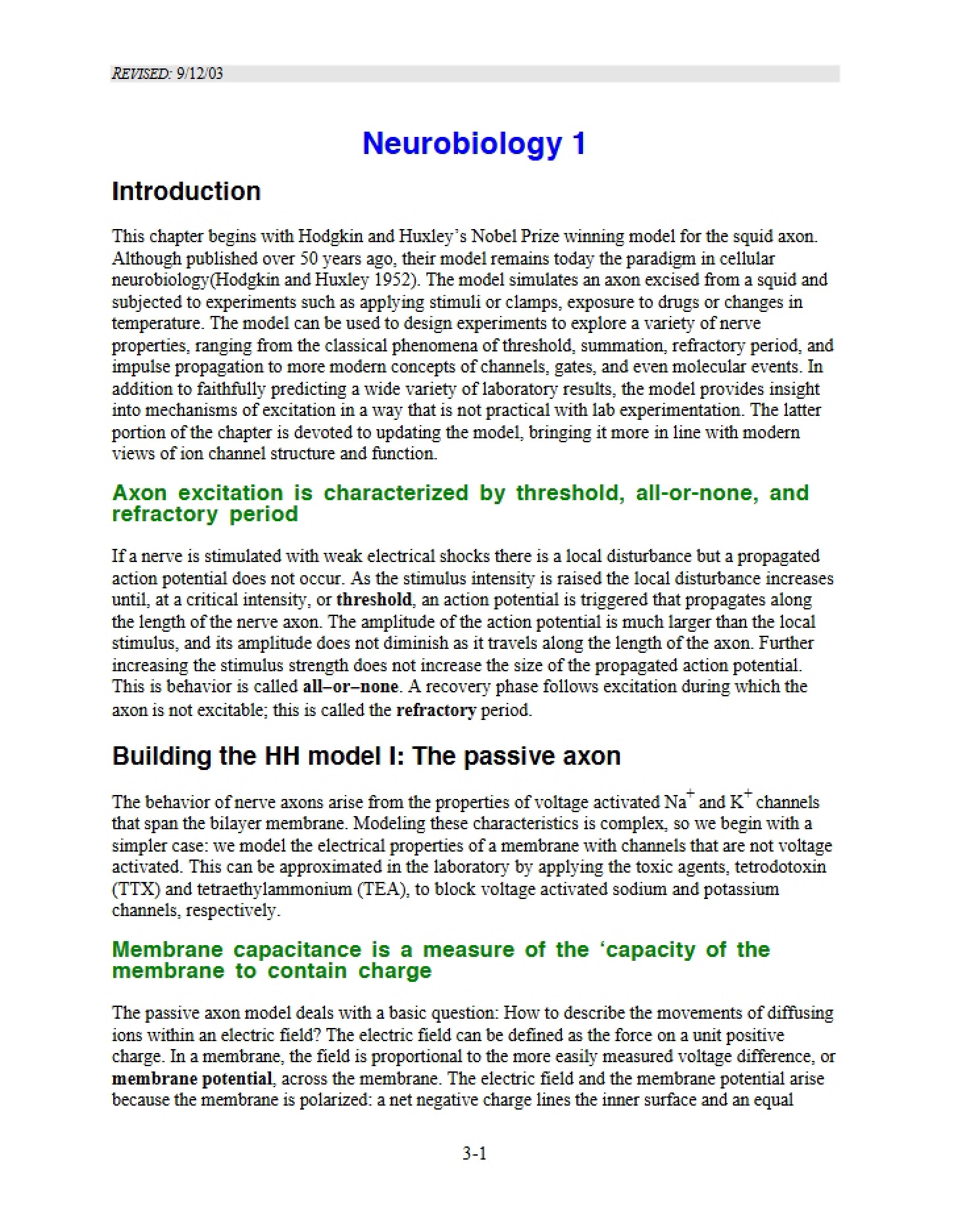
This document, “Excitation in Neurobiology 1,” is a detailed exploration of the fundamental principles governing electrical signaling in nerve cells. It delves into the biophysical mechanisms underlying neuronal excitation, building from foundational concepts to more complex interactions. The material is rooted in the landmark Hodgkin and Huxley model of the squid axon, a cornerstone of modern neurobiology. This resource is designed to provide a deep understanding of how neurons function at a cellular level.
Why This Document Matters
This resource is ideal for students enrolled in advanced biology or neurobiology courses, particularly those focusing on computational modeling or cellular physiology. It’s most valuable when you’re seeking to solidify your understanding of action potentials, membrane properties, and the ionic basis of neural signaling. It will be particularly helpful when tackling assignments or preparing for exams that require a mechanistic understanding of nerve impulse generation and propagation. Accessing the full content will unlock a deeper comprehension of these critical biological processes.
Topics Covered
* The all-or-none principle of action potential generation
* Threshold and its role in initiating excitation
* The refractory period and its impact on neuronal firing patterns
* Passive electrical properties of the axon membrane
* The role of ion channels in neuronal excitability
* The relationship between membrane potential and charge distribution
* Modeling approaches to understanding neuronal function
What This Document Provides
* A comprehensive introduction to the Hodgkin and Huxley model.
* A detailed examination of the factors influencing neuronal excitability.
* An exploration of the electrical characteristics of nerve axons.
* A framework for understanding the interplay between membrane properties and ion movement.
* Conceptual foundations for building and interpreting computational models of neuronal behavior.
* Connections between theoretical models and experimental observations.