What This Document Is
This document contains detailed worked solutions for Homework 11 of ECE 210, Analog Signal Processing, offered at the University of Illinois at Urbana-Champaign during the Fall 2014 semester. It’s designed as a companion resource to the original assignment, offering a comprehensive review of the problem-solving process for core concepts within the course. This isn’t a textbook or lecture notes replacement, but a focused guide to understanding specific homework challenges.
Why This Document Matters
This resource is invaluable for students currently enrolled in or recently completed an analog signal processing course. It’s particularly helpful if you’re looking to solidify your understanding of convolution, impulse responses, and system analysis techniques. Use this guide after attempting the homework problems yourself – reviewing the solutions can illuminate alternative approaches and identify areas where your understanding might need strengthening. It’s a great tool for exam preparation and building a stronger foundation in signal processing principles.
Topics Covered
* Convolution and its properties (time-domain analysis)
* The derivative property of convolution
* System response to specific input signals (unit step, rectangular functions)
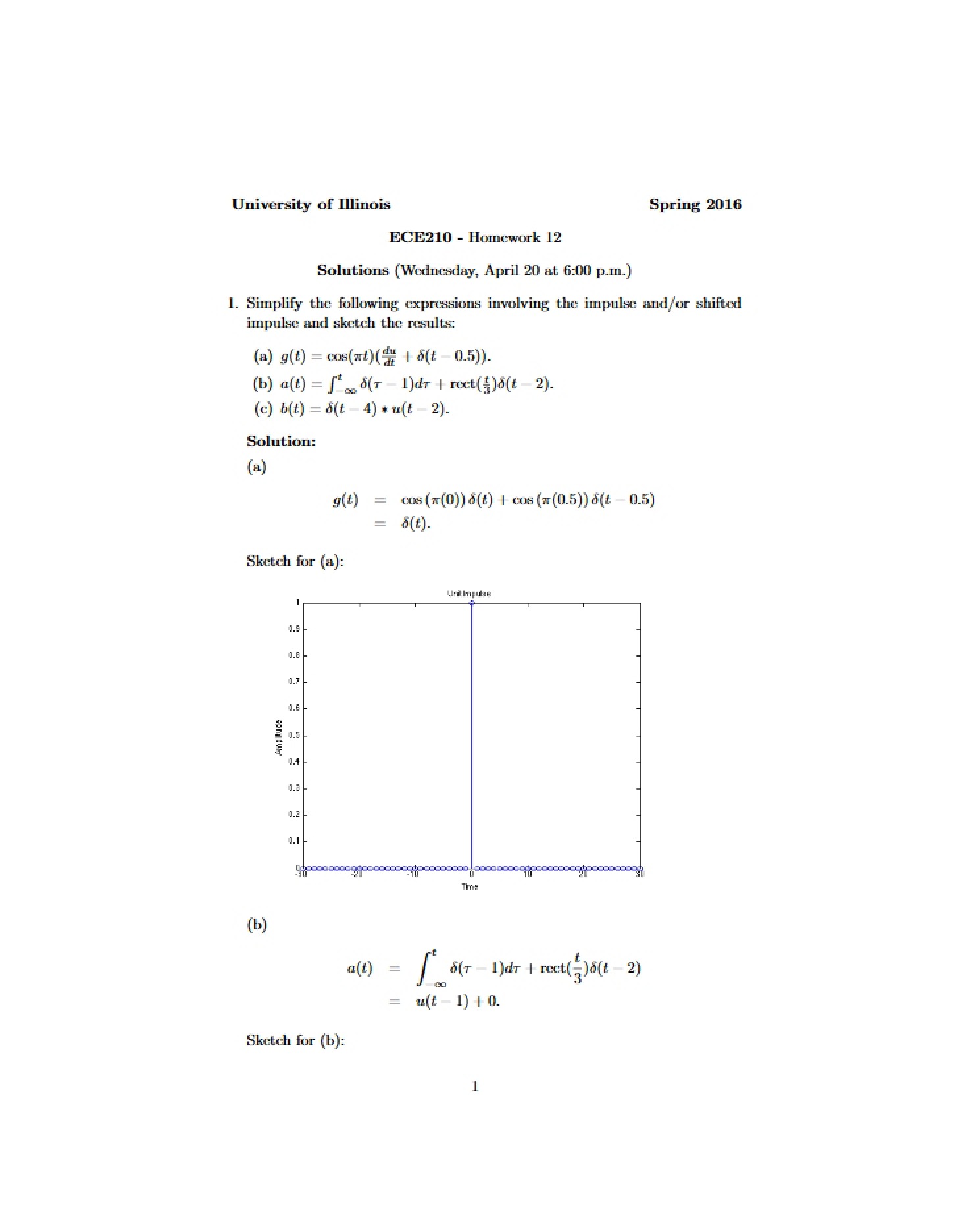
* Impulse and shifted impulse functions
* Analysis of systems defined by their impulse response
* Time-domain representation of signals and systems
* Rectangular and unit step functions
What This Document Provides
* Step-by-step breakdowns of solutions to assigned homework problems.
* Illustrative sketches accompanying the mathematical derivations.
* Detailed application of signal processing principles to practical problems.
* Alternative methods for solving problems, encouraging a deeper understanding of the underlying concepts.
* A focused review of key techniques for analyzing analog signals and systems.