What This Document Is
This document contains detailed, worked solutions for Homework 12 of ECE 210, Analog Signal Processing, offered at the University of Illinois at Urbana-Champaign during the Fall 2014 semester. It’s designed as a companion resource to the original assignment, offering a comprehensive review of the problem-solving approaches used in the course. This resource focuses on applying core concepts to practical examples, helping students solidify their understanding of signal processing techniques.
Why This Document Matters
This study guide is invaluable for students currently enrolled in or recently completed an analog signal processing course. It’s particularly helpful for those seeking to check their work, understand areas where they struggled on the assignment, or reinforce their grasp of key principles. It’s best utilized *after* attempting the homework problems independently, as a tool for self-assessment and deeper learning. Access to these solutions can significantly enhance comprehension and improve performance in future coursework.
Topics Covered
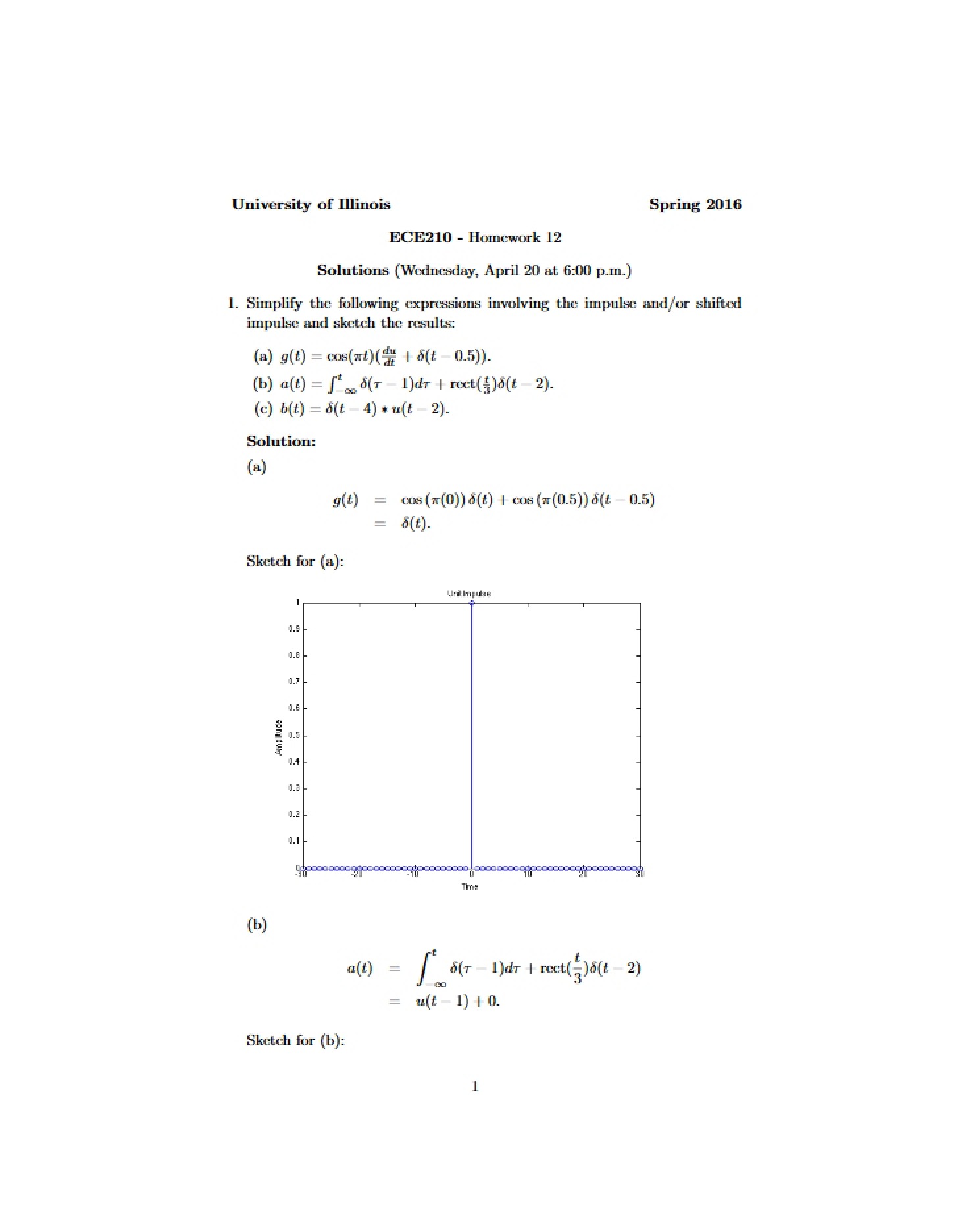
* Simplification of expressions involving impulse and shifted impulse functions
* System response to various input signals, determined using the impulse response
* Fourier Transform calculations and analysis of different signal types
* Application of trigonometric identities in signal processing
* Time and frequency domain analysis of signals
* Nyquist sampling theorem and aliasing considerations
* Analysis of bandwidth and sampling frequency requirements
What This Document Provides
* Step-by-step solutions to a variety of homework problems.
* Illustrative sketches to visualize signal behavior and transformations.
* Detailed explanations of the reasoning behind each solution step.
* Applications of key concepts and theorems from analog signal processing.
* A comprehensive review of Fourier Transform properties and their use.
* Guidance on determining appropriate sampling frequencies to avoid aliasing.