What This Document Is
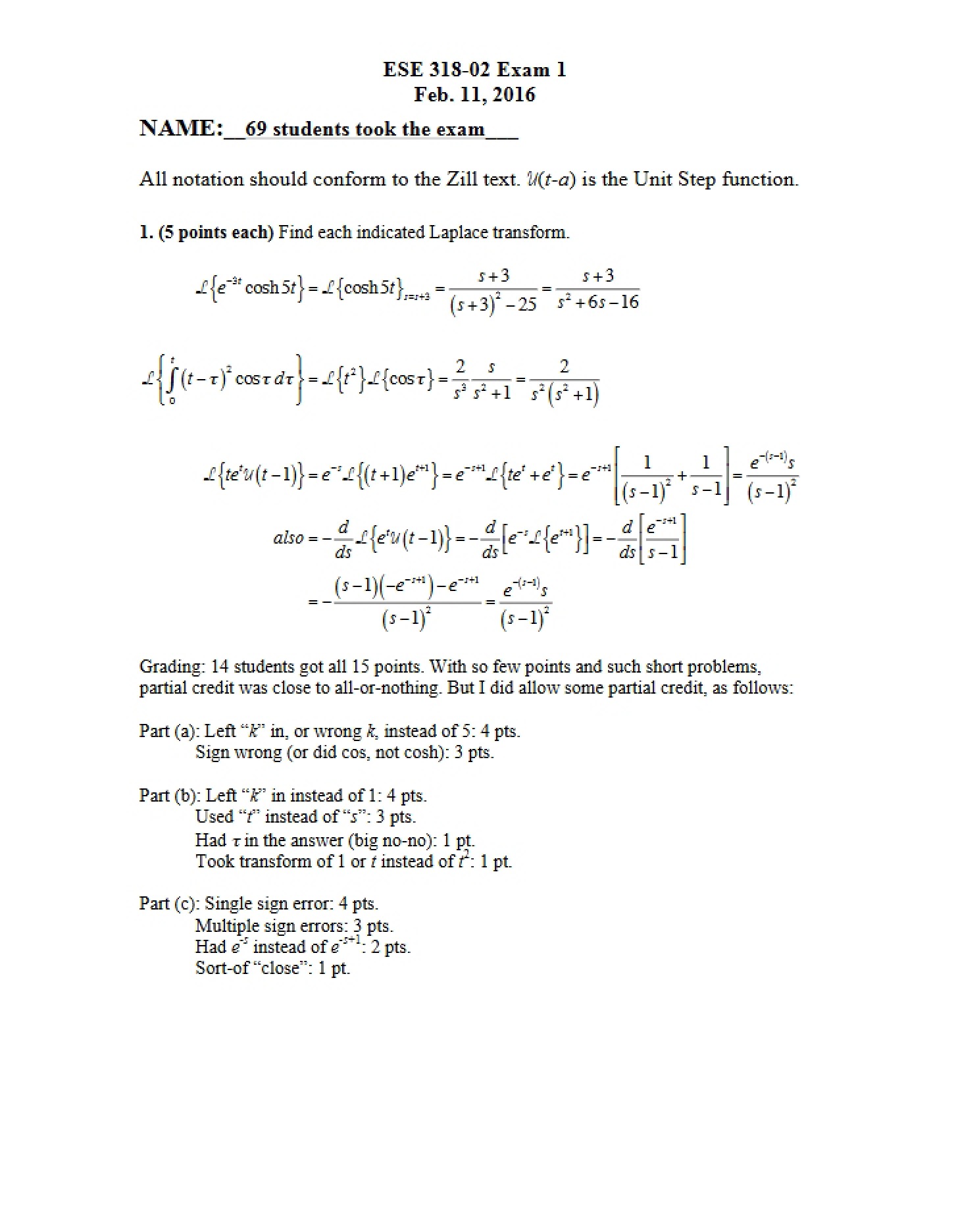
This document contains detailed worked solutions for a midterm examination in Engineering Mathematics A (ESE 318) at Washington University in St. Louis, originally administered in Fall 2015. It focuses on core concepts covered in the course, likely spanning several chapters from a primary textbook (referenced as "Zill"). The material centers around multivariable calculus and related mathematical techniques essential for engineering applications.
Why This Document Matters
This resource is invaluable for students currently enrolled in or preparing for similar engineering mathematics courses. It’s particularly helpful for those who want to review their understanding of key problem-solving techniques and identify areas where they may need further study. Access to these solutions can aid in solidifying comprehension *after* attempting the problems independently, and can be used as a comparative analysis tool to refine your approach. It’s best utilized after initial attempts at similar problems, not as a substitute for active learning.
Common Limitations or Challenges
This document presents solutions to a *specific* midterm exam. While the concepts are broadly applicable, the precise problems addressed are unique to that assessment. It does not include explanations of fundamental concepts, derivations of formulas, or comprehensive theory review. It assumes a base level of understanding of the course material. Furthermore, it does not offer alternative solution methods – it showcases approaches used on that particular exam.
What This Document Provides
* Detailed step-by-step solutions to a range of problems covering topics such as vector-valued functions, partial derivatives, and optimization.
* Solutions referencing specific problems from a textbook by Zill, allowing for easy cross-referencing with course materials.
* Worked examples demonstrating the application of calculus principles to engineering-related scenarios.
* Solutions addressing problems involving functions of multiple variables and their derivatives.
* Illustrations of techniques for finding gradients, directional derivatives, and tangent planes.