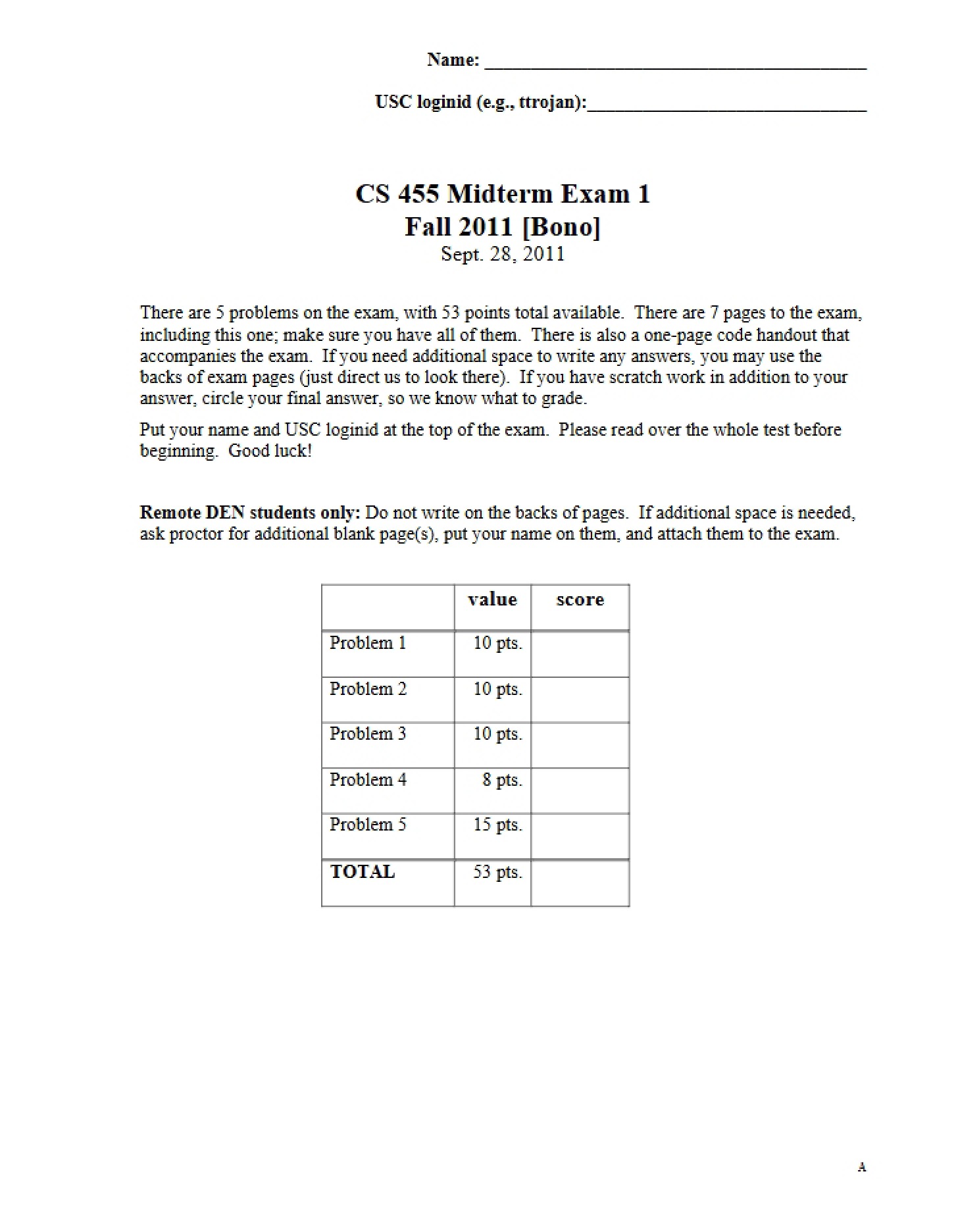
What This Document Is
This document is a past final exam for CSCI 455x, Introduction to Programming Systems Design, offered at the University of Southern California. It represents a comprehensive assessment of the concepts and skills taught throughout the course during the Fall 2015 semester. The exam covers a range of topics central to understanding how programming systems are designed and implemented. It’s designed to test not just recall, but also the ability to apply learned principles to solve problems.
Why This Document Matters
This resource is invaluable for students currently enrolled in or preparing for CSCI 455x. Reviewing past exams is a proven strategy for understanding the course’s expectations, the types of questions asked, and the level of difficulty. It’s particularly useful for identifying areas where your understanding might need strengthening. Utilizing this exam as a study tool can help you refine your test-taking strategies and build confidence before your own assessment. It’s best used *after* completing coursework and engaging with the primary learning materials.
Common Limitations or Challenges
It’s important to remember that this is a past exam. While the core concepts likely remain consistent, the specific questions and emphasis may vary in future iterations of the course. This document does *not* include solutions or explanations, and is intended for self-assessment only. Relying solely on this exam without a thorough understanding of the course material will likely be insufficient for success. Furthermore, changes to the curriculum or teaching staff could result in differences between this exam and current assessments.
What This Document Provides
* A full, previously administered final exam paper.
* A variety of problem types assessing different skills.
* Questions relating to data structures like binary search trees.
* Problems requiring analysis of code (Java in this instance).
* Exercises focused on algorithmic complexity (Big-O notation).
* Challenges involving string manipulation and stack implementations.
* A problem centered around concordance creation and efficient data storage.
* Clear point values assigned to each problem, indicating relative weight.