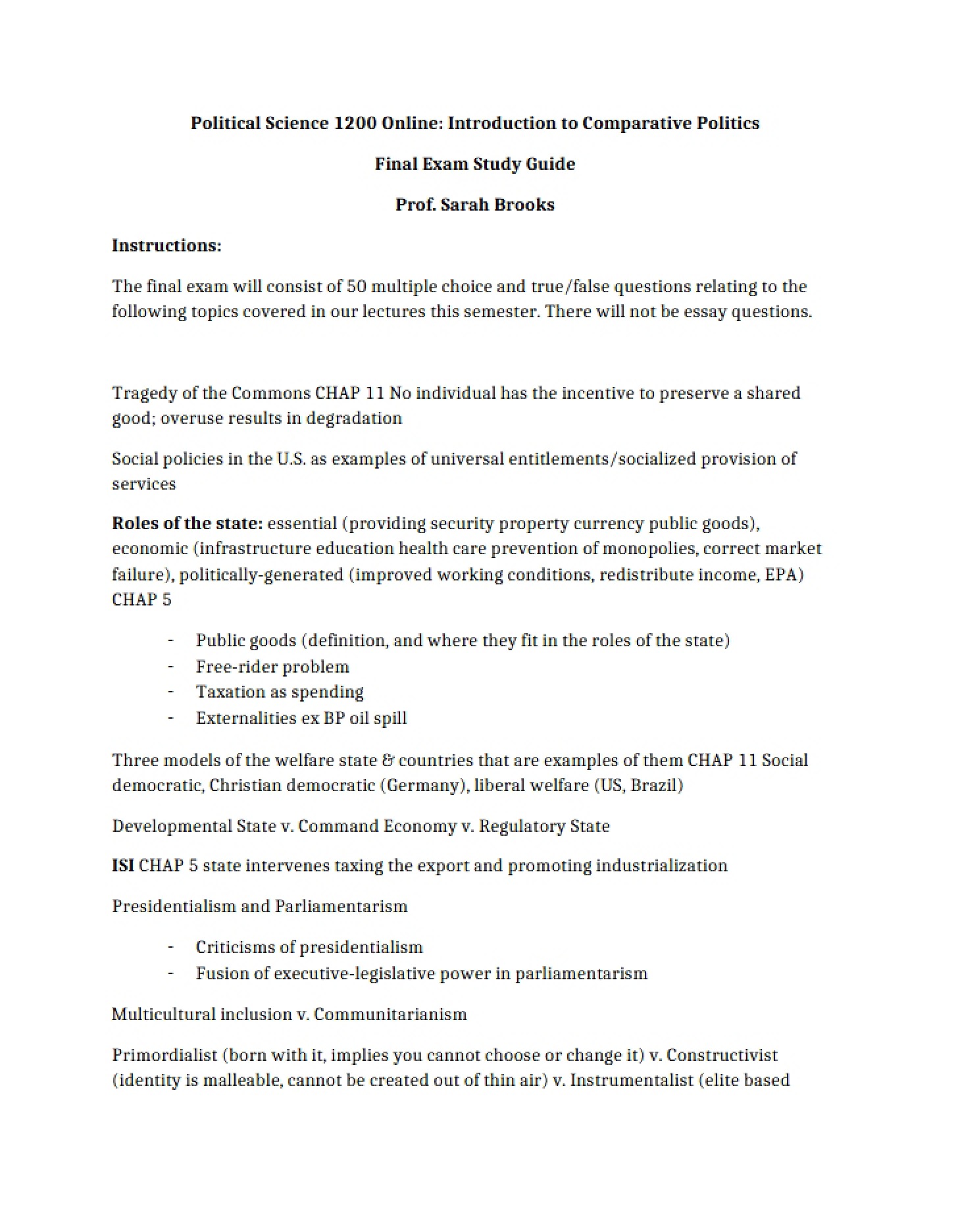
What This Document Is
This document represents the foundational chapter of an introductory university-level course in Comparative Politics. It establishes core concepts and methodologies essential for understanding the field, setting the stage for in-depth analysis of political systems around the globe. It’s designed to provide a rigorous, yet accessible, overview of the discipline’s key principles and approaches. This chapter serves as a building block for further exploration into the complexities of power, decision-making, and governance.
Why This Document Matters
This material is invaluable for students beginning their study of Comparative Politics, or for anyone seeking a structured understanding of the fundamental concepts underpinning political science. It’s particularly useful when first encountering the discipline, as it clarifies terminology and introduces the core debates within the field. Students will find it helpful to review this chapter when preparing for more specialized topics, or when needing to revisit the foundational logic of comparative analysis.
Topics Covered
* Defining and understanding the nature of ‘politics’ itself.
* The core subfields within Political Science, including Comparative Politics and International Relations, and their interrelationships.
* The challenges and considerations inherent in applying scientific methods to the study of social phenomena.
* The role of theory – both empirical and normative – in political science research.
* Key concepts in research design, including variables, correlation, and causation.
* An introduction to different research methods used in comparative political analysis.
* Foundational concepts related to the state, nation, and country.
What This Document Provides
* A clear articulation of the distinct approaches to studying politics.
* An overview of the systematic processes used to study political phenomena.
* A framework for understanding the relationship between theoretical arguments and empirical evidence.
* An introduction to the core terminology used by political scientists.
* A discussion of different methodological approaches to comparative analysis, including case studies and system design.
* A foundational understanding of the building blocks of political organization.