What This Document Is
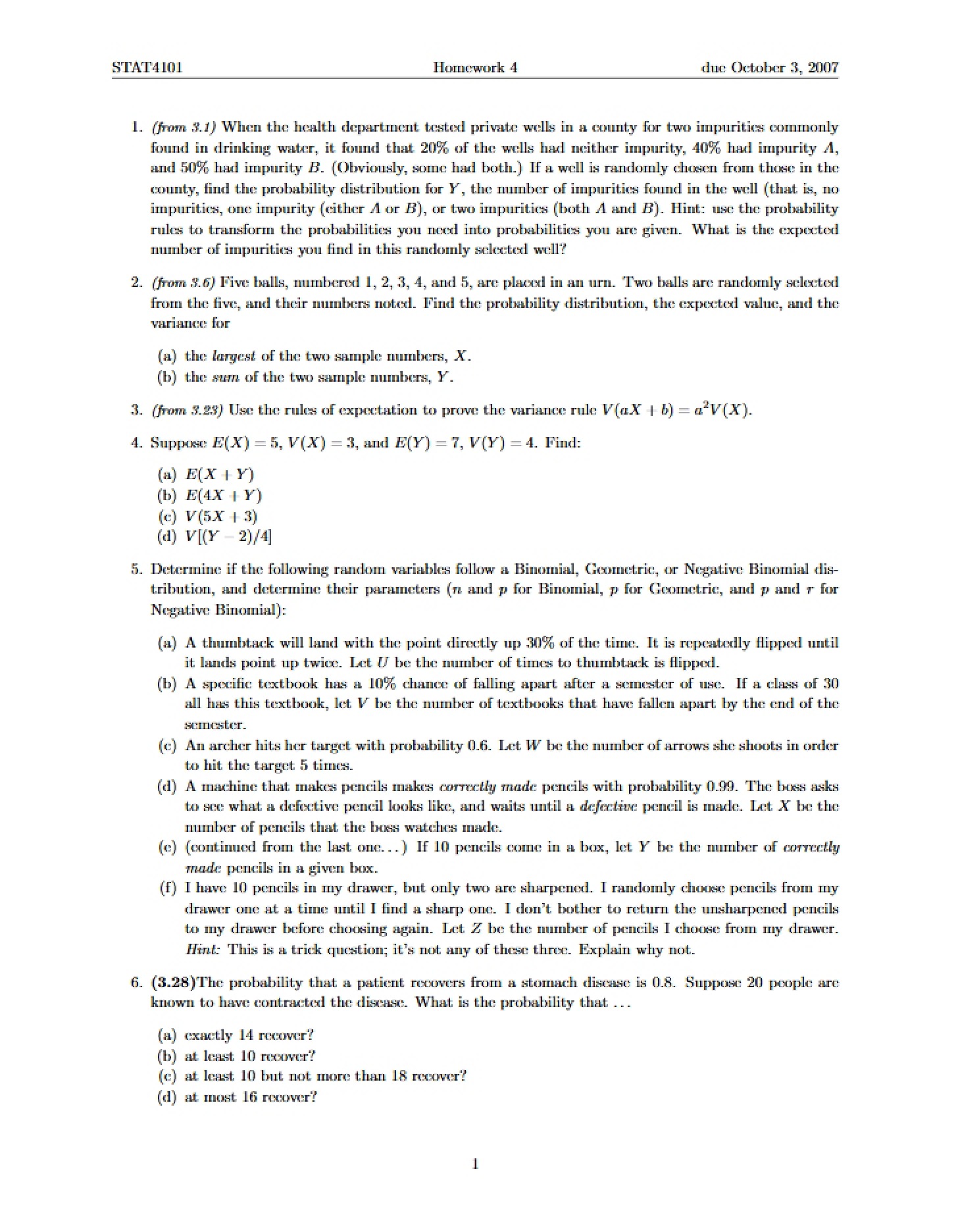
This is the first homework assignment for STAT 4101: Theory of Statistics I, offered at the University of Minnesota Twin Cities. It’s a practical exercise designed to reinforce foundational concepts introduced in the early stages of the course. The assignment focuses on applying statistical thinking to real-world scenarios and beginning to work with data. It requires students to demonstrate an understanding of core principles related to populations, samples, and statistical inference.
Why This Document Matters
This assignment is crucial for students enrolled in STAT 4101. Successfully completing it demonstrates a grasp of the fundamental building blocks necessary for more advanced statistical analysis. It’s particularly beneficial for those who are new to statistical reasoning or need to solidify their understanding of basic concepts before moving on to more complex topics like probability distributions and hypothesis testing. Working through these problems will help build confidence in applying statistical principles to interpret data and draw meaningful conclusions. It’s best used *after* reviewing the corresponding lecture materials and textbook readings.
Common Limitations or Challenges
This assignment does not provide a comprehensive review of all statistical concepts. It assumes a basic familiarity with introductory statistical ideas. It also doesn’t offer step-by-step solutions or detailed explanations of *how* to arrive at the answers; it’s designed to test your ability to apply learned concepts independently. Furthermore, the assignment focuses on conceptual understanding and initial data manipulation – it doesn’t delve into advanced statistical software or complex calculations.
What This Document Provides
* A series of problems requiring the definition of populations and inferential objectives.
* Exercises designed to differentiate between population characteristics and sample data.
* Questions prompting reflection on the importance of quantifying the reliability of statistical inferences.
* A dataset related to reported cases of a significant public health issue, for descriptive statistical analysis.
* Tasks involving the calculation of basic descriptive statistics (mean and standard deviation).
* Problems exploring the application of the empirical rule.
* Scenarios involving normal distributions and probability calculations.
* Exercises focused on set theory and basic probability concepts.
* A survey-based problem requiring application of learned principles.