What This Document Is
This is a first midterm examination for MATH 2263, Multivariable Calculus, offered at the University of Minnesota Twin Cities. It’s designed to assess your understanding of core concepts covered in the initial stages of the course. The exam focuses on applying theoretical knowledge to problem-solving, requiring you to demonstrate a comprehensive grasp of multivariable calculus principles. Expect a format typical of university-level mathematics assessments – showing your work is crucial!
Why This Document Matters
This resource is invaluable for students currently enrolled in MATH 2263, or those preparing to take a similar multivariable calculus course. It’s particularly useful for gauging your preparedness for a midterm exam. Working through problems *similar* to those found here (though the specific problems are behind a paywall) will help identify areas where you need further study and practice. It’s best utilized after completing relevant coursework and practice problems, as a way to consolidate your understanding and build confidence.
Common Limitations or Challenges
This document presents a completed exam, but does *not* include detailed solutions or step-by-step explanations. It serves as a practice tool to test your existing knowledge, not as a teaching resource. Successfully navigating the problems requires a solid foundation in the course material. Furthermore, this is *one* specific midterm; while representative of the course content, it may not cover every single topic exhaustively.
What This Document Provides
* Problems assessing understanding of partial derivatives and their applications.
* Questions relating to the identification and classification of critical points of multivariable functions.
* Tasks involving the analysis of quadric surfaces.
* Problems focused on directional derivatives and steepest descent.
* Exercises testing knowledge of continuity of multivariable functions.
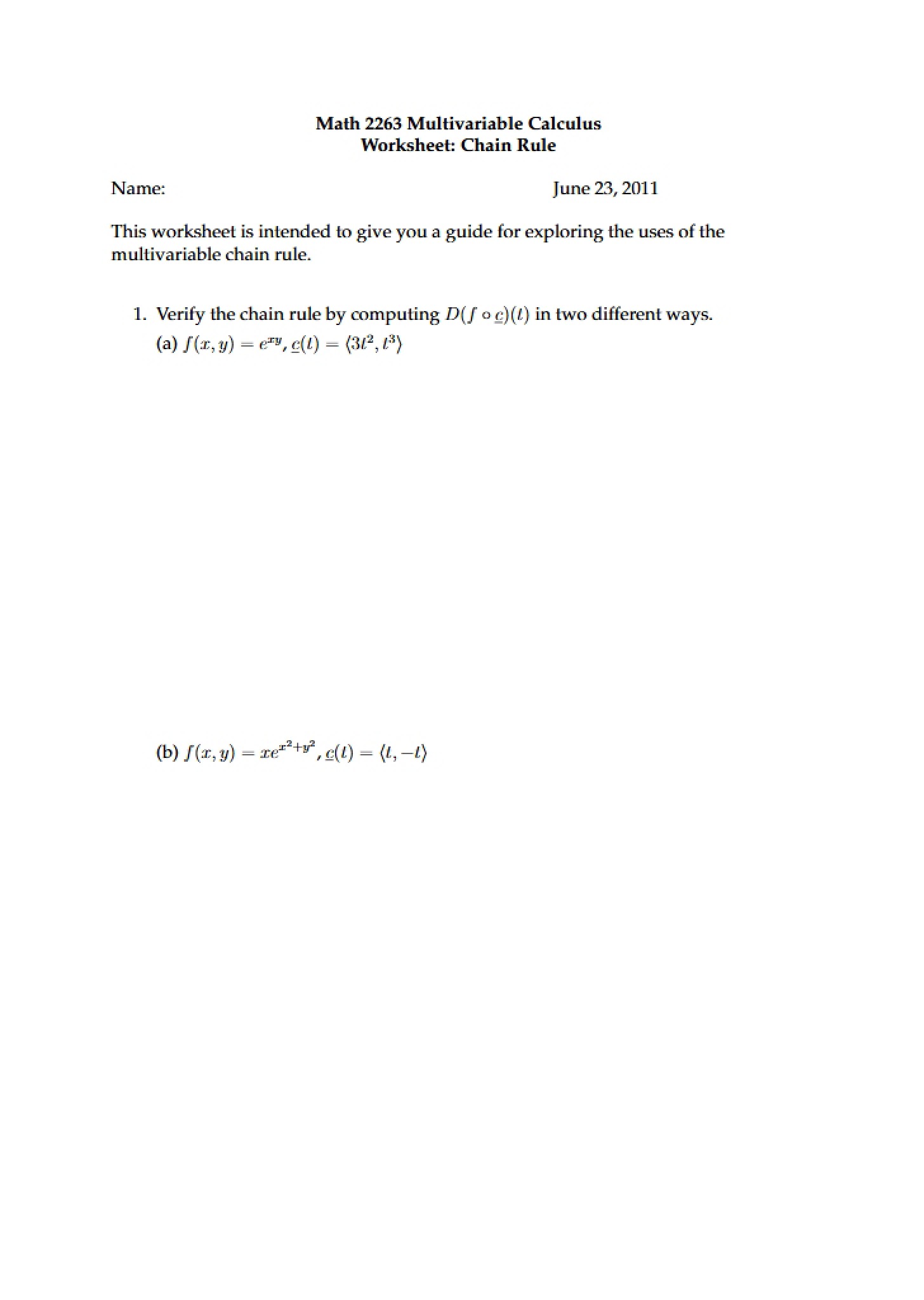
* Applications of the chain rule with multiple independent variables.
* Problems requiring the use of Lagrange Multipliers for optimization.
* Questions related to tangent planes and linear approximation techniques.
* Problems involving the intersection of planes and finding symmetric equations of lines.