What This Document Is
This is a focused instructional resource delving into the complexities of heat and mass transfer, specifically examining reaction and diffusion processes. Developed for students in the CHBE 523 course at the University of Illinois at Urbana-Champaign, it provides a detailed exploration of transient behavior in systems involving chemical reactions occurring within a diffusion-controlled environment. The material centers around applying mathematical techniques to model and understand these phenomena.
Why This Document Matters
This resource is invaluable for chemical engineering students tackling advanced transport phenomena. It’s particularly helpful for those needing a robust understanding of how reaction rates influence diffusion processes, and vice versa. Students preparing for exams, working on related assignments, or seeking a deeper grasp of reaction engineering principles will find this a useful study aid. It’s best utilized when you’re already familiar with the fundamentals of diffusion and reaction kinetics and are ready to apply more sophisticated analytical methods.
Topics Covered
* Transient Diffusion with First-Order Reactions
* Application of the Finite Fourier Transform method to solve diffusion equations
* Dimensionless Analysis in reaction-diffusion systems
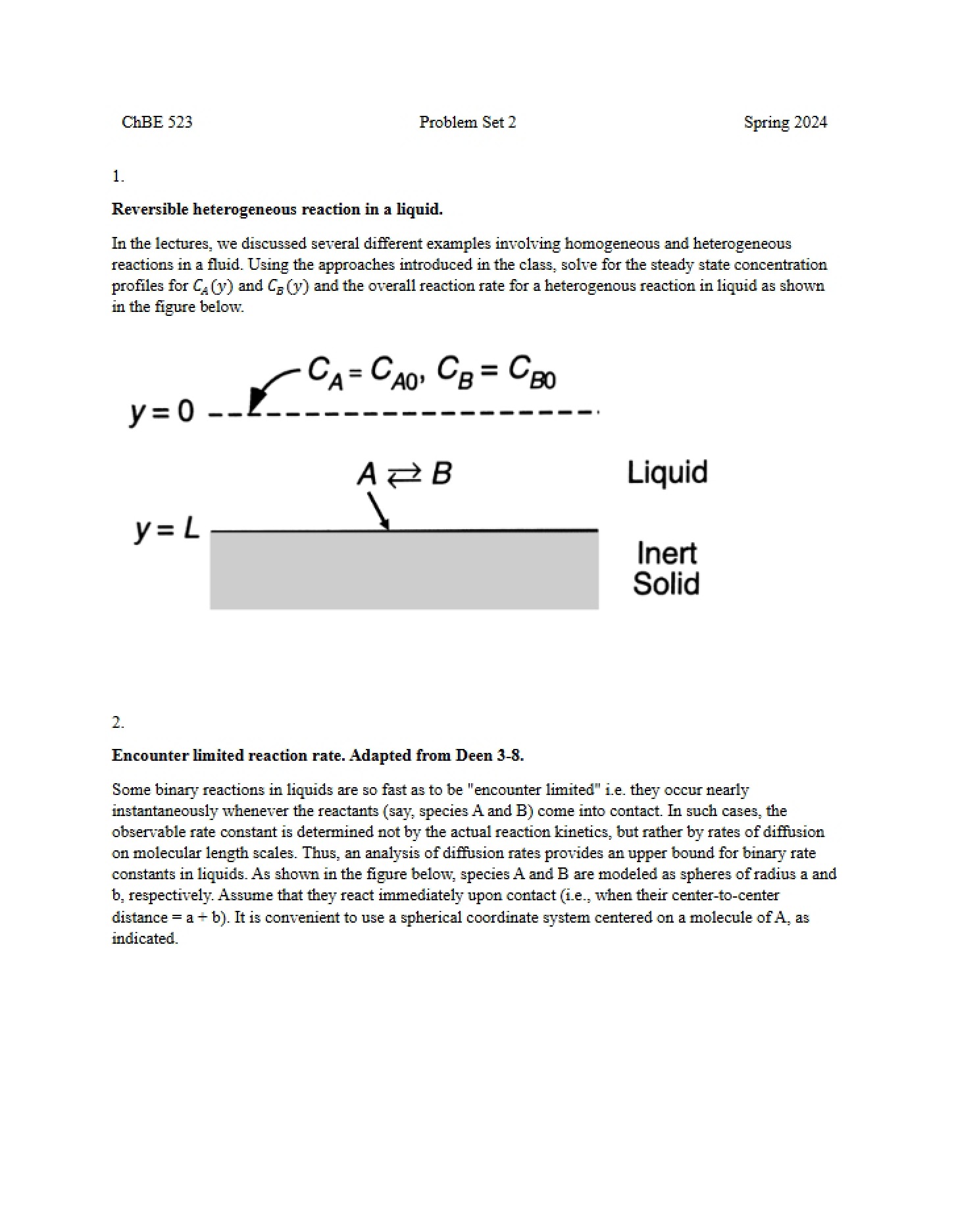
* Modeling of reaction within liquid films
* Zeroth-Order Reactions and their impact on diffusion
* Determining valid problem formulations for reaction-diffusion scenarios
* Analysis of steady-state concentration profiles
What This Document Provides
* A structured approach to solving transient diffusion problems with chemical reactions.
* Detailed mathematical framework for utilizing the Finite Fourier Transform technique.
* Illustrative examples focusing on reaction within liquid films.
* A comprehensive exploration of the Damkohler number and its significance in these systems.
* A foundation for understanding the limitations and applicability of different modeling approaches.
* Key equations and relationships for analyzing reaction-diffusion processes.