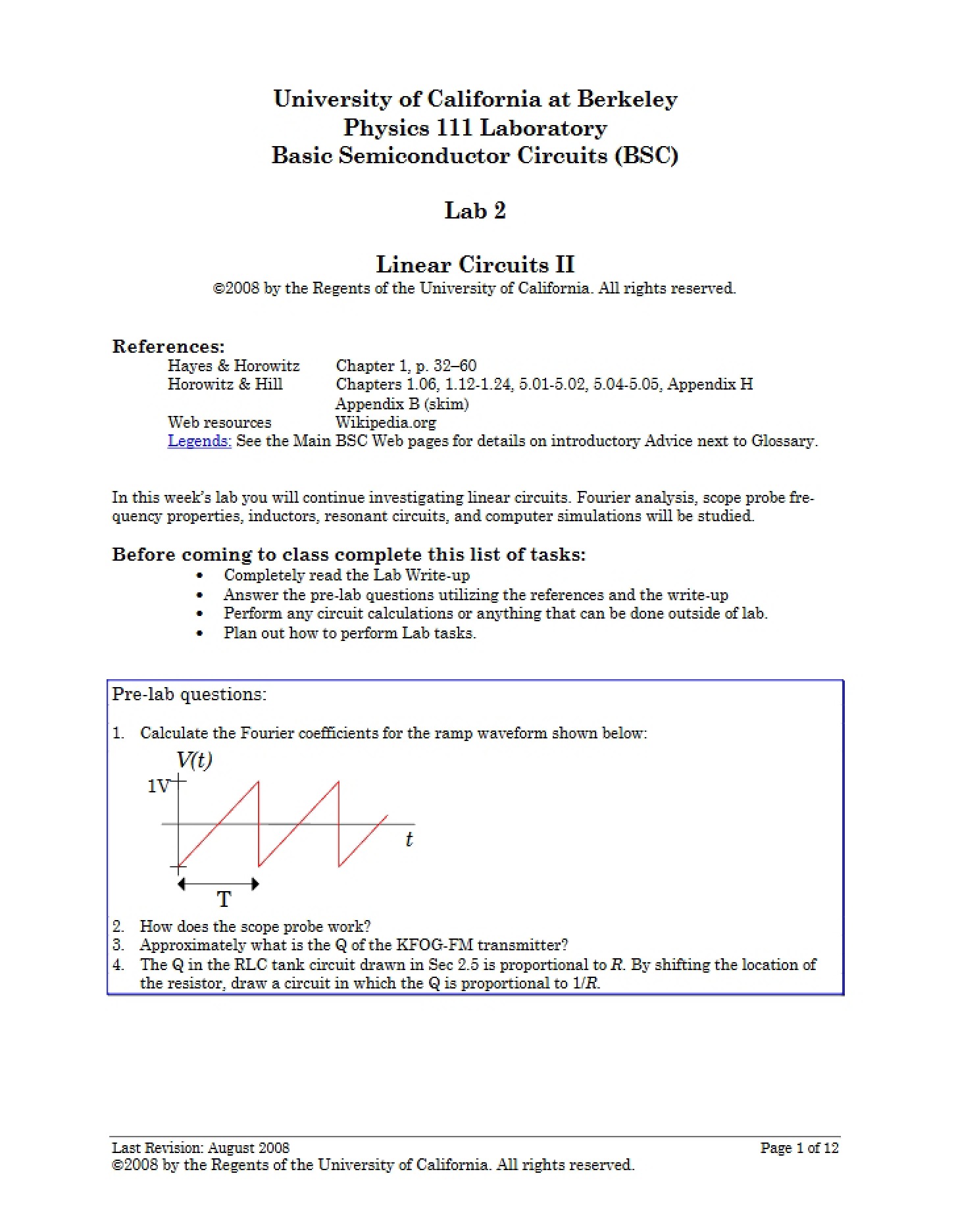
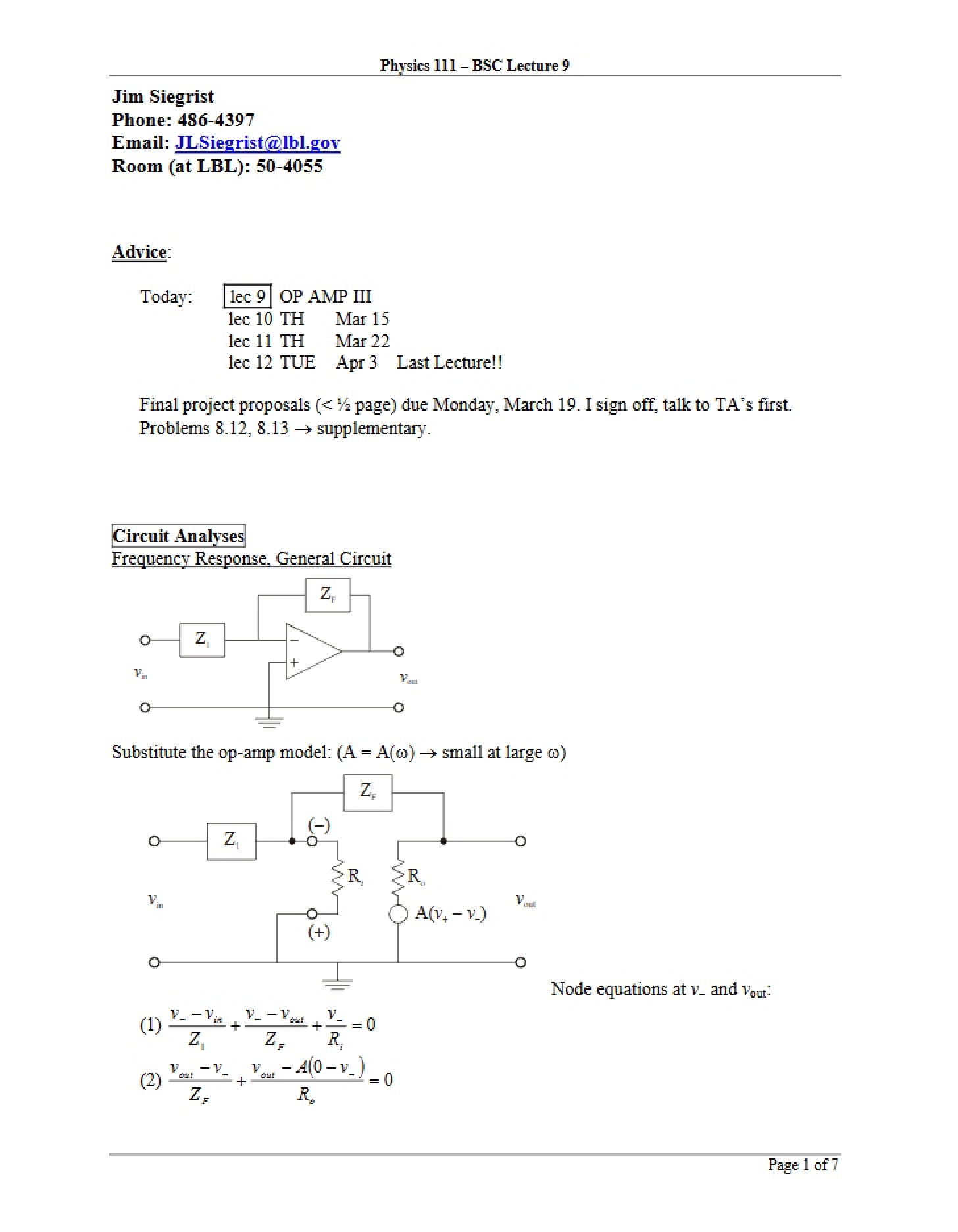
What This Document Is
This document is a detailed laboratory guide for Physics 111 at UC Berkeley, specifically focusing on the practical application of Junction Field-Effect Transistors (JFETs). It’s designed to accompany a hands-on laboratory session exploring fundamental semiconductor circuit principles. This lab write-up provides the theoretical background and preparatory information needed to successfully build and analyze JFET-based circuits. It’s part of a series of labs within the Basic Semiconductor Circuits (BSC) section of the course.
Why This Document Matters
This resource is essential for students enrolled in Modern Physics and Advanced Electrical Laboratory (PHYSICS 111) who are seeking to solidify their understanding of JFETs through practical experimentation. It’s most valuable *before* and *during* the corresponding lab session. Students who carefully review this material will be better prepared to construct circuits, take accurate measurements, and interpret their results. It’s particularly helpful for those needing a bridge between theoretical concepts and real-world circuit implementation.
Topics Covered
* JFET transistor characteristics and operation
* Comparison of JFETs with other transistor types (BJTs and MOSFETs)
* JFET circuit applications, including switches and current sources
* Load line analysis for JFET circuits
* The concept of transconductance and its impact on circuit performance
* Proper JFET biasing techniques to avoid damage
What This Document Provides
* Detailed background information on JFETs and their underlying physics.
* A list of pre-lab tasks designed to ensure preparedness for the experiment.
* Pre-lab questions to test understanding of key concepts.
* References to relevant textbook chapters for further study.
* Important safety precautions regarding JFET operation and potential damage.
* A structured approach to building and analyzing specific JFET circuits.