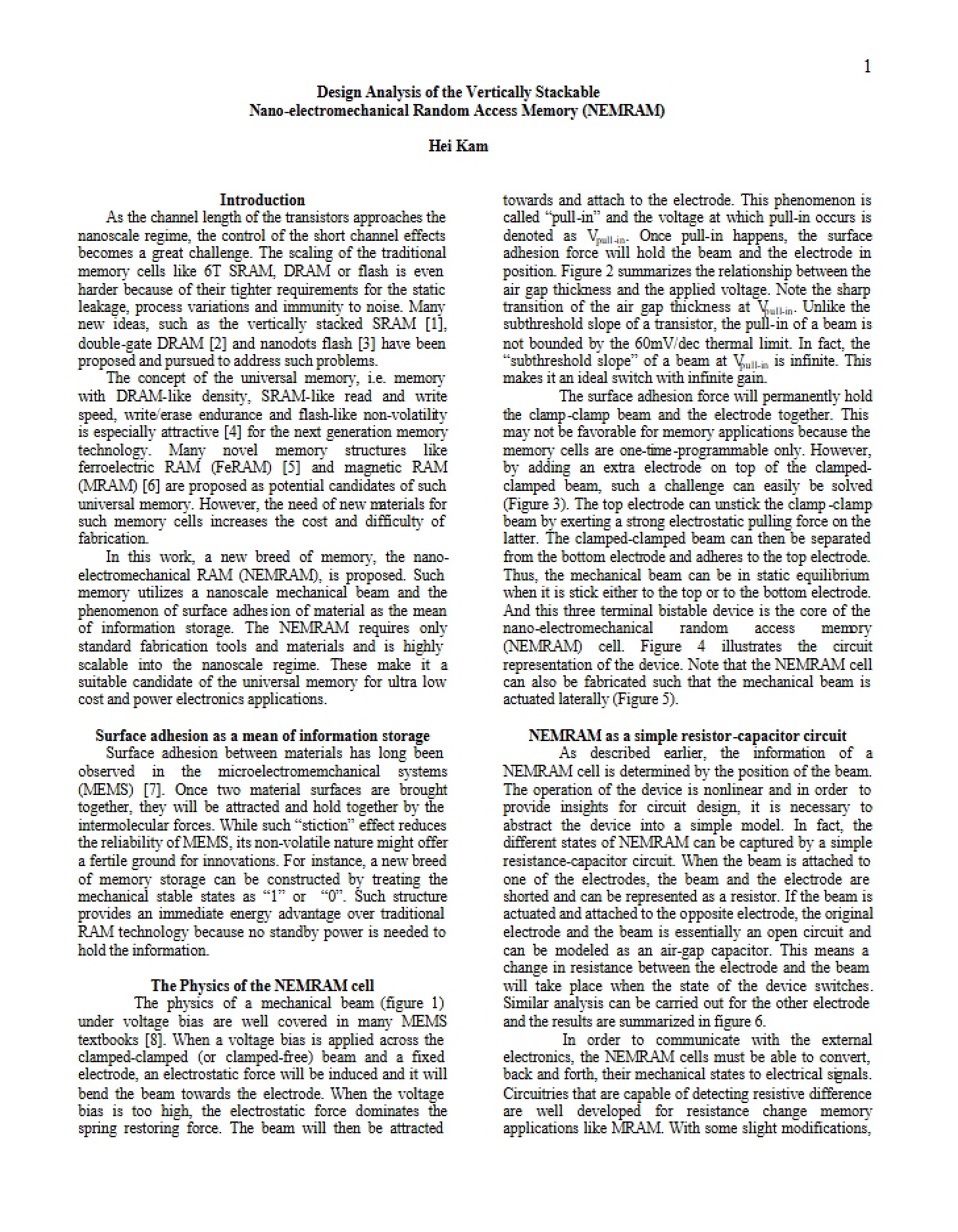
What This Document Is
This document presents a detailed exploration of Field-Programmable Gate Array (FPGA) architecture, with a specific focus on a novel approach utilizing Multiple Drain Transistor (MDT) technology. It’s a technical paper originating from research at the University of California, Berkeley, delving into the design and potential advantages of this innovative device structure for reconfigurable circuits. The work investigates how MDTs can be leveraged to improve density and efficiency in both the programmable logic blocks and the routing fabric within FPGAs.
Why This Document Matters
This resource is invaluable for students and engineers specializing in digital integrated circuit design. It’s particularly relevant for those studying advanced FPGA architectures, VLSI design, or emerging semiconductor device technologies. Individuals working on projects involving reconfigurable computing, low-power design, or seeking alternatives to traditional ASIC approaches will find this a useful reference. It’s best utilized during coursework focused on FPGA design principles or as background research for related projects.
Topics Covered
* FPGA fundamentals and design challenges
* Switching circuit designs for FPGAs
* The principles and operation of Multiple Drain Transistors (MDTs)
* MDT application in multiplexer and memory element design
* Comparison of MDT-based circuits with existing FPGA architectures
* Analysis of area, performance, and design flexibility trade-offs
* Non-volatile memory concepts and sidewall charge storage
What This Document Provides
* A comprehensive overview of the current state of FPGA design.
* Detailed explanation of the MDT device structure and its operational mechanisms.
* A review of existing switching circuit and programmable block designs.
* An exploration of the potential benefits of MDT technology in enhancing FPGA density and performance.
* A framework for evaluating the cost-effectiveness of MDT-based FPGA implementations.
* Technical specifications and diagrams illustrating the MDT’s functionality.