What This Document Is
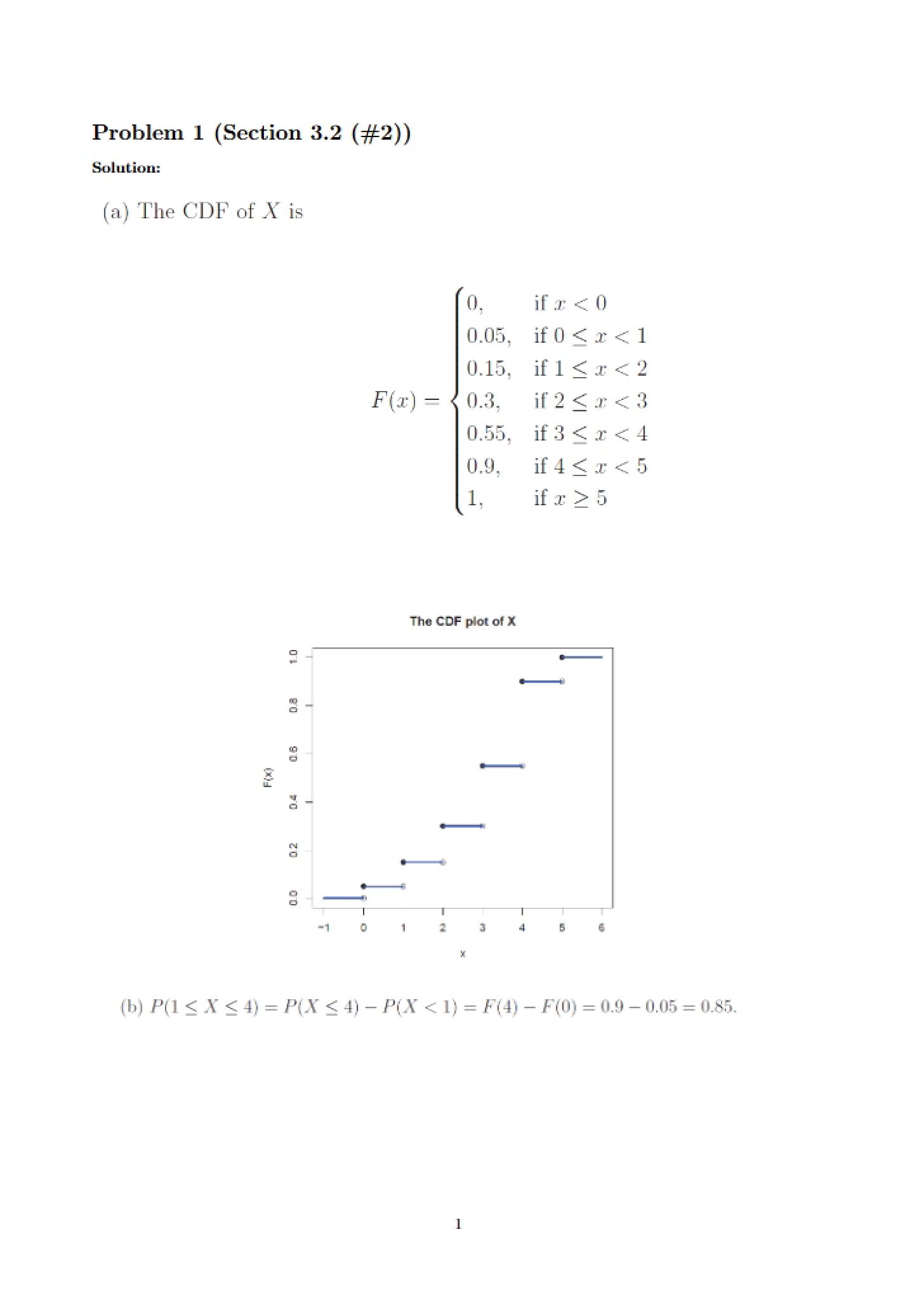
This study guide provides detailed worked solutions to selected problems from Washington University in St. Louis’ MATH 3200 course: Elementary to Intermediate Statistics and Data Analysis. It focuses on core concepts covered in Sections 3.2 and 3.3, dealing with probability distributions – both discrete and continuous – and their associated calculations. The material is presented as a series of problem sets with complete, step-by-step resolutions intended to reinforce understanding of key statistical methods.
Why This Document Matters
This resource is invaluable for students seeking to solidify their grasp of probability and distribution theory. It’s particularly helpful when you’re working through challenging homework assignments, preparing for quizzes or exams, or simply need to see how theoretical concepts translate into practical problem-solving. Students who benefit most will be those actively engaged in applying statistical principles and looking for detailed examples to guide their own work. It’s best used *after* attempting problems independently, as a way to check your approach and identify areas where you may need further review.
Common Limitations or Challenges
This guide does *not* provide a comprehensive overview of all topics covered in MATH 3200. It concentrates specifically on a selection of problems from Sections 3.2 and 3.3. It also doesn’t offer foundational explanations of the underlying statistical principles themselves; it assumes you have already been introduced to these concepts in lectures or through assigned readings. The solutions presented are specific to the problems included and may not directly address every possible variation or application of the techniques.
What This Document Provides
* Detailed solutions for a variety of problems relating to cumulative distribution functions (CDFs).
* Worked examples demonstrating probability calculations involving both continuous and discrete random variables.
* Illustrations of how to verify the validity of probability density functions (PDFs).
* Applications of expected value and variance calculations.
* Solutions involving the use of histograms to visualize probability distributions.
* Examples of finding percentiles and the interquartile range (IQR) for specific distributions.
* Problem resolutions utilizing integration techniques to determine statistical properties.