What This Document Is
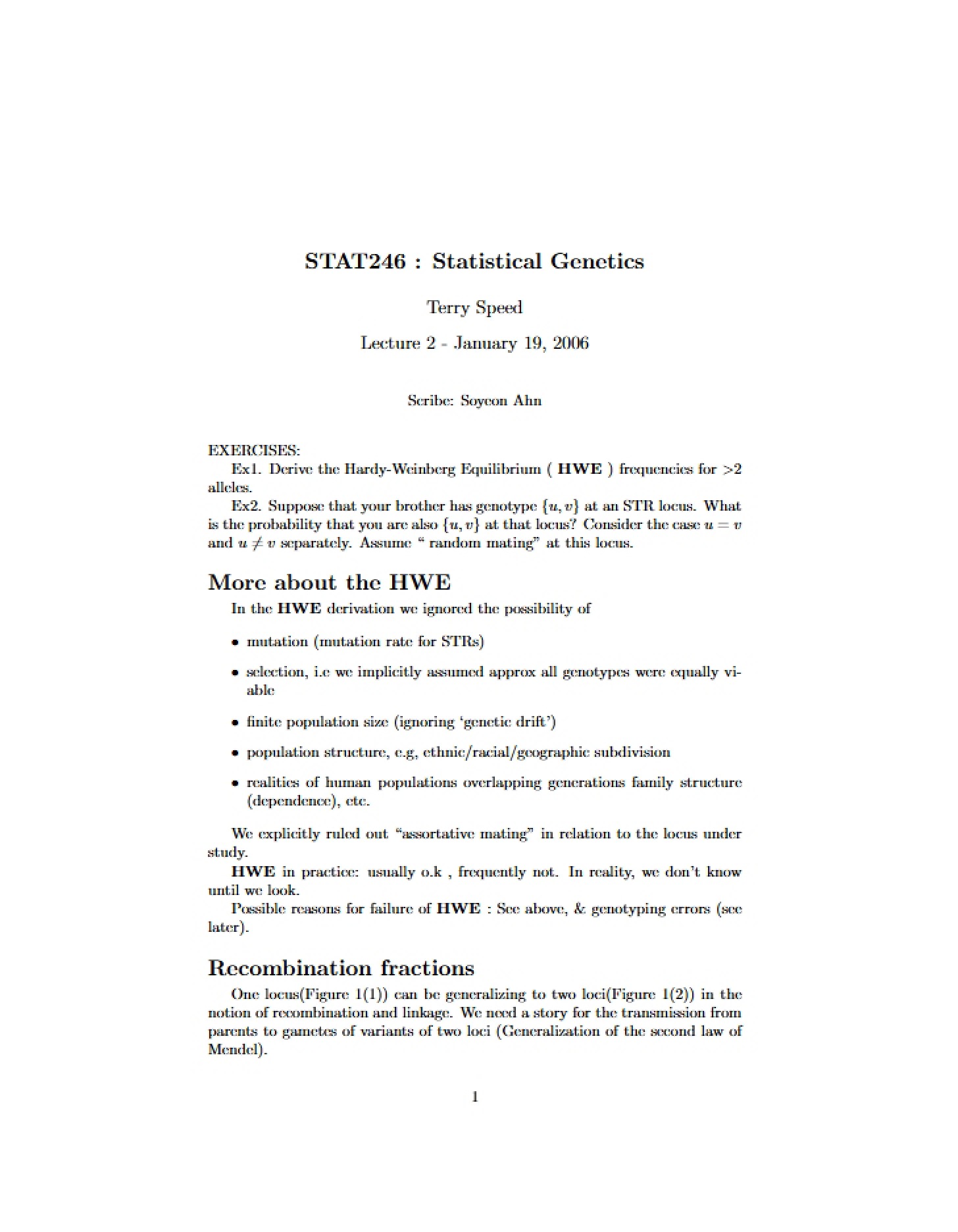
This is a set of lecture notes from Statistics 246, a course in Statistical Genetics at the University of California, Berkeley. It delves into the fundamental relationship between the biological processes of meiosis and recombination, and their mathematical representation as genetic distance and recombination fractions. The material explores how these concepts are used to understand the inheritance of traits and the organization of genomes. It builds a theoretical framework for analyzing genetic data related to chromosome behavior during cell division.
Why This Document Matters
Students enrolled in advanced genetics, genomics, or biostatistics courses will find this resource particularly valuable. It’s also beneficial for researchers working with genetic mapping, quantitative trait loci (QTL) analysis, or population genetics. This material is most helpful when you are seeking a deeper understanding of the underlying principles connecting physical chromosome arrangements with observed patterns of genetic variation. It serves as a strong foundation for more complex analyses and interpretations in the field.
Topics Covered
* The mechanics of meiosis and the role of recombination
* Modeling exchange events during meiosis as a stochastic process
* The concept of genetic distance and its relationship to recombination fractions
* Different models for strand involvement in recombination events (including No Chromatid Interference)
* The relationship between exchange events and observable crossovers
* Determining recombination fractions and their interpretation
* The Poisson model as applied to recombination
What This Document Provides
* A detailed exploration of the processes occurring during meiosis, focusing on recombination.
* A mathematical framework for understanding the relationship between recombination and genetic distance.
* Discussion of key concepts like crossovers, recombinant and non-recombinant individuals.
* A presentation of Mather’s formula and its implications for calculating recombination fractions.
* A foundation for understanding more advanced topics in genetic mapping and analysis.