What This Document Is
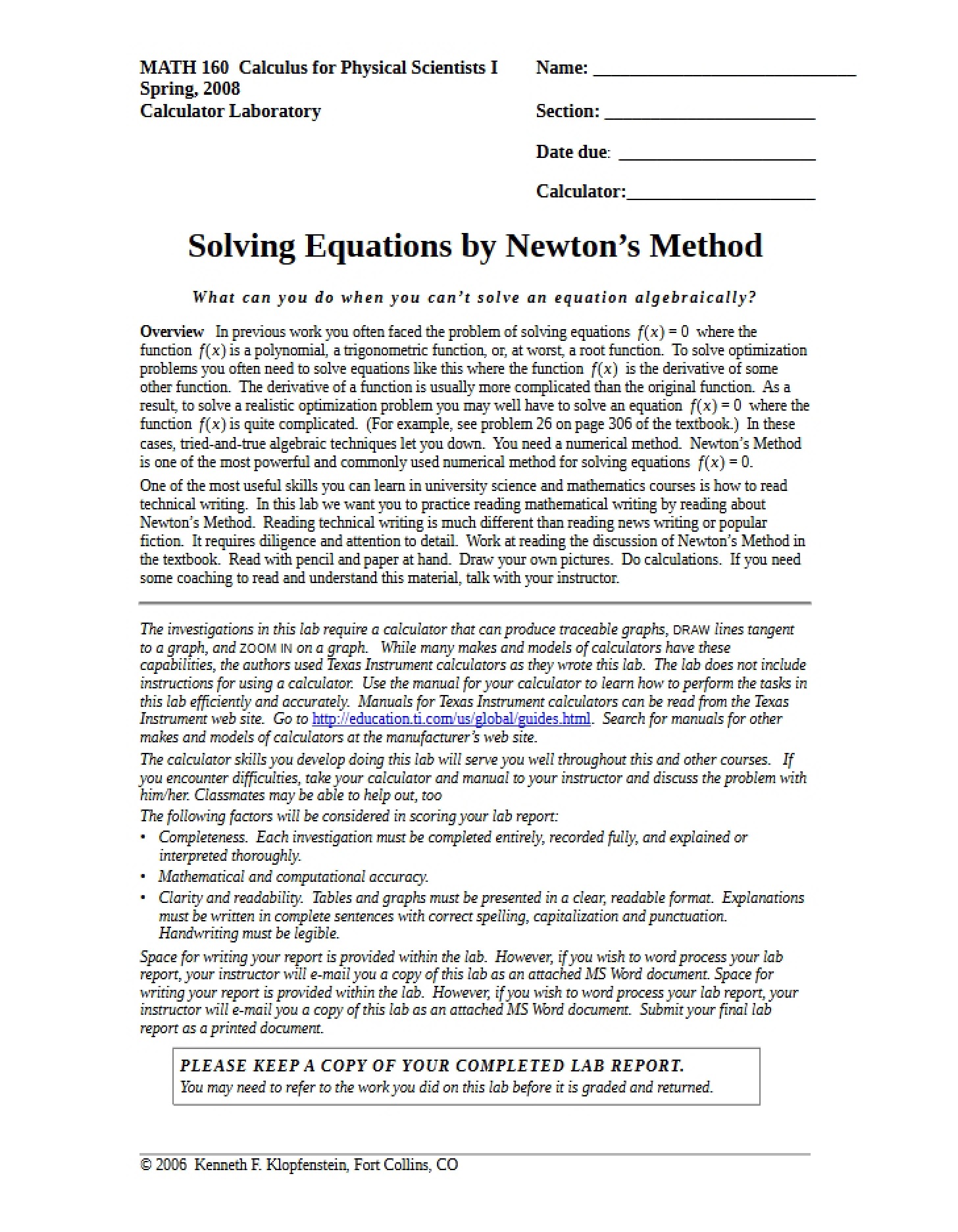
This is a laboratory exercise designed to accompany a Calculus course, specifically geared towards students in physical sciences. It focuses on building a deeper, graphical understanding of differentiation theorems – the rules governing how to find the derivatives of combinations of functions. The material explores the connection between abstract derivative formulas and the concrete visualization of tangent lines to function graphs. It’s intended to be used in conjunction with a graphing calculator capable of generating traceable graphs and tables of values.
Why This Document Matters
This resource is ideal for students enrolled in a first-semester calculus course who want to solidify their understanding of differentiation beyond rote memorization of formulas. It’s particularly beneficial for those who learn best through visual and hands-on exploration. This lab will strengthen your calculator skills while simultaneously reinforcing core calculus concepts, preparing you for more advanced coursework and problem-solving in physics, engineering, and other scientific disciplines. It’s best utilized as a supplemental learning tool alongside lectures and textbook readings.
Topics Covered
* Graphical interpretation of derivatives
* Tangent lines and their relationship to function behavior
* Differentiation rules for sums of functions
* Differentiation rules for products of functions
* Utilizing graphing calculators to explore calculus concepts
* Connecting algebraic formulas to visual representations
What This Document Provides
* A structured laboratory investigation with clear objectives.
* Guidance on utilizing graphing calculator features for calculus applications.
* A framework for discovering differentiation formulas through graphical analysis.
* Considerations for completeness, accuracy, clarity, and readability in lab report submissions.
* A scoring rubric outlining the key elements of a successful lab report.
* Background information on the importance of understanding the link between derivatives and tangent lines.