What This Document Is
This handout provides a focused review of commonly used discrete probability distributions, essential for success in actuarial science and related fields. It’s designed as a companion to lectures on probability models, offering a consolidated reference for key distribution characteristics. This material builds upon foundational probability concepts and prepares students for more advanced modeling techniques.
Why This Document Matters
Students enrolled in actuarial problem-solving courses, particularly those tackling risk assessment and modeling, will find this resource incredibly valuable. It’s best utilized during study sessions, when working through practice problems, or as a quick reference when encountering different distribution types. Actuarial students will frequently encounter these distributions in exams and professional work, making familiarity crucial. Understanding these distributions is also beneficial for anyone applying statistical modeling to discrete data.
Topics Covered
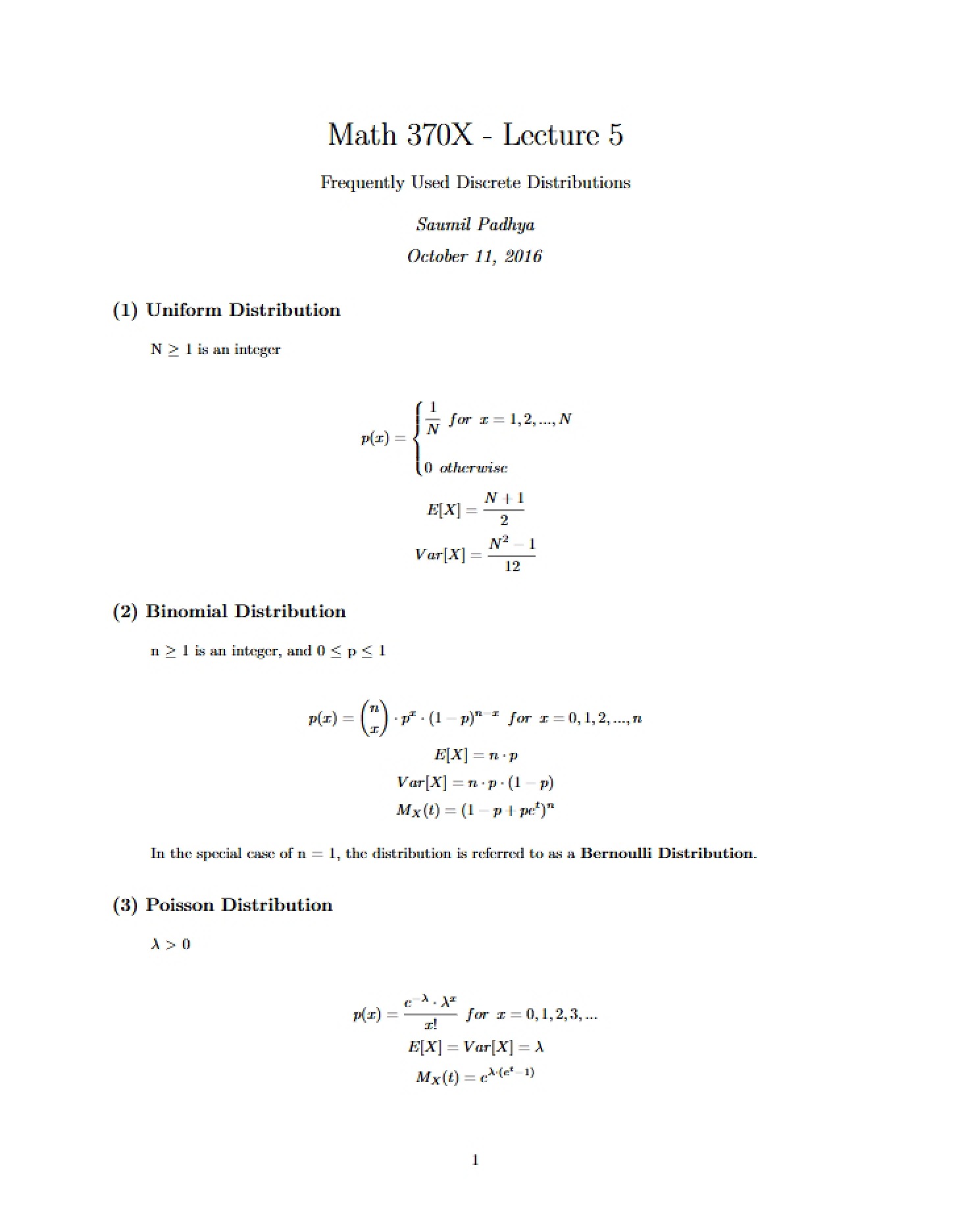
* Uniform Distribution – exploring distributions with equal probabilities.
* Binomial Distribution – modeling the probability of success in a fixed number of trials.
* Poisson Distribution – analyzing the occurrence of events over a continuous interval.
* Geometric Distribution – examining the number of trials needed for a single success.
* Negative Binomial Distribution – extending the geometric distribution to model multiple successes.
* Hypergeometric Distribution – dealing with sampling without replacement.
* Multinomial Distribution – modeling probabilities for multiple outcomes in a single trial.
What This Document Provides
* A concise overview of each distribution’s probability mass function.
* Formulas for calculating expected values and variances for each distribution.
* Representations of the moment generating function for each distribution.
* Connections between related distributions, such as the relationship between the geometric and Bernoulli distributions.
* A structured format for easy comparison and recall of distribution properties.