What This Document Is
This handout provides a focused review of several key continuous probability distributions frequently encountered in actuarial work and statistical analysis. It’s designed as a companion to lectures on probability, specifically building upon the foundational concepts of discrete distributions and transitioning to the nuances of continuous modeling. The material is geared towards students in an upper-level mathematics course focused on problem solving within the actuarial field.
Why This Document Matters
Students enrolled in actuarial science programs, or those taking courses with a strong statistical component, will find this resource particularly valuable. It serves as a concise reference during problem sets, exam preparation, and when applying these distributions to real-world scenarios. Understanding these distributions is crucial for modeling random events and making informed predictions – a core skill for any aspiring actuary. This material is best utilized *after* initial exposure to the concepts in a lecture setting, as it assumes a basic understanding of probability density functions and distribution functions.
Topics Covered
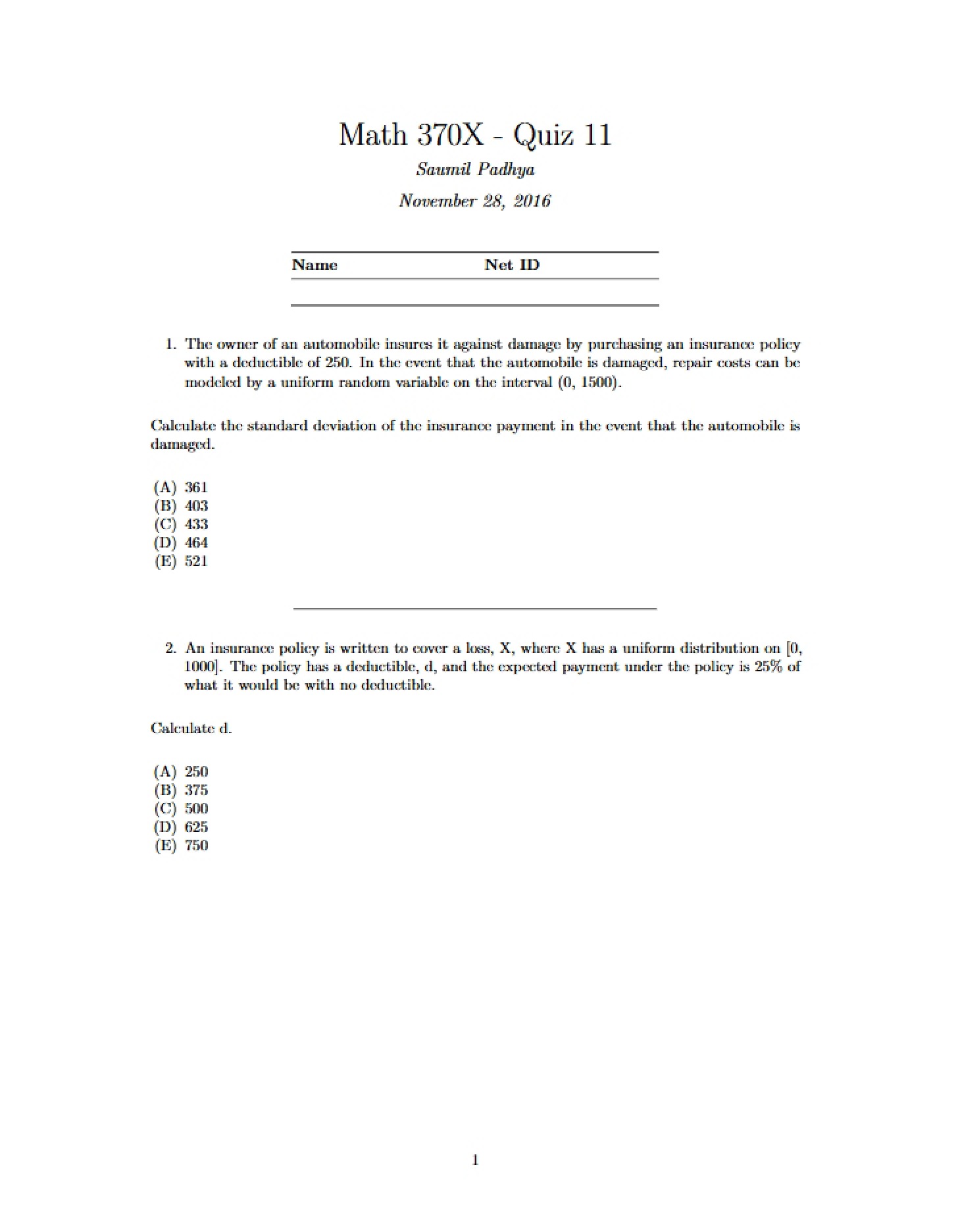
* The Uniform Distribution and its properties
* The Normal Distribution, including its standardized form
* Techniques for utilizing standard normal distribution tables
* Approximating distributions with the Normal Distribution, including correction factors
* The Exponential Distribution and its relationship to the Poisson distribution
* The Gamma Distribution and its connection to the Exponential Distribution
* Key properties and characteristics of each distribution
What This Document Provides
* A clear presentation of the defining features of each distribution.
* Guidance on transforming variables to utilize standard distribution tables.
* Discussion of the conditions under which normal approximation techniques can be applied.
* A reference table for probabilities associated with the standard normal distribution.
* Conceptual links between different distributions, highlighting their relationships and applications.