What This Document Is
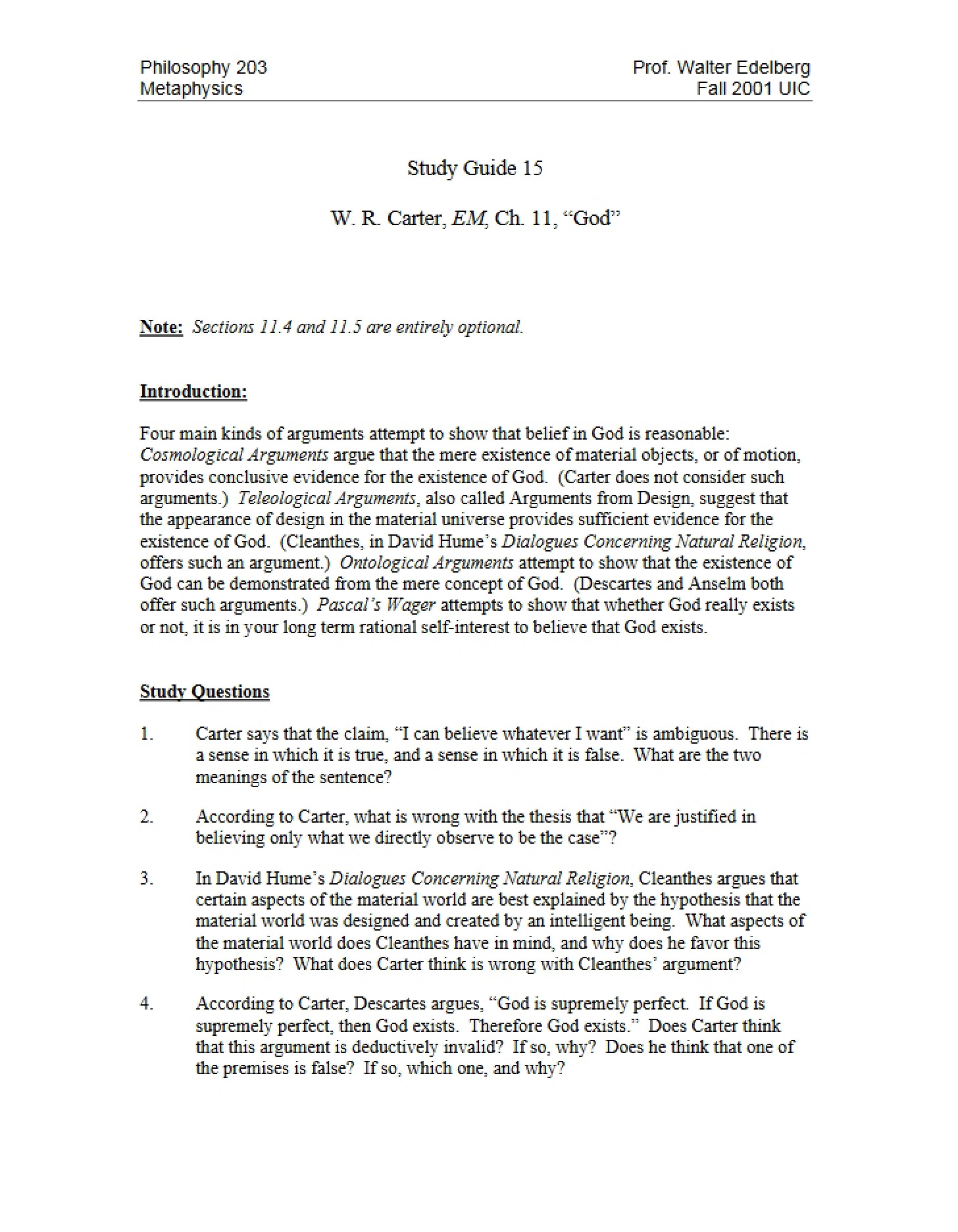
This is a handout from a university-level Metaphysics course (PHIL 203) at the University of Illinois at Chicago, focusing on arguments related to the existence of God. It’s designed to explore different philosophical perspectives on this complex topic, presenting a structured overview of classical and adapted arguments. The handout delves into the historical context of these arguments and their logical structures, offering a foundation for deeper philosophical inquiry.
Why This Document Matters
This resource is particularly valuable for students enrolled in metaphysics, philosophy of religion, or related courses. It’s ideal for use when studying arguments for theism, preparing for class discussions, or formulating your own philosophical positions. It will be most helpful when you are grappling with the fundamental questions of existence and attempting to critically evaluate different lines of reasoning concerning the divine. This handout provides a starting point for independent study and a framework for understanding complex philosophical concepts.
Topics Covered
* Cosmological Arguments and their core principles
* Teleological Arguments (Arguments from Design) and their underlying assumptions
* Ontological Arguments – exploring arguments based on the concept of being
* Pascal’s Wager – a pragmatic approach to belief
* Detailed examination of Saint Anselm’s Ontological Argument
* Logical structure and potential criticisms of philosophical arguments
* The concept of “greatest conceivable being” and its implications
What This Document Provides
* A categorized overview of four major types of arguments for the existence of God.
* A direct excerpt from a foundational philosophical text – Saint Anselm’s *Proslogion*.
* A reconstructed argument inspired by Saint Anselm, presented in a modern logical format.
* Preliminary definitions and premises used in constructing philosophical arguments.
* A framework for analyzing the internal consistency and potential weaknesses of these arguments.