What This Document Is
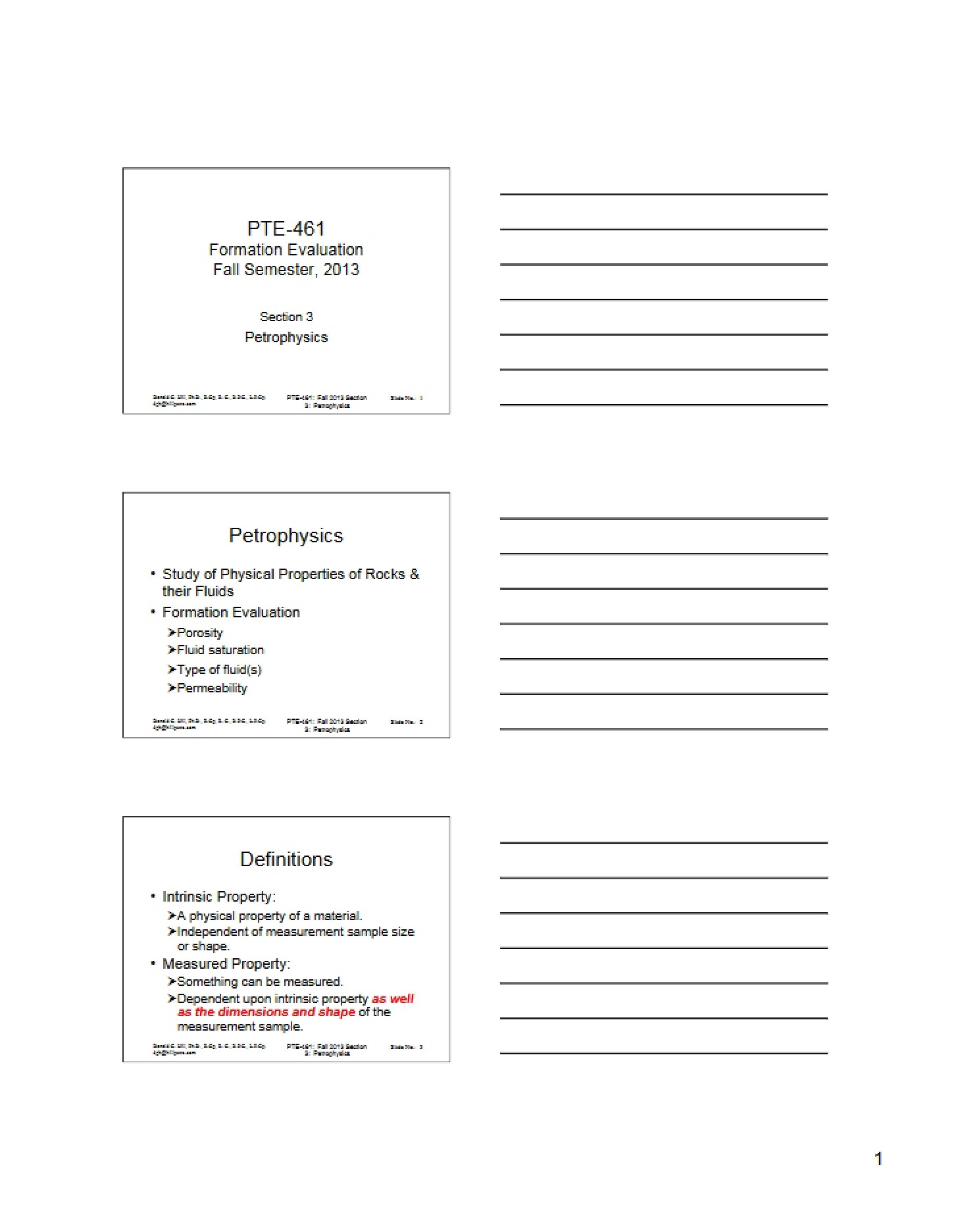
These are lecture handouts from a Formation Evaluation course (PTE 461) at the University of Southern California, specifically focusing on the foundational principles of Petrophysics. Petrophysics is a crucial subdiscipline within petroleum engineering, bridging the gap between geological formations and reservoir performance. This material represents Lecture 2 within the Petrophysics section of the course, providing a concentrated overview of core concepts. It’s designed to supplement in-class lectures and provide a structured resource for understanding the physical properties of rocks and the fluids they contain.
Why This Document Matters
This resource is invaluable for students pursuing degrees in petroleum engineering, geology, or related fields. It’s particularly helpful for anyone needing a solid grounding in the properties that govern fluid flow within subsurface reservoirs. Professionals involved in well logging, reservoir characterization, and production optimization will also find the foundational principles discussed here beneficial for refreshing their understanding. Use this material to prepare for exams, reinforce lecture concepts, or build a strong base for more advanced studies in formation evaluation.
Common Limitations or Challenges
This handout set provides a theoretical framework and definitions. It does *not* include detailed calculations, real-world case studies, or step-by-step instructions for applying these concepts in software or field settings. It also doesn’t cover advanced topics like anisotropic effects or complex fluid behavior. The material is a starting point, and further study and practical application are necessary for complete mastery of the subject. Access to the full document is required for a comprehensive understanding of the concepts presented.
What This Document Provides
* Definitions of key terms related to rock and fluid properties.
* Distinction between intrinsic and measured properties.
* An introduction to the concepts of porosity and permeability, and their significance in formation evaluation.
* An overview of fluid saturation and its calculation.
* Fundamental principles of resistivity and its relationship to fluid content.
* Discussion of bulk density and hydrogen index as rock properties.
* Introduction to acoustic velocity and its role in formation characterization.
* Brief overview of core sampling techniques, including side wall cores and core barrels.