What This Document Is
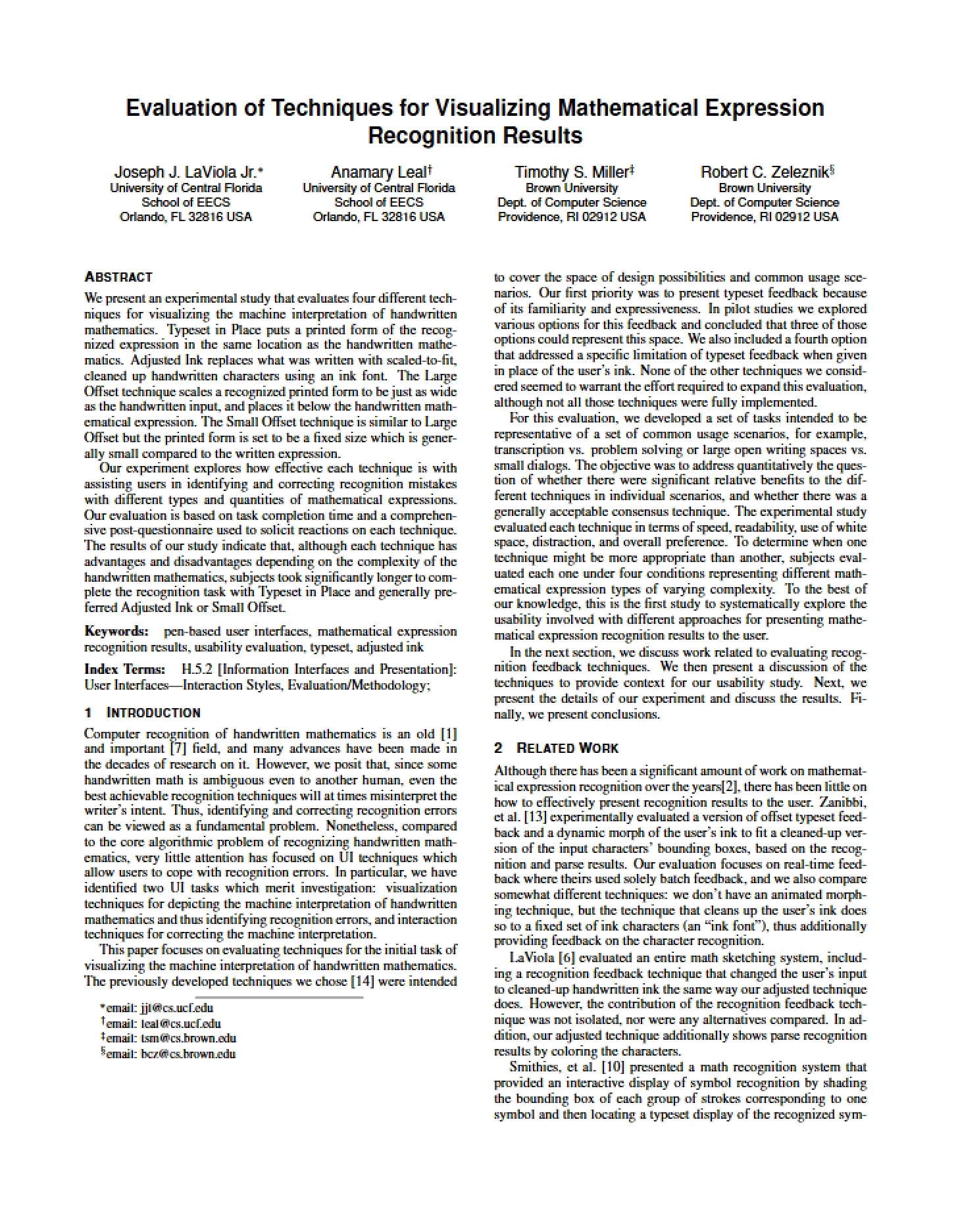
This document represents a comprehensive thesis exploring the field of handwritten mathematical expression recognition. It details research undertaken to develop a system capable of translating handwritten mathematical notation into a digital, typeset format. The work focuses on an “on-line” approach, meaning it processes expressions as they are being written, rather than from static images. It’s a detailed exploration of the challenges and potential solutions within this specialized area of pattern recognition and human-computer interaction.
Why This Document Matters
This resource is invaluable for students and researchers in computer science, electrical engineering, and related fields. Individuals studying pattern recognition, user interface design, or specifically, mathematical software development will find this work particularly relevant. It’s also beneficial for anyone interested in the complexities of bridging the gap between natural human expression and computer interpretation, and understanding the development of intelligent systems. Those seeking a deep dive into the historical context and foundational research of this technology will also benefit.
Topics Covered
* Symbol Classification Techniques
* Algorithms for Expression Partitioning
* Geometric Grammar Parsing
* User Interface Considerations for Error Correction
* Mathematical Typesetting Command Languages (e.g., TEX, MathML)
* On-line Handwriting Recognition Systems
* Pattern Recognition Research Methodologies
* Constrained Search Algorithms
What This Document Provides
* A detailed description of a system designed for handwritten mathematical expression recognition.
* An exploration of the core components required for such a system, including symbol classification, partitioning, and expression conversion.
* Insights into the challenges of accurately interpreting handwritten mathematical notation.
* A discussion of techniques for improving user experience through error feedback and correction mechanisms.
* A thorough investigation of the underlying principles and methodologies used in the research.
* A historical context for the development of this technology.