What This Document Is
This document represents the lecture materials for the first session of EE 230, Optical Fiber Communication, offered at the University of California, Santa Cruz. It’s a foundational overview designed to introduce students to the core principles and practical considerations within this rapidly evolving field. It outlines the course structure, expectations, and a preliminary exploration of the technologies driving modern communication networks. This is a key starting point for anyone embarking on a study of optical fiber systems.
Why This Document Matters
This material is essential for students enrolled in or considering a course on optical fiber communication, as well as professionals seeking a refresher on the fundamentals. It’s particularly valuable at the beginning of a course to understand the scope, grading criteria, and required resources. Individuals preparing for related engineering roles or further study in photonics will also find this a useful introductory resource. Accessing the full content will provide a solid base for understanding more complex concepts later in the course.
Topics Covered
* Historical context and evolution of fiber optic technology
* Fundamental types of optical fibers and their characteristics
* Key phenomena impacting signal quality in fiber optic systems
* Overview of light sources and optical detectors
* Introduction to optical amplifiers and their role in long-distance communication
* Basic networking concepts related to optical fiber systems
* Course logistics, grading breakdown, and required readings
What This Document Provides
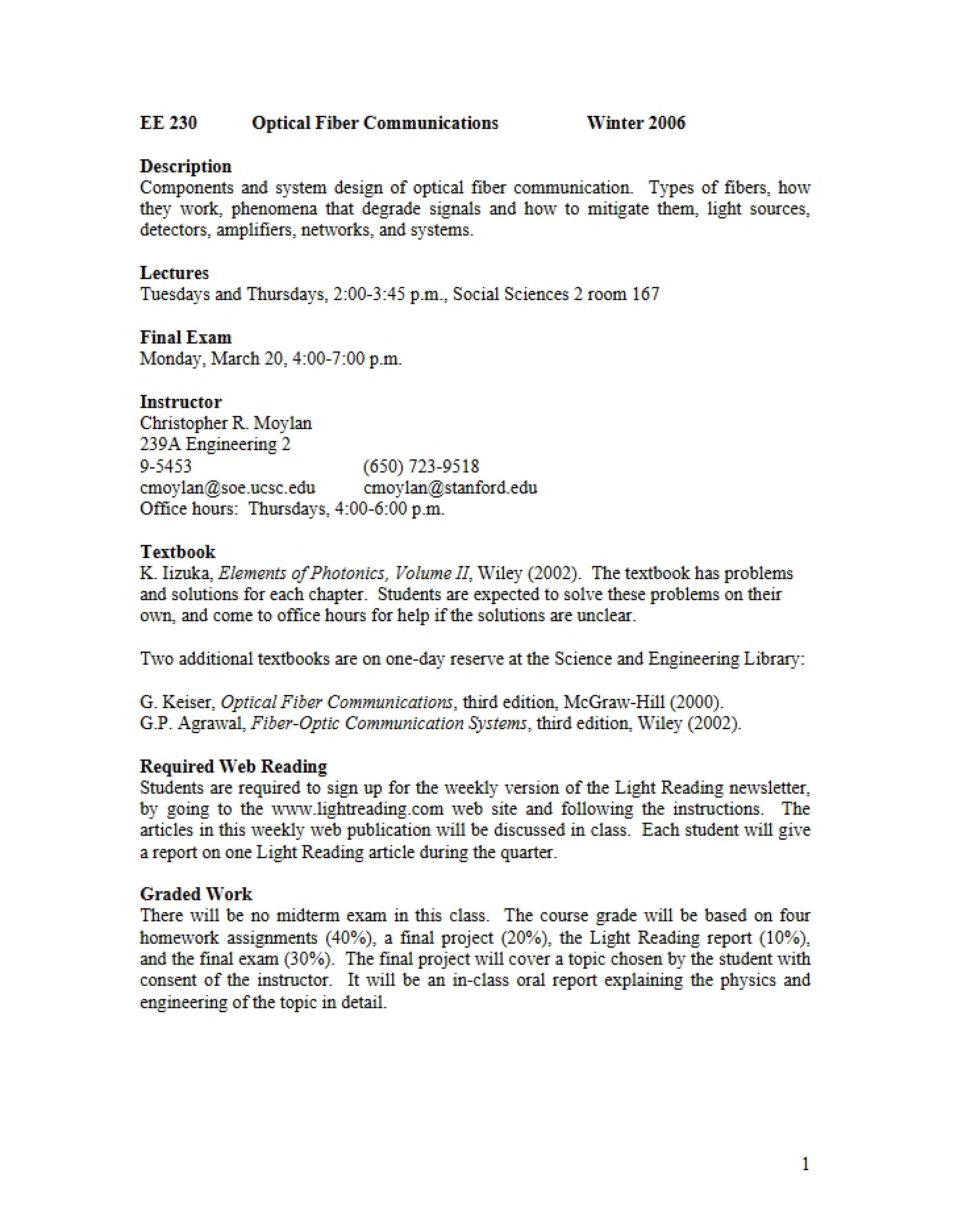
* A detailed course syllabus outlining lecture schedule and topics.
* Information on required textbooks and supplementary reading materials.
* Details regarding graded assignments, including homework, a final project, and a final exam.
* Instructor contact information and office hour availability.
* Initial insights into the relationship between capacity, distance, and technological advancements in optical communication.
* References to external resources like industry newsletters for staying current with the field.