What This Document Is
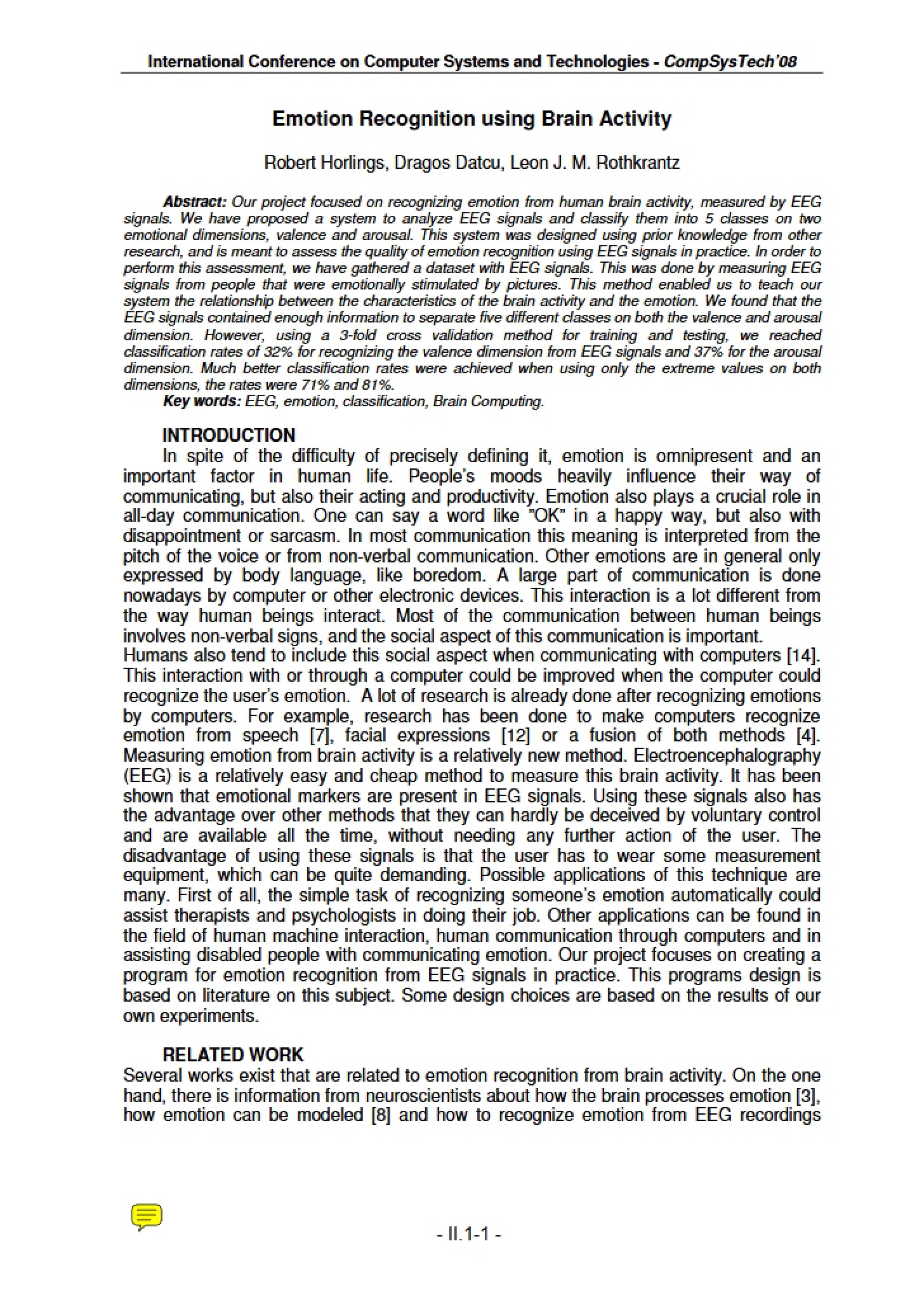
This document presents a research exploration into the application of brain-sensing technologies – specifically, electroencephalography (EEG) – within the field of Human-Computer Interaction (HCI). It details investigations into classifying different types of tasks based on observed brain activity, utilizing a readily accessible and affordable EEG system. The work focuses on understanding how these technologies can be leveraged to interpret user intent and cognitive states. It’s a focused study examining the feasibility and accuracy of task identification through brainwave analysis.
Why This Document Matters
This research is valuable for students and professionals in Computer Science, particularly those specializing in HCI, Brain-Computer Interfaces (BCIs), or related areas. It’s especially relevant for those interested in exploring novel input methods and understanding the cognitive processes underlying human interaction with technology. Researchers looking for insights into low-cost alternatives for brain activity monitoring will find this a useful starting point. It can inform the design of more intuitive and responsive interfaces, and potentially open avenues for assistive technologies.
Topics Covered
* Brain-Computer Interface (BCI) fundamentals
* Electroencephalography (EEG) and its application in HCI research
* Task classification based on brain activity patterns
* Cognitive task analysis (e.g., mental arithmetic, relaxation)
* Experimental design for brain-sensing studies
* The impact of ecological validity on classification accuracy
* Potential applications of low-cost EEG systems
What This Document Provides
* A detailed account of experiments conducted to classify user tasks using EEG.
* Discussion of the challenges and lessons learned when applying brain-sensing technologies in HCI research settings.
* Categorization and subject descriptors relevant to the research area.
* A conceptual framework for understanding the relationship between brain activity and user tasks.
* Keywords to aid in further research and exploration of the topic.
* References to related work in the field of BCIs and neuroscience.