What This Document Is
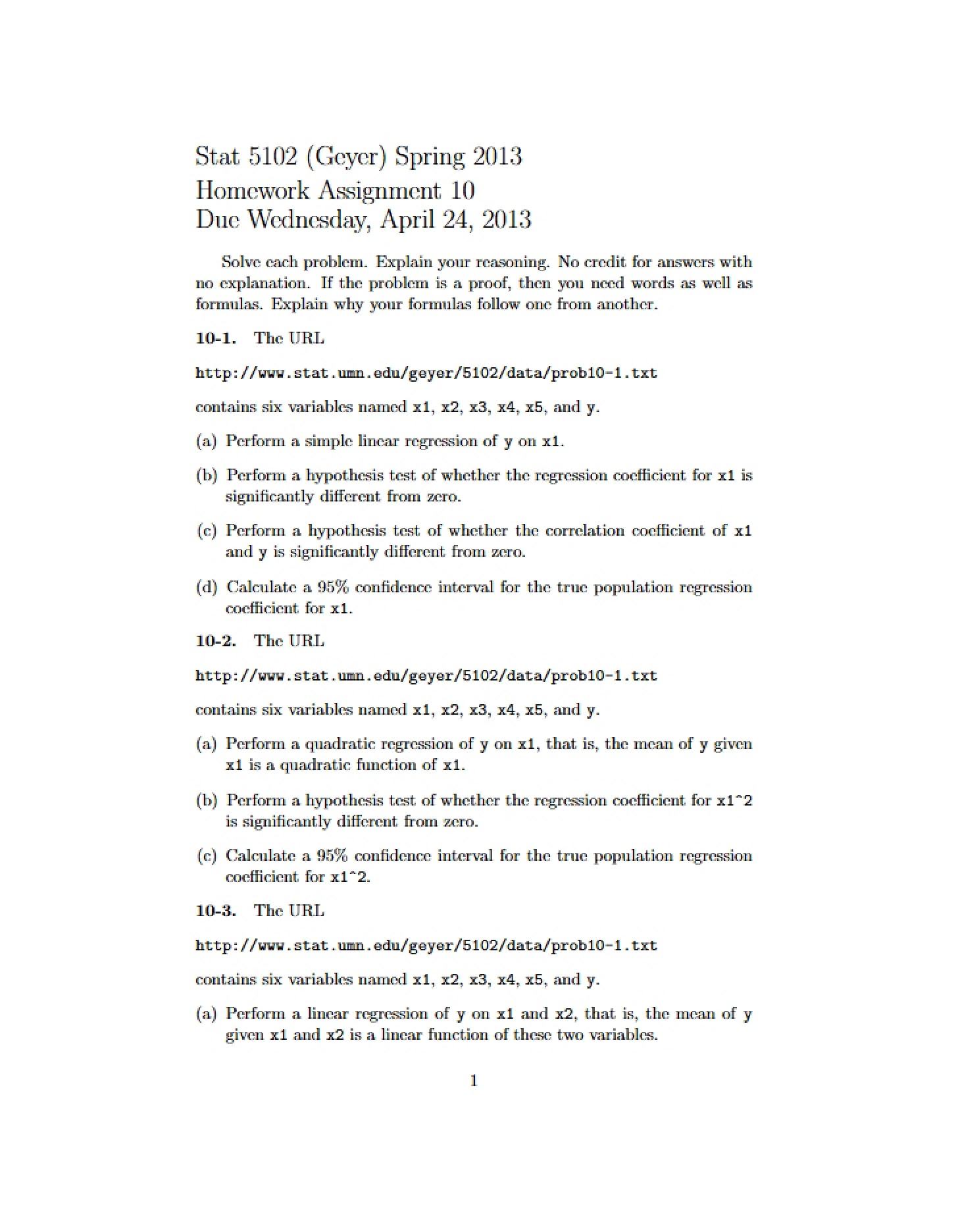
This is a homework assignment for STAT 5102: Theory of Statistics II, offered at the University of Minnesota Twin Cities. It focuses on applying theoretical statistical concepts to problem-solving, requiring students to demonstrate a deep understanding of the course material. The assignment centers around demonstrating proficiency in statistical estimation, consistency, and asymptotic properties of estimators. It builds upon foundational knowledge from prior coursework and lectures.
Why This Document Matters
This assignment is crucial for students enrolled in an advanced theory of statistics course. Successfully completing it demonstrates a grasp of key concepts necessary for further study in statistical inference and modeling. It’s particularly valuable for those pursuing careers in data science, biostatistics, or any field requiring rigorous statistical analysis. Working through these problems will solidify understanding and prepare you for more complex statistical challenges. It’s best utilized *after* thorough review of lecture notes and relevant textbook sections.
Common Limitations or Challenges
This assignment does not provide step-by-step solutions or worked examples. It is designed to test your independent problem-solving abilities and requires you to apply the principles learned in class. The assignment assumes a strong foundation in probability theory, statistical distributions, and methods of estimation. It also doesn’t offer explanations of the underlying statistical concepts themselves – those are assumed to be understood from course instruction.
What This Document Provides
* A series of problems focused on statistical estimation theory.
* Exercises involving properties of estimators like bias, mean squared error, consistency, and asymptotic normality.
* Problems requiring the application of method of moments estimation.
* Questions relating to scale families of distributions.
* Practice applying theoretical concepts to specific distributions like the Gamma, Binomial, Geometric, and Beta distributions.
* Review problems based on previous test material.
* Opportunities to work with empirical distributions and quantiles.
* Problems involving the asymptotic distribution of sample statistics.