What This Document Is
This is a homework assignment for ECE 559, a graduate-level Topics in Communications course at the University of Illinois at Urbana-Champaign. It presents a series of analytical problems designed to test understanding of core concepts in wireless communication and signal processing. The assignment focuses on applying theoretical knowledge to practical scenarios involving signal detection and combining techniques. It requires students to demonstrate proficiency in probability, statistical signal processing, and communication systems analysis.
Why This Document Matters
This assignment is crucial for students enrolled in ECE 559 seeking to solidify their grasp of advanced communication principles. It’s particularly valuable for those preparing for careers in wireless communications, signal processing, or related fields. Working through these problems will build a strong foundation for more advanced coursework and research. It’s best utilized after reviewing relevant lecture materials and textbook chapters on diversity combining, detection theory, and fading channels. Successfully completing this assignment demonstrates a deep understanding of the subject matter.
Topics Covered
* Maximal-Ratio Combining (MRC) in coherent detection systems
* Equal Gain Combining (EGC) and its performance analysis
* Diversity combining with non-coherent detection in fading channels
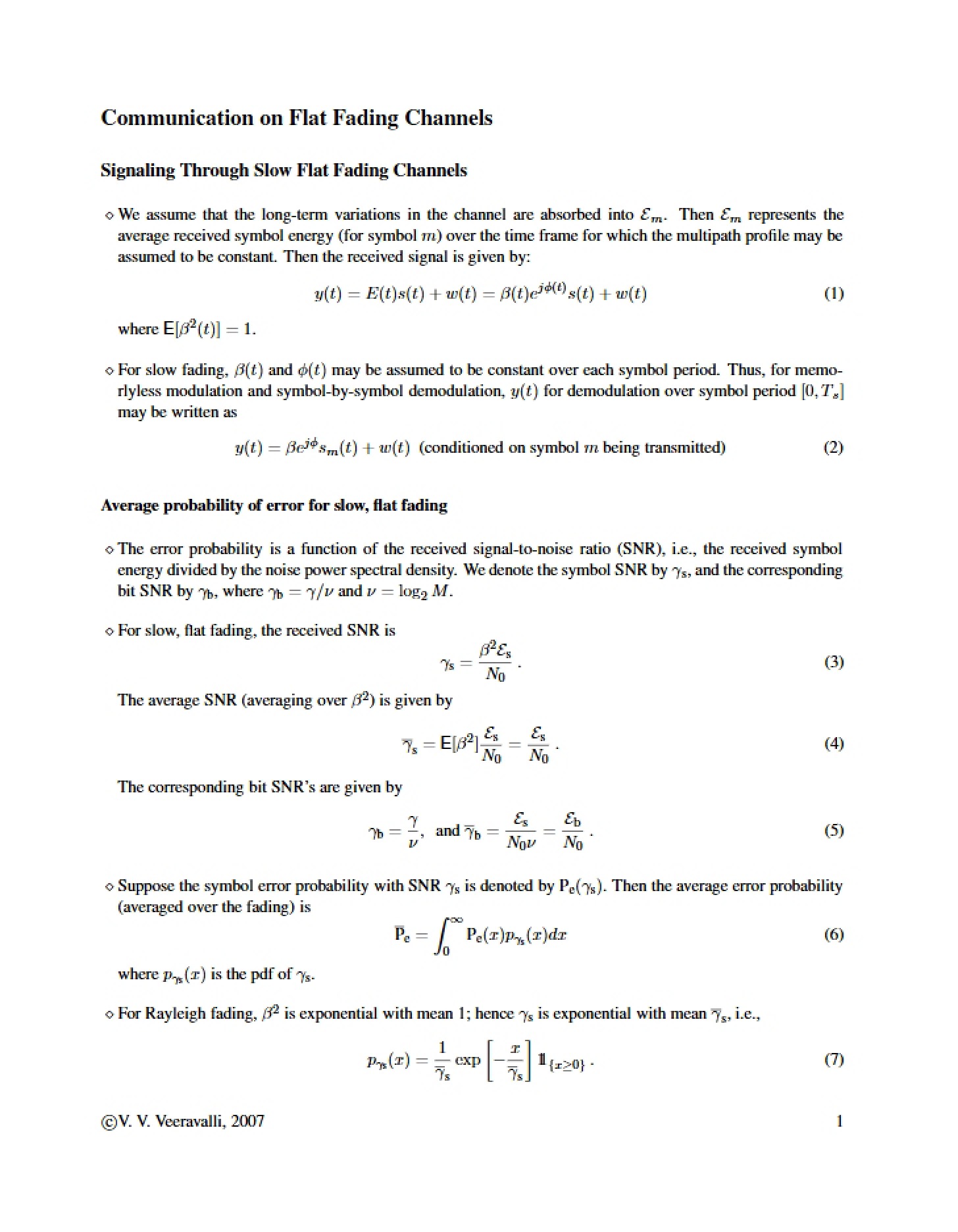
* Bit Error Rate (BER) analysis for BPSK signaling over Rayleigh fading channels
* Performance bounds with perfect interleaving and hard/soft decision decoding
* Application of the Cauchy-Schwarz inequality in communication systems
What This Document Provides
* A set of challenging problems requiring analytical derivations and performance evaluations.
* Detailed problem statements outlining specific system models and assumptions.
* Opportunities to apply theoretical concepts to practical communication scenarios.
* A framework for analyzing the impact of fading channels on system performance.
* Exercises designed to enhance problem-solving skills in communication theory.