What This Document Is
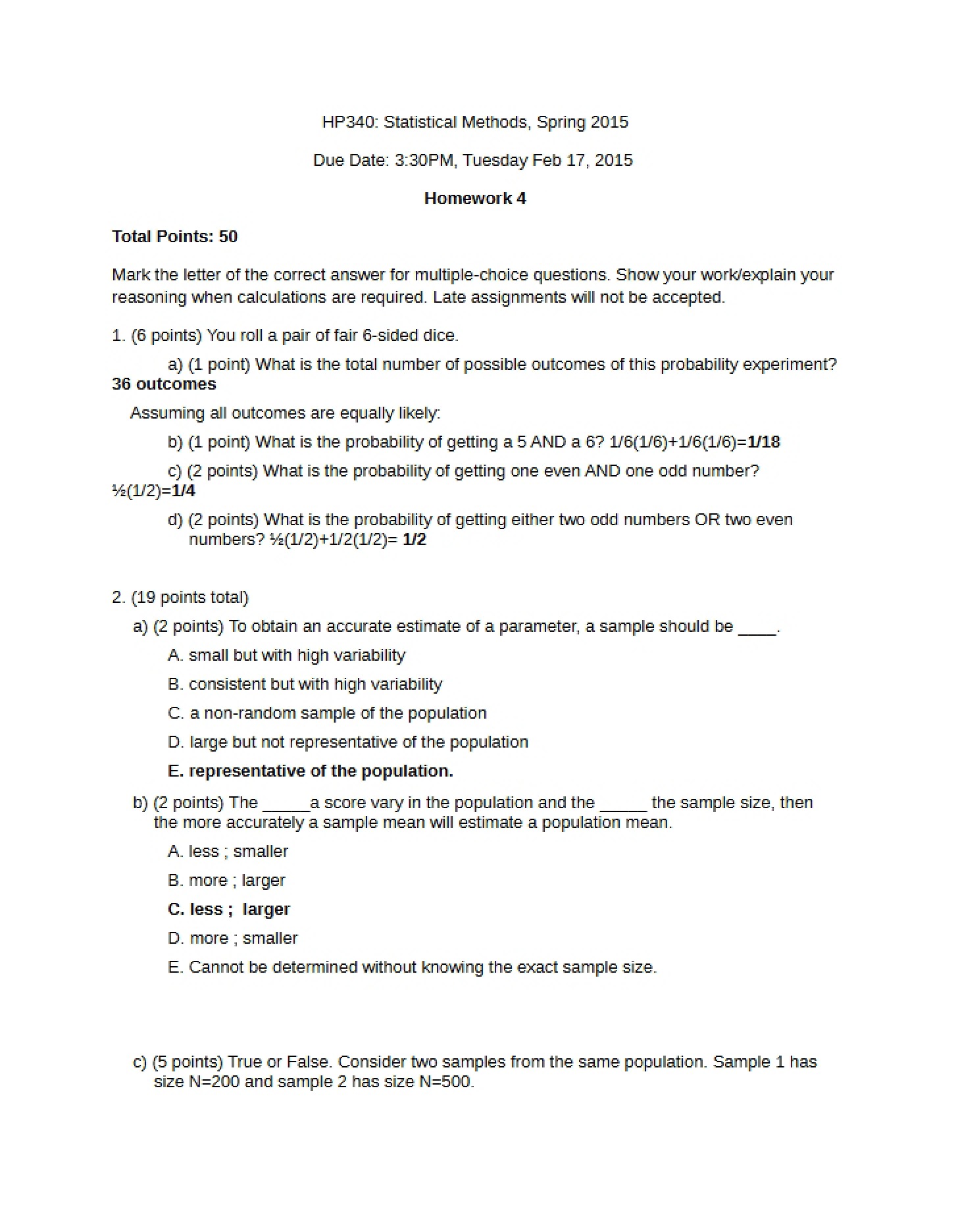
This is a homework assignment for HP 340: Health Behavior Statistical Methods, offered at the University of Southern California. It focuses on applying statistical hypothesis testing principles to health-related scenarios. The assignment challenges students to demonstrate their understanding of core concepts related to t-tests and interpreting statistical results. It’s designed to be completed individually and requires showing detailed work and reasoning behind calculations.
Why This Document Matters
This assignment is crucial for students enrolled in HP 340, or similar courses covering biostatistics or statistical methods for public health. It’s particularly beneficial for those preparing for careers involving data analysis in health-related fields. Successfully completing this assignment will reinforce your ability to translate theoretical statistical knowledge into practical application, a skill essential for research, program evaluation, and informed decision-making. It’s best utilized *after* thorough review of lecture materials and textbook readings on hypothesis testing, p-values, and confidence intervals.
Common Limitations or Challenges
This assignment does not provide a step-by-step tutorial on *how* to perform the calculations. It assumes a foundational understanding of statistical formulas and procedures. It also doesn’t offer pre-solved examples; the intention is for students to independently apply their knowledge to new problems. Access to statistical software or tables is not included and is the student’s responsibility. The assignment focuses on interpretation and application, not on teaching the fundamental calculations themselves.
What This Document Provides
* Problem sets requiring application of one-sample and two-sample t-tests.
* Scenarios involving interpreting the results of hypothesis tests (True/False/Can't be determined questions).
* Opportunities to practice relating statistical concepts like Type I and Type II errors to real-world research.
* A health-focused context – specifically, investigating dietary cholesterol and blood cholesterol levels.
* A practical exercise in formulating conclusions based on statistical findings.
* Clear point values for each question, indicating the relative weight of different concepts.