What This Document Is
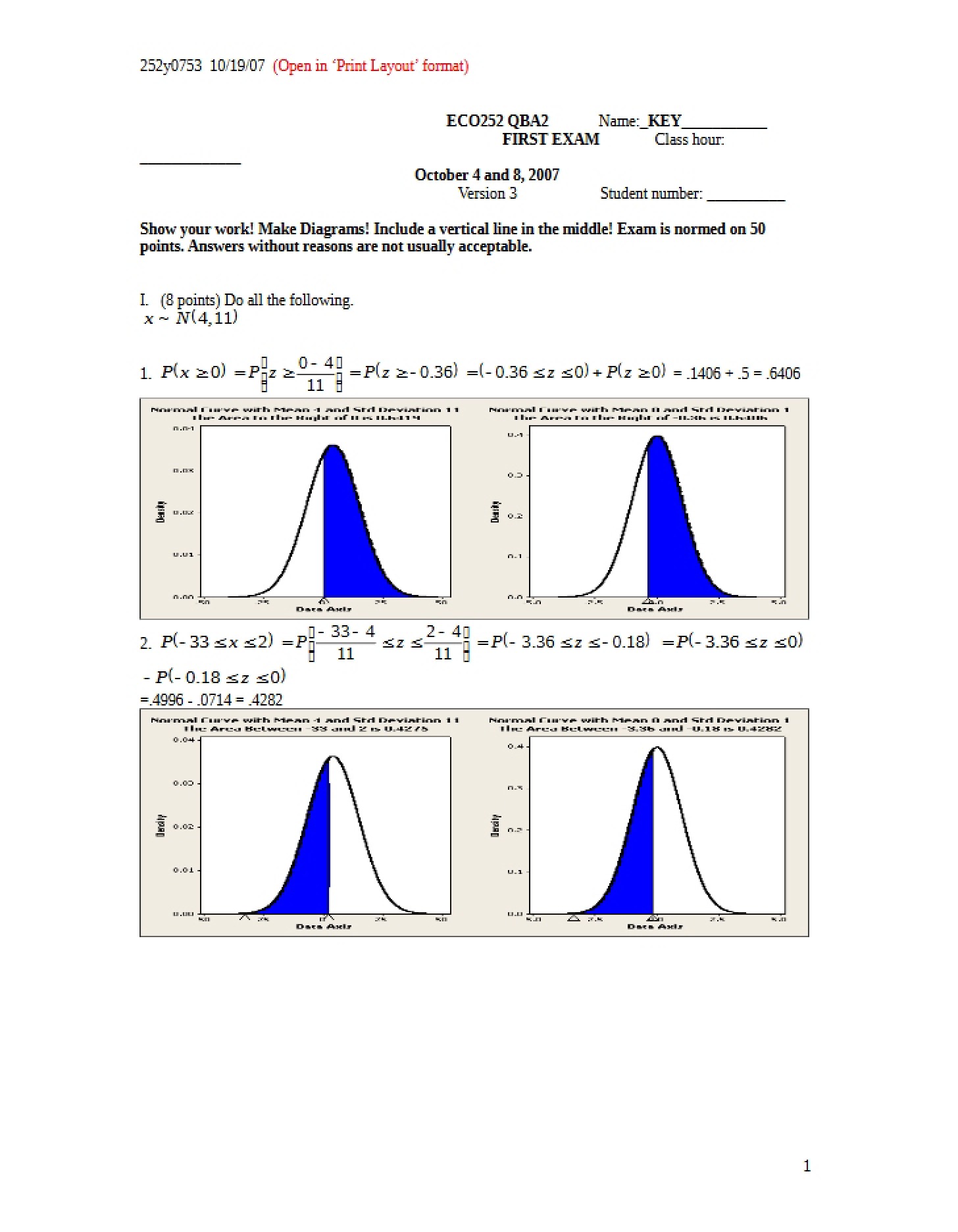
This is a take-home and in-class hour exam for ECO 252: Quantitative Business Analysis II, offered at West Chester University of Pennsylvania. It assesses your understanding of statistical concepts and their application to business scenarios, building upon the principles covered in the course. The exam focuses on applying statistical methods to analyze data and draw meaningful conclusions.
Why This Document Matters
This exam is crucial for students enrolled in ECO 252 seeking to evaluate their grasp of key course material. It’s designed to test your ability to perform statistical analysis, interpret results, and make informed business decisions based on data. Working through practice problems similar to those found within will help solidify your understanding before a high-stakes assessment. It’s particularly useful for students who benefit from applying theoretical knowledge to practical examples. This resource is best utilized during your study phase, after reviewing lecture notes and assigned readings.
Common Limitations or Challenges
Please note that this document *only* contains the exam itself. It does not include worked-out solutions, explanations of concepts, or supplementary learning materials. Access to the full document is required to view the complete questions and demonstrate your understanding. This exam assumes prior knowledge of statistical techniques and formulas covered in ECO 252. It will not re-teach foundational concepts.
What This Document Provides
* A series of problems requiring statistical hypothesis testing.
* Data sets related to business scenarios, such as cereal sales and advertising expenditures.
* Opportunities to apply regression analysis and ANOVA techniques.
* Questions involving variance analysis and Levene’s Test.
* Problems designed to assess understanding of statistical significance and interpretation of results.
* A section requiring the completion of ANOVA tables and F-tests.
* Challenges involving potential modifications to analysis based on data structure (store-level vs. individual data points) and distributional assumptions.