What This Document Is
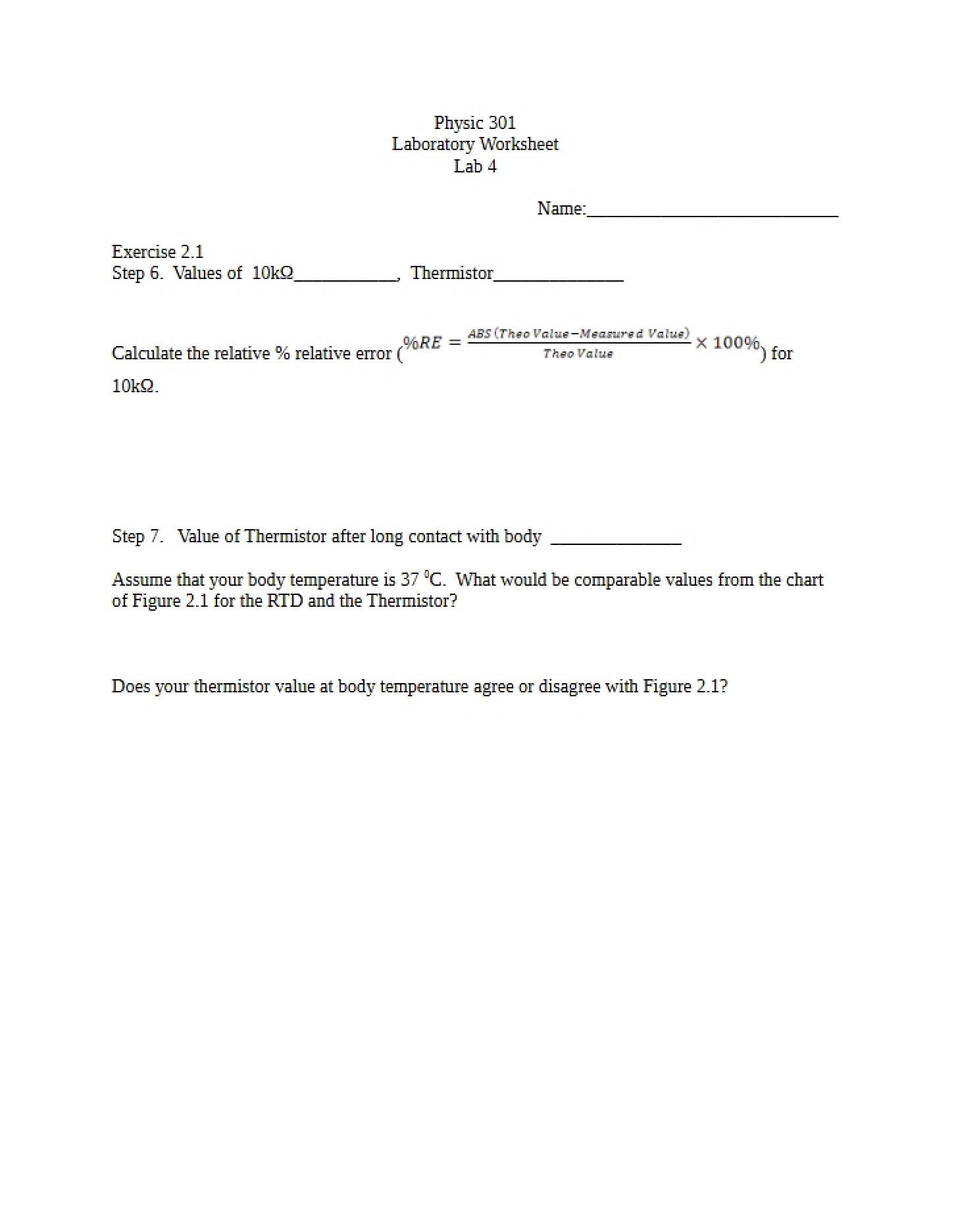
This is a laboratory worksheet designed for a third-level physics course focusing on electrical measurements. Specifically, it’s tailored for Lab Six within the PHYS 301 curriculum at Western Kentucky University. The worksheet guides students through a series of practical exercises centered around AC circuits, impedance, and signal analysis. It requires hands-on work with laboratory equipment and data analysis using software like LabVIEW. The core focus appears to be on reinforcing theoretical concepts through experimental verification and practical application.
Why This Document Matters
This worksheet is essential for students currently enrolled in Lab Electrical Measurements (PHYS 301) at Western Kentucky University. It serves as a structured record of experimental procedures and findings. Completing this assignment accurately demonstrates a student’s ability to apply theoretical knowledge to real-world electrical circuits, interpret experimental data, and draw meaningful conclusions. It’s particularly valuable when preparing for assessments and building a strong foundation for more advanced coursework in electrical engineering or physics. Students will benefit from working through this lab to solidify their understanding of circuit behavior under alternating current conditions.
Common Limitations or Challenges
This worksheet does *not* provide foundational explanations of electrical circuit theory. It assumes students already possess a working knowledge of concepts like impedance, reactance, phase shifts, and decibels. It also doesn’t include detailed step-by-step instructions on *how* to use the LabVIEW software; familiarity with the software interface is expected. The worksheet focuses on the application of these concepts within a lab setting, not on teaching the underlying principles. Access to the completed worksheet will not substitute for active participation in the lab session itself.
What This Document Provides
* Structured exercises relating to AC circuit analysis.
* Sections dedicated to investigating resistor-capacitor (RC) circuits.
* Opportunities to analyze frequency response and phase relationships.
* Tables for recording experimental data and observations.
* Space for graphical representation and mathematical analysis of results.
* A challenge question prompting deeper investigation into gain and phase characteristics.
* A section requiring the definition and application of decibel measurements.
* Guidance for data collection and plotting using logarithmic scales.