What This Document Is
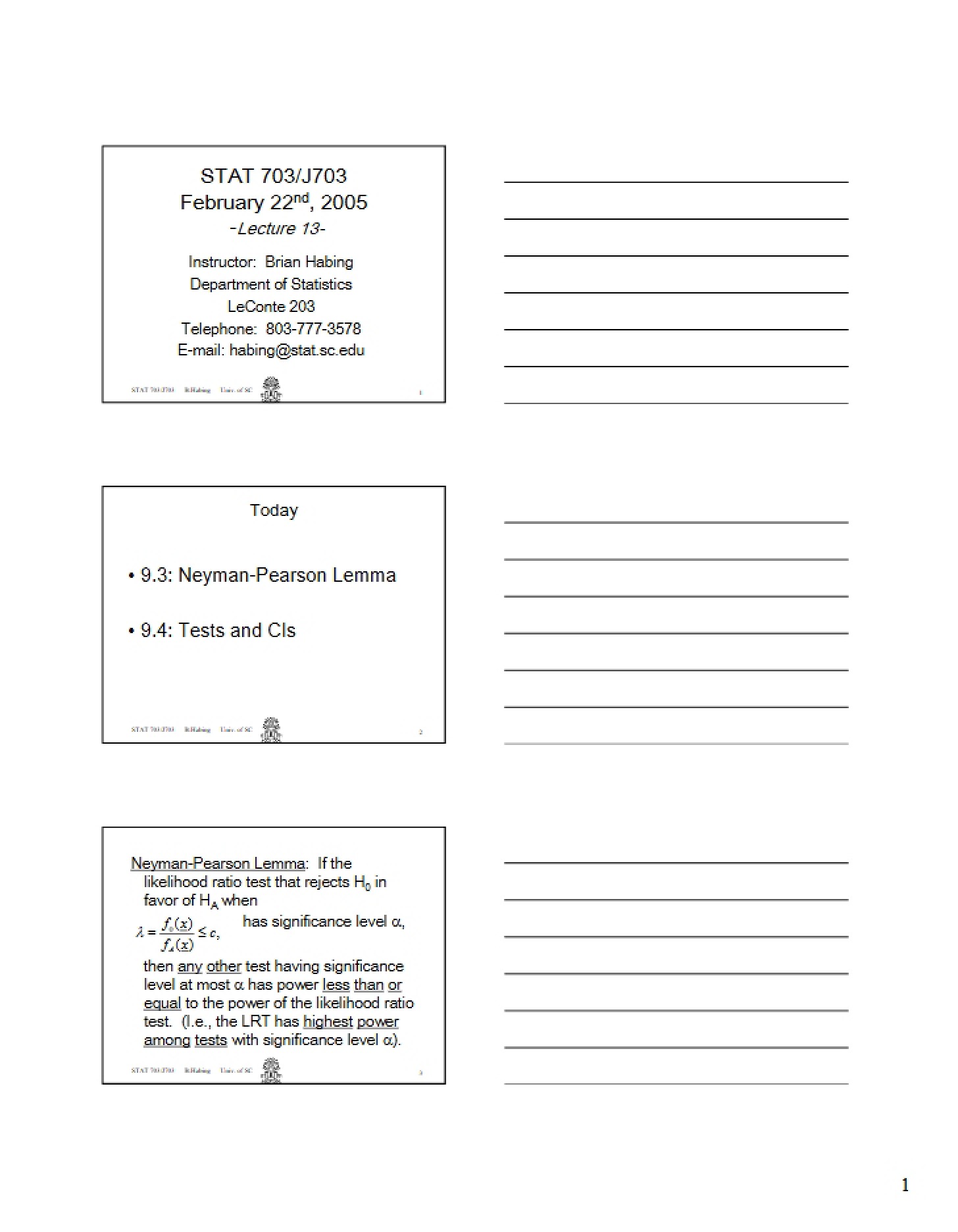
These are lecture notes from STAT 703, an advanced course in Statistical Theory II, offered at the University of South Carolina. Specifically, this installment covers key concepts related to hypothesis testing and confidence intervals, building upon foundational statistical principles. The material delves into more sophisticated methods for evaluating statistical claims and drawing inferences from data. It focuses on the theoretical underpinnings of these methods, rather than practical application with software.
Why This Document Matters
This resource is invaluable for students enrolled in a graduate-level statistical theory course. It’s particularly helpful for those seeking a detailed record of lecture material to supplement their understanding and prepare for assessments. Students who benefit most will have a solid foundation in introductory statistics and probability, and are ready to explore the ‘why’ behind statistical procedures. Reviewing these notes alongside independent study and textbook readings will solidify comprehension of complex topics. It’s best utilized *during* the course, immediately following the corresponding lecture, to reinforce learning.
Common Limitations or Challenges
These notes are a direct transcription of a lecture and are intended to *accompany* – not replace – textbook readings and independent problem-solving. The notes do not include fully worked-out examples or step-by-step calculations. They present the theoretical framework and notation, requiring the student to actively apply the concepts. Access to the course textbook and a strong grasp of prerequisite statistical concepts are essential for full comprehension. This resource does not offer practice problems or solutions.
What This Document Provides
* A focused discussion on Generalized Likelihood Ratio Tests, including the formulation of the test statistic.
* An exploration of the relationship between hypothesis testing and confidence interval construction – the concept of duality.
* Theoretical foundations relating to the distribution of test statistics under certain conditions.
* Discussion of specific scenarios, such as testing hypotheses about the mean and variance of a normal distribution.
* Key theorems and their page references within the course textbook.