What This Document Is
This is a lecture transcript from CHEM 156: Physical Biochemistry at UCLA, specifically Lecture #22. It delves into the core principles of chemical kinetics, focusing on how to interpret experimental rate data to infer the underlying mechanisms of complex chemical reactions. The material builds upon foundational knowledge of reaction rates and rate laws, extending these concepts to multi-step processes.
Why This Document Matters
This lecture is crucial for students seeking a deeper understanding of reaction dynamics. It’s particularly beneficial for those preparing to analyze and interpret kinetic data in laboratory settings, or for anyone needing to predict reaction behavior based on proposed mechanisms. Students encountering challenges with complex reaction systems, or those needing to solidify their understanding of rate-determining steps, will find this resource valuable. It’s best utilized alongside textbook readings and problem sets, offering a detailed exploration of the theoretical framework.
Topics Covered
* Deducing reaction mechanisms from observed rate laws
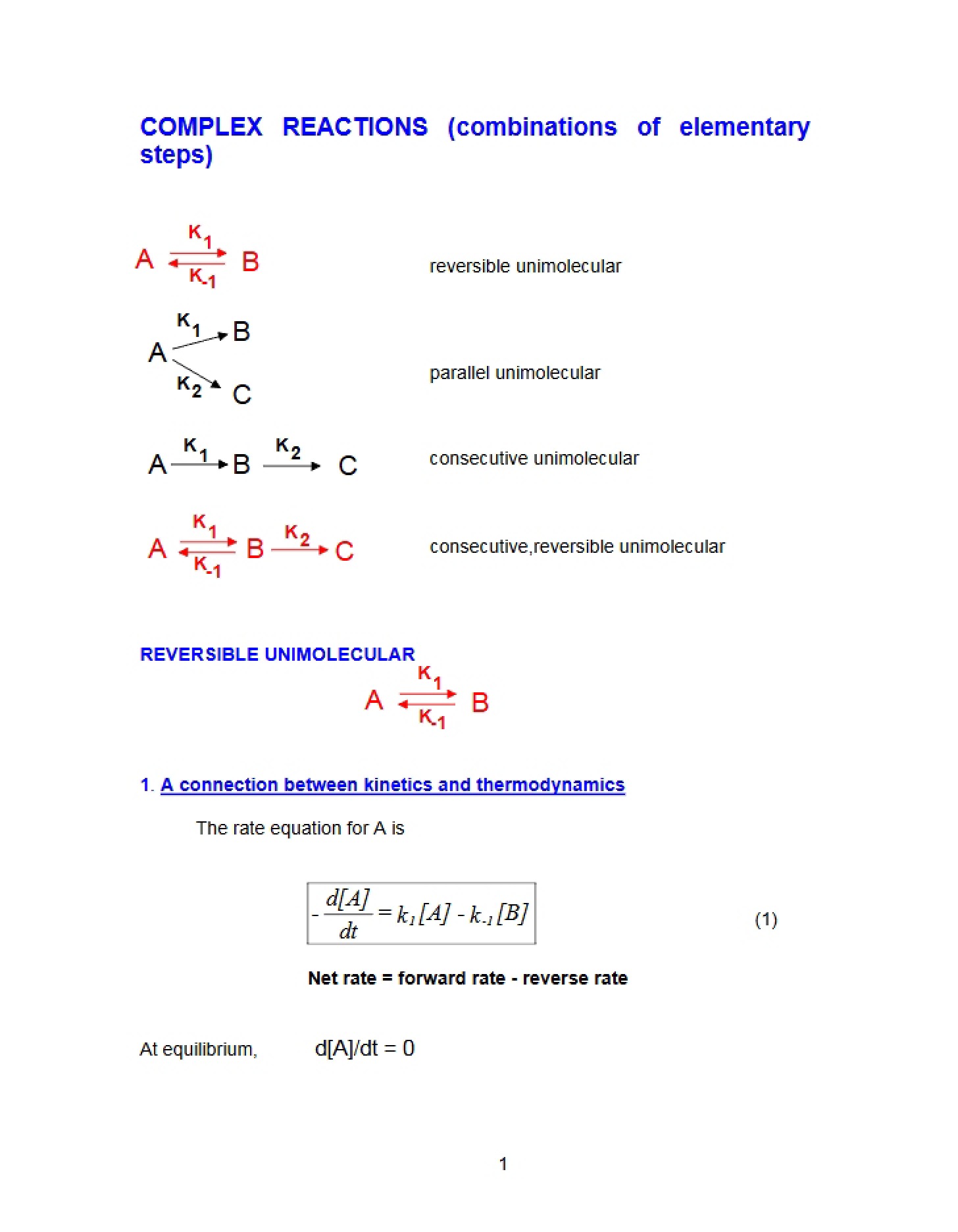
* Complex reactions involving multiple elementary steps
* Unimolecular reactions (reversible, parallel, and consecutive)
* Rate limiting steps and their impact on overall reaction rates
* The pre-equilibrium approximation and steady-state approximation
* Evaluating proposed mechanisms against empirical rate data
* Analysis of reactions with reversible steps
What This Document Provides
* A systematic approach to analyzing experimental rate data.
* Detailed discussion of different types of reaction mechanisms.
* Explanations of key concepts like microscopic reversibility.
* Frameworks for approximating rate laws in complex systems.
* Guidance on how to assess the plausibility of proposed reaction mechanisms.
* Illustrative examples demonstrating the application of these principles (detailed solutions are within the full lecture).